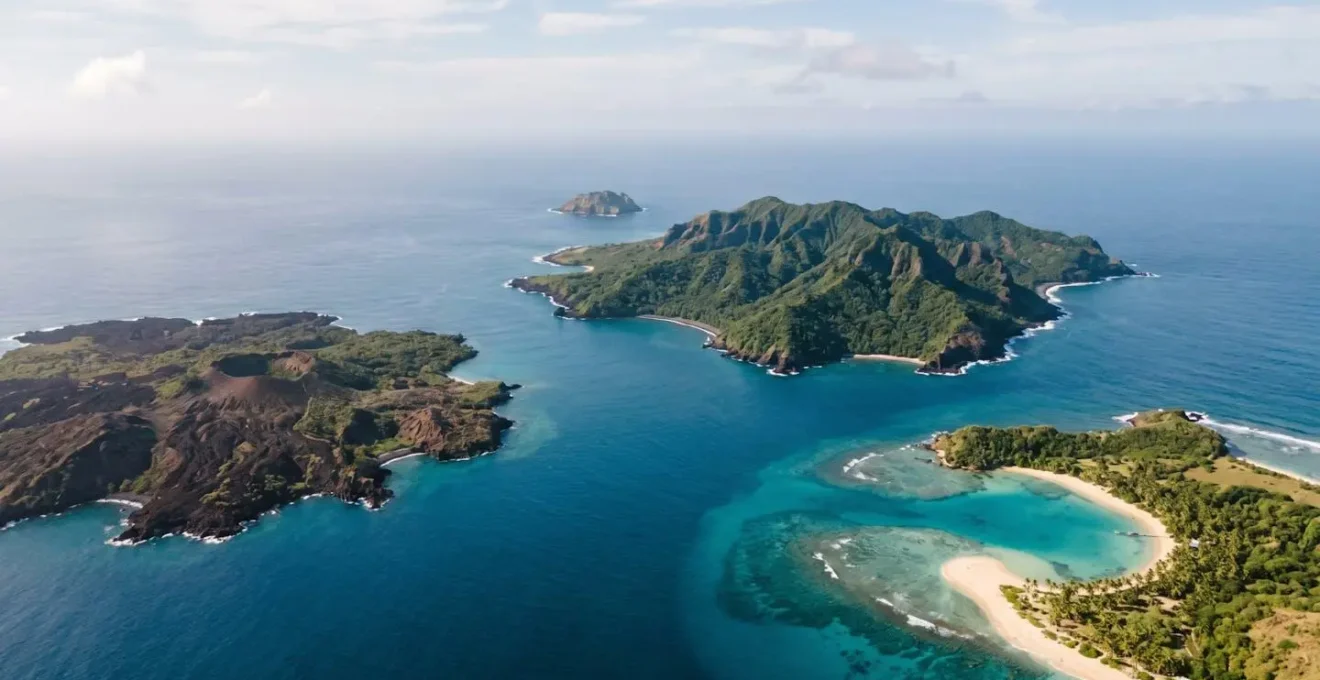
The best archipelago trips aren’t about visiting more islands, but about maximising ‘Experiential Return on Investment’ (eROI) by treating your route as a strategic portfolio.
- True travel time includes ‘logistical friction’—packing, transfers, and waiting—which can consume up to 40% of your vacation if you move too frequently.
- Route geometry (Linear, Circular, or Hub-and-Spoke) is a critical choice that dictates efficiency, cost, and immersion levels.
Recommendation: Focus on curating a balanced ‘island portfolio’ of 3-4 diverse islands and meticulously plan for logistical friction by choosing the optimal route structure and transport modes for your specific goals.
The dream of an archipelago adventure often involves a romantic vision of hopping from one sun-drenched island to another, collecting experiences like seashells. Yet, for many travellers, the reality quickly sours into a frantic race against ferry schedules, a blur of packing and unpacking, and the nagging feeling that you’re seeing everything and experiencing nothing. The common advice— »check ferry times, » « book in advance »—treats the symptoms but ignores the disease: a flawed routing strategy. The problem isn’t a lack of planning, but the wrong kind of planning.
What if the secret to a profoundly satisfying multi-island journey wasn’t about cramming in more destinations, but about a fundamental shift in thinking? Instead of a checklist, what if you approached your itinerary as a strategic portfolio, where each island is a carefully chosen asset and every hour spent in transit is a calculated investment? This is the art of maximising your Experiential Return on Investment (eROI). It requires moving beyond simple logistics to become a true archipelago routing strategist, focusing on the diversity of character, the geometry of your path, and the real, all-in cost of movement.
This guide will deconstruct the principles of strategic archipelago routing. We will explore why depth trumps breadth, how to curate a balanced portfolio of island experiences, and how to make the critical logistical choices that will transform your trip from a stressful dash into a masterpiece of travel design. By understanding these core concepts, you can craft a journey that is not only efficient but deeply, unforgettably rewarding.
To help you master this strategic approach, we’ve broken down the essential components of archipelago route planning. This table of contents will guide you through each critical decision point, from foundational principles to specific logistical trade-offs.
Summary: A Strategic Guide to Archipelago Route Design
- Why Do 3-4 Archipelago Islands Explored Deeply Beat 7 Islands Visited Superficially?
- How to Choose Archipelago Islands With Different Characters for a Balanced Experience?
- Linear Archipelago Route or Circular Loop: Which Minimises Wasted Travel Time?
- The Archipelago Planning Mistake: Not Checking Ferry Frequency Between Your Chosen Islands
- When Should You Visit Island Archipelagos: Timing for Consistent Weather Across the Chain?
- How to Plan a Mediterranean Island-Hopping Route Using Regional Ferry Connections?
- High-Speed Catamaran or Conventional Ferry: Which for Island Hopping?
- Ferry or Flight for Inter-Island Travel: Which Mode Suits Your Journey Best?
Why Do 3-4 Archipelago Islands Explored Deeply Beat 7 Islands Visited Superficially?
The core principle of masterful archipelago planning is valuing quality of experience over quantity of passport stamps. The impulse to « see it all » is a trap that leads to what can be called ‘logistical friction’—the hidden time and energy cost of moving. Expert analysis reveals a startling truth: every single island transfer, from packing your bags to checking into the next hotel, consumes a minimum of half a day. A case study of Greek island logistics found that travellers attempting to visit four or more islands in a week spent 35-40% of their vacation time in pure transit, not exploration. This means on a 7-day trip, almost 3 full days are lost to the mechanics of movement.
Conversely, allocating more time to fewer islands transforms the experience. Travel specialists recommend a minimum of 3 days per island for any meaningful exploration. This « rule of three » allows you to move beyond the main port town, discover secluded beaches, engage with local culture, and actually unwind. By choosing a « depth over breadth » strategy, you reduce logistical friction and dramatically increase your eROI. You trade the stress of constant motion for the luxury of immersion, replacing a frantic blur with a collection of distinct, vivid memories. The traveller who boasts of seeing seven islands in seven days has likely only experienced seven ports and a lot of waiting.
How to Choose Archipelago Islands With Different Characters for a Balanced Experience?
A successful multi-island trip is a story with a compelling narrative arc, and the islands are its characters. Visiting three islands that are all « party hubs » or all « quiet retreats » is like reading a book with one-dimensional characters—it quickly becomes monotonous. The goal is to build a diverse « island portfolio » where each destination offers a unique value proposition, creating a balanced and stimulating journey. This requires looking beyond glossy brochure photos and assessing the true character of each island.
To do this, you must become an island profiler, categorising potential destinations by their core identity. Are you looking for a rugged, volcanic landscape for hiking, a polished, cosmopolitan hub for dining and culture, a remote, sandy paradise for disconnection, or a historical outpost steeped in ancient ruins? Combining these contrasting character archetypes is the key to a rich experience. For example, pairing a bustling, well-developed island like Naxos with the rugged, lesser-known Amorgos in the Cyclades creates a perfect blend of convenience and authentic adventure. This deliberate curation prevents « experience saturation » and ensures each new island feels like a fresh discovery, not just a continuation of the last.
This illustration visually captures the essence of pairing islands with distinct personalities. The goal is to create a journey of harmonious contrasts, not a sequence of repetitive scenes.
As the image suggests, the most memorable itineraries are built on the principle of complementary opposition. The energy of a vibrant, populated island can make the tranquillity of a secluded one feel even more profound. Use this strategic lens to build your island portfolio.
Your Action Plan: Island Character Assessment
- Research topographical diversity: Use Google Maps Satellite/Terrain view to verify if islands offer genuinely different landscapes (volcanic vs. sandy vs. forested vs. mountainous).
- Analyze cultural & vibe differentiation: Check Instagram location tags and travel forums to gauge whether islands serve different traveler profiles (party hub vs. quiet retreat vs. cultural center vs. outdoor adventure base).
- Verify activity focus complementarity: Ensure each selected island specializes in different primary activities (e.g., one for diving, one for hiking, one for historical sites) to prevent experience saturation.
- Balance development levels: Mix one well-developed island with reliable infrastructure alongside one or two less touristy islands to combine convenience with authenticity.
Linear Archipelago Route or Circular Loop: Which Minimises Wasted Travel Time?
Once you’ve curated your island portfolio, the next strategic decision is to define your route’s geometry. This isn’t just about connecting dots on a map; it’s a critical choice that impacts your time, budget, and overall experience. The three primary geometries are the Linear Route, the Circular Loop, and the Hub-and-Spoke model. Each has distinct advantages and is suited to different travel styles and priorities. Choosing the wrong geometry for your goals is a classic planning error that creates unnecessary backtracking and wasted days.
A Linear Route (A → B → C → D) is the most efficient for progressive exploration, completely eliminating backtracking. It pairs perfectly with « open-jaw » flights (arriving at airport A, departing from airport D), making it ideal for first-time visitors who want to cover new ground continuously. The Circular Loop (A → B → C → A) is excellent for travellers on a standard round-trip ticket who want to conduct a comprehensive survey of a specific island group. Its main drawback is that the final leg is purely for returning, effectively costing a day of exploration. Finally, the Hub-and-Spoke model involves basing yourself on a central island and taking day trips. This drastically reduces packing logistics and is ideal for families or slow travellers, but it offers a less immersive experience on the « spoke » islands and involves repeated daily commutes.
This decision is fundamental to your trip’s efficiency. The following table breaks down the trade-offs to help you select the optimal route geometry for your archipelago strategy.
| Route Strategy | Best For | Time Efficiency | Packing/Logistics | Immersion Level | Key Advantage | Main Drawback |
|---|---|---|---|---|---|---|
| Linear Route (A→B→C→D) | First-time visitors, progressive exploration | High (no backtracking) | Moderate (multiple relocations) | High (no repeats) | Pairs perfectly with open-jaw flights; eliminates return journey waste | Requires booking two one-way flights (often pricier) |
| Circular Loop (A→B→C→A) | Comprehensive regional surveys, single-flight bookings | Moderate (some backtracking on return) | Moderate (multiple relocations) | High (full cluster coverage) | Works with round-trip tickets; complete archipelago understanding | Final leg retraces path, losing 1 day to return logistics |
| Hub-and-Spoke (Base on Island A, day trips to B, C, D) | Families, slow travelers, those prioritizing stability | Moderate (daily commutes) | Low (single accommodation, no packing/unpacking cycles) | Moderate (limited overnight immersion on satellite islands) | Minimal packing stress; stable home base; predictable routine | Less immersive; repeated ferry commutes; satellite islands experienced superficially |
The Archipelago Planning Mistake: Not Checking Ferry Frequency Between Your Chosen Islands
Perhaps the most common and devastating planning error is assuming that because two islands look close on a map, a convenient ferry connects them. Archipelago ferry networks are not uniform grids; they are complex systems of primary and secondary routes with vastly different service levels. Mistaking a secondary route for a primary one can unravel an entire itinerary, forcing costly backtracking and lost days.
Primary routes are the high-traffic arteries of an archipelago, typically connecting the mainland or a major hub to the most popular islands. These often feature multiple daily crossings, even in the shoulder season. Secondary routes, which connect smaller islands to each other or to less popular hubs, are the veins of the system. Their service can be sparse, running only a few times a week or not at all outside of peak season. A detailed case study of Croatian island hopping documented how a dream itinerary including Vis and Korčula was rendered impossible in May because the necessary inter-island connections ran only 2-3 times weekly, with no direct link at all between certain pairs.
The strategic lesson is clear: your route is only as strong as its weakest link. Before booking a single night of accommodation, you must verify the existence and frequency of every single ferry leg for your specific travel dates. Furthermore, seasonal variations are drastic. A route that is seamless in July can be a logistical nightmare by early autumn, as Greek archipelago seasonal analysis shows ferry frequencies drop significantly by October, making multi-island trips very challenging. Use tools like Ferryhopper to build and validate your chain, ensuring no link is missing.
When Should You Visit Island Archipelagos: Timing for Consistent Weather Across the Chain?
A common ambition among archipelago planners is to time their visit for a period of « consistent weather » across the entire chain. However, this desire often stems from a misconception. For many of the world’s great archipelagos, the very idea of universally consistent weather is a myth. The same topographical features that make islands interesting—mountains, varied coastlines—also create complex microclimates, where conditions can vary dramatically over just a few miles.
This phenomenon is not just about one side of an island being windier than the other. In large, geographically dispersed archipelagos, entire island clusters can operate on opposing weather schedules. The classic example is Thailand, where the Gulf and Andaman coasts experience almost inverse monsoon seasons. As a case study on Thai island hopping demonstrates, the Samui archipelago (Gulf coast) has its wettest period from October to January, precisely when the Andaman islands like Phuket are entering their optimal dry season. A traveller attempting to hop between both coasts will inevitably encounter one region’s bad weather, regardless of timing.
The image below illustrates how even a single island’s topography creates distinct weather zones, with a lush, cloud-covered windward side and a drier, sunnier leeward side. This effect is magnified across an entire archipelago.
The strategic takeaway is not to abandon weather planning, but to refine it. Instead of searching for a single magic window of « perfect weather » for the entire region, a strategist accepts and plans for microclimate variance. This means either focusing your trip on a single, more weather-consistent cluster (e.g., only the Cyclades, or only the Andaman coast) or building flexibility into your itinerary to adapt to changing conditions if you choose to cross climatic zones.
How to Plan a Mediterranean Island-Hopping Route Using Regional Ferry Connections?
The Mediterranean is the quintessential island-hopping playground, but not all its archipelagos are created equal. The ferry networks of Greece, Croatia, and Italy each have a unique structure, or « network geometry, » that fundamentally dictates the most logical way to travel. Applying a Greek « spider-web » strategy to Croatia’s linear coast will lead to frustration and inefficiency. A savvy strategist first understands the underlying structure of the network they intend to use.
The Greek Cyclades feature a dense, spider-web network with Piraeus (Athens) as the main hub but also strong inter-island hubs like Paros, making circular loops and hub-and-spoke models highly effective. In contrast, the Croatian Dalmatian Coast is a linear, coast-hugging network. The most logical route is a linear progression (e.g., Split → Hvar → Korčula → Dubrovnik), as connections between non-adjacent islands are rare and often require backtracking to the mainland. Italy’s archipelagos, like the Aeolian Islands, are predominantly hub-and-spoke systems radiating from mainland ports like Milazzo, limiting direct inter-island travel.
A critical strategic error is assuming easy travel between these national networks. As documented in Mediterranean ferry infrastructure analysis, direct international ferry routes between the Greek and Croatian archipelagos are almost non-existent. Attempting to combine both in a single ferry-based trip is a logistical fallacy that requires long mainland detours or flights. The following table provides a strategic overview of these key networks.
| Mediterranean Region | Network Structure | Primary Hub Ports | Ferry Frequency (Summer) | International Connections | Most Logical Route Type | Key Planning Challenge |
|---|---|---|---|---|---|---|
| Greek Cyclades | Dense spider-web network with multiple intersecting routes | Piraeus, Rafina (mainland); Paros (inter-island hub) | Very High (multiple daily) | Italy (Ancona, Bari, Brindisi) | Circular Loop or Hub-and-Spoke from Paros | Hub-and-spoke geography means some cross-Cyclades routes require 5+ hours with transfers |
| Croatian Dalmatian Coast | Linear coast-hugging network following mainland shoreline | Split (main hub), Zadar, Dubrovnik | High (daily catamarans + car ferries) | Italy (Ancona, Bari); minimal Greece connections | Linear Route along coast (Split→Hvar→Korčula→Dubrovnik) | Inter-island connections between non-adjacent islands often require mainland backtracking |
| Italian Aeolian Islands | Hub-and-spoke radiating from mainland ports | Milazzo, Naples (mainland departure points) | Moderate-High (seasonal variation) | Greece, Croatia, Tunisia, Algeria via Sicily/Sardinia routes | Hub-and-Spoke from Milazzo or island-based star pattern | Most routes originate from mainland; limited direct inter-island links force returning to hub port |
High-Speed Catamaran or Conventional Ferry: Which for Island Hopping?
Within the ferry ecosystem, a key decision is the choice between a high-speed catamaran and a conventional, open-deck ferry. This is not merely a question of speed; it’s a strategic trade-off between efficiency and experience. The right choice depends entirely on the specific leg of your journey and your overarching travel goals. Choosing a catamaran for a scenic, short crossing can feel sterile and rushed, while opting for a slow ferry on a long, open-sea route can feel like a wasted day.
As ferry experts from Ferryhopper highlight in their analysis, the difference is fundamental to the travel experience:
Conventional ferries are larger and include large decks where passengers can move around, relax and enjoy the view. Catamarans, on the other hand, often come equipped with modern amenities like air-conditioned lounges but the dual-hull design provides better stability at high speeds.
– Ferryhopper, Ferry comparison guide for Mediterranean travelers
Conventional ferries are floating viewpoints. Their slower pace and spacious open decks make the journey part of the destination, ideal for scenic routes where you want to soak in the coastal views. They are also more resilient to bad weather and offer generous baggage allowances, making them the default choice for travellers with vehicles or significant gear. High-speed catamarans are time-saving tools. They excel on longer, open-sea crossings where scenery is minimal, turning a 5-hour journey into a 3-hour one. However, this efficiency comes at a cost: a higher ticket price (often 30-50% more), limited or no outdoor access, and a higher likelihood of cancellation in rough seas.
| Vessel Type | Speed | Typical Capacity | Outdoor Deck Access | Weather Resilience | Baggage Allowance | Cost | Best Use Case |
|---|---|---|---|---|---|---|---|
| Conventional Ferry (Open Ferry) | Slower (15-20 knots) | High (hundreds of passengers + vehicles) | Spacious open decks for movement and viewing | High (operates in choppy conditions) | Generous (vehicles accommodated) | Lower | Scenic short-to-medium routes where the journey IS the experience; travelers with gear/vehicles; families wanting space |
| High-Speed Catamaran | Faster (25-35+ knots) | Moderate (smaller, passenger-focused) | Limited/Enclosed (often no outdoor access during transit) | Lower (prone to cancellation in rough seas due to stability limits) | Restricted (no vehicles, strict passenger baggage) | Higher (often 30-50% premium) | Long open-sea crossings with minimal scenery where time savings justify cost; business/efficiency-focused travel |
Key Takeaways
- Depth over breadth: Aim for 3-4 islands explored deeply rather than 7 visited superficially to minimise ‘logistical friction’ and maximise your experience.
- Curate your portfolio: Actively choose islands with different characters (topography, culture, activity focus) to create a balanced and memorable journey.
- Calculate true travel time: A short flight is not always faster than a ferry once you factor in total door-to-door time including airport transit and security.
Ferry or Flight for Inter-Island Travel: Which Mode Suits Your Journey Best?
The final layer of transport strategy is the macro-choice between sea and air. The common assumption is that flying is always faster and therefore more efficient. However, a strategic analysis reveals a more nuanced reality. When you calculate the true, door-to-door journey time, the perceived speed advantage of flying often evaporates, especially for shorter inter-island hops. This is the ultimate test of understanding and planning for logistical friction.
A detailed breakdown of Hawaiian island hopping logistics found that a seemingly quick 30-45 minute inter-island flight often requires 4-5 hours of total time when you account for driving to the airport, returning a rental car, security checks, boarding, deplaning, and picking up a new car at the destination. In contrast, a 3-hour ferry journey might only require 3.5 hours of total time, as ports are often more centrally located and involve far less security and boarding overhead. The ferry offers a more predictable and often more relaxed experience, with significantly more generous baggage allowances—a crucial factor for travellers with diving gear, hiking equipment, or large families.
However, flying does offer one unique strategic advantage: geographical context. The bird’s-eye view from an airplane window provides an unparalleled understanding of the archipelago’s scale, layout, and the relationships between islands. This aerial perspective, impossible to gain from sea level, can be incredibly valuable for a first-time visitor trying to build a mental map of the region.
The decision to fly or take a ferry is not a simple one. It requires a careful calculation of true journey time, baggage needs, and the value you place on experiential factors versus pure efficiency or geographical understanding.
Your Action Plan: Ferry vs. Flight Decision Framework
- Calculate TRUE total journey time: For flights, sum pre-departure (90 min), flight time, and post-arrival (60 min). For ferries, sum pre-departure (30 min), crossing time, and post-arrival (15 min).
- Assess baggage & equipment needs: If travelling with gear or multiple large bags, the generous allowance of ferries often makes them the superior financial and logistical choice.
- Evaluate route geography: Flights provide a valuable bird’s-eye perspective of the archipelago’s layout, which can be a strategic advantage for understanding the region.
- Consider flexibility priorities: Ferries typically allow for more last-minute bookings and easier schedule changes, whereas flights require advance booking but may be the only option for very distant islands.
Now, open your maps not as a tourist, but as a routing strategist. Curate your island portfolio, calculate your true eROI, and design an archipelago journey that is as intelligent as it is unforgettable.