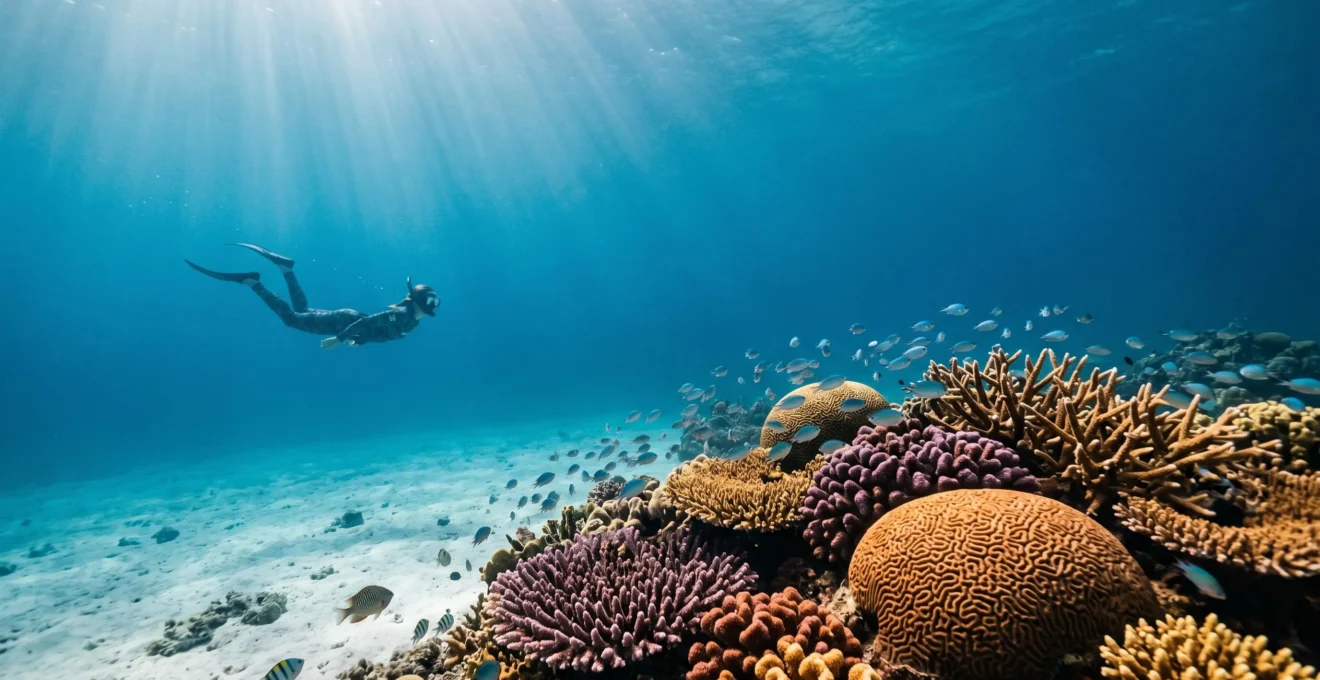
Becoming a truly responsible snorkeler isn’t about memorizing rules; it’s about understanding the fragile science that makes a reef thrive.
- Coral is a delicate animal, and a single touch can destroy a protective mucus layer, causing damage that takes decades to heal.
- Water clarity is a science based on geology and tides. Choosing the right reef type and time to snorkel is critical for visibility and reef health.
Recommendation: Shift your mindset from a tourist who avoids harm to an informed guardian who understands the ‘why’ behind every action, ensuring the reefs you visit remain healthy for generations.
The vision of gliding over a sun-drenched coral reef, a kaleidoscope of fish darting through intricate structures, is a powerful lure for travellers. Yet, for the environmentally conscious snorkeler, this dream is tinged with anxiety. We’ve all heard the warnings: don’t touch the coral, wear reef-safe sunscreen, don’t stir up sand. These rules are essential, but they are only the surface layer of a much deeper responsibility.
Simply following a checklist makes you a compliant tourist. Understanding the delicate biology of a coral polyp, the physics of water clarity, and the ecological rhythms of a reef transforms you into a true steward of the ocean. This guide moves beyond the platitudes. It’s built on the principle that knowledge is the most effective tool for conservation. We will explore the science that dictates reef health, helping you not only to minimize your impact but to actively seek out and support the most vibrant and resilient marine ecosystems.
By understanding the ‘why’ behind the rules—why a touch is so damaging, why Caribbean water is so clear, and why timing is everything—you gain the ability to make informed decisions. This is the key to unlocking profound snorkelling experiences that are not just harmless, but genuinely beneficial to the preservation of these underwater wonders. This journey will equip you to read the ocean, choose your destinations wisely, and interact with marine life in a way that honours its fragility.
This article breaks down the essential scientific principles and practical skills that empower you to become a more conscious and effective reef guardian. Below is a summary of the key areas we will explore to deepen your understanding and enhance your snorkelling practice.
Summary: A Scientific Approach to Responsible Snorkelling
- Why Does Touching Coral Cause Reef Damage That Takes 50 Years to Recover?
- How to Snorkel Coral Reefs Without Damaging Them: Buoyancy and Reef-Safe Sunscreen?
- Barrier Reef or Fringing Reef: Which Offers Healthier Coral With Easier Snorkelling Access?
- The Reef Snorkelling Timing Mistake That Results in Murky Water and No Visibility
- When Can You Snorkel Coral Reefs During Spawning Events and Peak Fish Activity?
- Why Are Caribbean Waters Clearer Than the Mediterranean Despite Similar Warm Climates?
- Why Do Discovery Scuba Dives Restrict You to 12 Metres and 40 Minutes?
- How to Choose Island Scuba Diving Experiences Matching Your Certification and Experience?
Why Does Touching Coral Cause Reef Damage That Takes 50 Years to Recover?
The most fundamental rule of snorkelling, « don’t touch the coral, » is often heard but rarely understood in its full biological context. A coral structure might look like a durable, colourful rock, but it is a living colony of thousands of tiny, fragile animals called coral polyps. Each polyp is covered by a thin, transparent layer of mucus. This layer is not just slime; it is a critical defense mechanism, protecting the colony from bacterial infections and harmful UV radiation. When you touch, stand on, or even lightly brush against coral, you strip away this protective mucus, leaving the polyps exposed and vulnerable to disease and stress.
The damage is compounded by the coral’s incredibly slow growth rate. Most reef-building corals grow at a rate of only a few millimetres to a few centimetres per year. A careless kick with a fin can break off a piece that took a decade to form. The recovery from such physical damage or from a widespread disease outbreak following human contact is a monumental task for the reef. It is not a simple matter of regrowth; it involves the complex process of larval settlement, competition with algae, and surviving environmental stressors.
Case Study: The Variable Path to Recovery at Little Cayman Island
The journey to recovery is uncertain and highly dependent on local conditions. For instance, a long-term study of coral assemblages at Little Cayman Island provided a stark illustration of this variability. Following bleaching and disease events, researchers documented that live coral cover plummeted from 26% to 14% over five years. However, the reef demonstrated remarkable resilience, achieving a full recovery seven years later. This successful outcome, detailed in a study on coral assemblage recovery, highlights that while recovery is possible, the timescales can be extensive and are influenced by the specific type of disturbance and the dominance of faster-growing coral species. For many other reefs, especially those with slow-growing species or persistent stressors, such a recovery may never occur without significant intervention.
Understanding this fragility changes your perspective. You are not swimming above an inanimate landscape; you are a guest in a delicate, living city built over millennia. Every movement you make matters, and the consequences of a single moment of carelessness can echo for half a century.
How to Snorkel Coral Reefs Without Damaging Them: Buoyancy and Reef-Safe Sunscreen?
Beyond the passive act of not touching, actively protecting coral reefs requires mastering two key areas: your physical presence in the water and the chemical footprint you leave behind. The single most important skill for a snorkeler is buoyancy control. This means being able to float effortlessly and horizontally on the surface, using gentle fin movements to propel yourself without your legs dropping and kicking the reef below. Poor buoyancy control is the number one cause of accidental coral damage. Practice in a sandy area or pool: find your trim, learn to float flat, and use slow, deliberate kicks that originate from your hips, not your knees. Keep your arms at your sides to avoid the temptation to paddle or steady yourself on a coral head.
Your second major responsibility is your choice of sunscreen. Common chemical sunscreens contain ingredients like oxybenzone and octinoxate, which are highly toxic to coral. When these chemicals wash off your skin, they can induce coral bleaching, damage coral DNA, and disrupt their reproductive cycles. With an estimated 4,000 tons of sunscreen washing into coral reef areas each year, the cumulative effect is devastating. The solution is to switch to a non-nano mineral-based sunscreen. Look for products where the only active ingredients are zinc oxide or titanium dioxide. These create a physical barrier on your skin rather than a chemical one and are considered much safer for marine ecosystems. Better yet, the most effective sun protection is physical: wear a long-sleeved rash guard and a hat. This drastically reduces the amount of sunscreen you need to apply, minimizing your chemical impact to near zero.
Combining masterful buoyancy with a conscious choice of sun protection are the two most powerful actions you can take as an individual. They represent a commitment to not only see the reef but to leave it completely untouched and untainted by your presence.
Barrier Reef or Fringing Reef: Which Offers Healthier Coral With Easier Snorkelling Access?
Not all reefs are created equal, and choosing the right type of reef for your skill level and conservation goals is a strategic part of responsible snorkelling. The two most common types you will encounter are fringing reefs and barrier reefs, each offering a different balance of accessibility and coral health. Fringing reefs grow directly from the shore and are the most accessible. You can often simply walk into the water from a beach to explore them. This convenience, however, is their greatest vulnerability. They are highly susceptible to land-based pollution, agricultural runoff, and physical damage from the high volume of human traffic. While perfect for beginners and families, they often show more signs of stress and may have lower visibility, especially after rainfall.
Barrier reefs are located further offshore, separated from the mainland by a deep lagoon. This separation acts as a protective buffer, shielding the coral from most land-based runoff and direct human contact. Consequently, barrier reefs often host healthier and more pristine coral ecosystems. However, accessing them requires a boat, making them less convenient and more suited to experienced snorkelers who are comfortable in open water. The choice between them involves a trade-off: the ease of a fringing reef versus the likely superior health of a barrier reef. By understanding this, you can match your choice to the experience you seek and be aware of the specific pressures each reef type faces.
| Reef Type | Access Method | Typical Depth | Coral Health Factors | Best For | Challenges |
|---|---|---|---|---|---|
| Fringing Reef | Shore entry | Shallow (1-10m) | Vulnerable to land runoff, pollution, and human contact | Beginners, families with children, limited swimmers | Lower visibility after rain, higher human impact zones |
| Barrier Reef | Boat access required | Variable (5-30m+) | Healthier due to protective lagoon, less land-based pollution | Experienced snorkelers, pristine coral viewing | Exposed to open-ocean swells, currents, requires boat logistics |
| Patch Reef | Boat or lagoon access | Shallow (2-8m) | Protected within lagoons, ideal juvenile fish habitat | Intermediate snorkelers seeking biodiversity hotspots | Requires local knowledge to locate, may be isolated |
| Atoll Reef | Boat access via passes | Variable with strong currents | Nutrient-rich passes attract pelagic species | Advanced snorkelers, drift snorkeling enthusiasts | Strong currents in passes, timing critical, remote locations |
Ultimately, a healthy reef experience depends on more than just geography. The timing of your visit is just as critical, a factor that is often overlooked but has a dramatic impact on both your enjoyment and the reef’s well-being.
The Reef Snorkelling Timing Mistake That Results in Murky Water and No Visibility
Arriving at a world-class reef only to be met with murky, green water is a common and avoidable disappointment. The visibility on a coral reef is not constant; it is governed by a dynamic interplay of tides, weather, and recent rainfall. The single biggest timing mistake is ignoring the tidal cycle. The optimal time for snorkelling is almost always at slack tide during the high tide peak. This is the moment when the water is deepest, stillest, and has had the most time to flush out sediment, resulting in maximum clarity. Conversely, you should actively avoid the outgoing (ebb) tide. As the tide recedes, it pulls warmer, nutrient-rich water and sediment from lagoons and coastal areas out over the reef, significantly reducing visibility.
Weather plays an equally important role. Heavy rainfall, even a day or two before your snorkel, can be disastrous for visibility on fringing reefs. Freshwater runoff carries silt and pollutants from the land, creating a murky surface layer. Similarly, strong onshore winds are a snorkeler’s enemy. They whip up waves that churn the seabed in shallow areas, creating underwater « dust storms » of suspended sand that can reduce visibility to near zero. Before you even pack your fins, a responsible snorkeler should become a student of local conditions.
- Check recent rainfall history: On islands, even a brief, intense storm can impact near-shore reefs for 24-48 hours.
- Monitor wind and swell forecasts: Look for days with light offshore winds. If it’s windy, seek out the leeward (sheltered) side of the island.
- Consult local tide charts: Pinpoint the exact time of high tide and plan to be in the water during the one-hour window surrounding it.
By synchronizing your snorkel with these natural cycles, you not only guarantee yourself the best possible experience with crystal-clear water but also reduce your own impact. In calm, clear conditions, you have better awareness of your surroundings and are far less likely to accidentally bump into the reef.
When Can You Snorkel Reefs During Spawning Events and Peak Fish Activity?
Timing your visit can also unlock some of the ocean’s most spectacular and ephemeral events, offering a glimpse into the reef’s vibrant life cycle. The most dramatic of these is the annual mass coral spawning. For a few specific nights a year, entire reef systems synchronize to release their eggs and sperm into the water column in a massive reproductive blizzard. Witnessing this underwater « snowstorm » is a bucket-list experience for any ocean lover. As a research team noted in a PNAS study on the phenomenon, « Mass coral spawning is a perplexing annual event that occurs over a few nights following a full moon. »
While the exact timing varies by region and species, a general rule is that mass coral spawning events typically occur about 7 to 10 days after the full moon in the warmest summer months. Local dive operators are the best source of information for precise predictions. Snorkelling during a spawning event is possible, though it’s usually a nighttime activity and requires an experienced guide to do so safely and without disturbing the process.
Mass coral spawning is a perplexing annual event that occurs over a few nights following a full moon.
– Research team, PNAS study on coral spawning synchronization
For more regular viewing, fish activity also follows predictable patterns. Many reefs experience peaks of activity during the « golden hours » of dawn and dusk. This is when nocturnal species are returning to their shelters and diurnal (daytime) species are emerging, often leading to a « shift change » with a flurry of movement, hunting, and social interaction. Another key time is during a « cleaning station » rush hour. These are specific spots on the reef where larger fish, turtles, and rays congregate to have parasites removed by smaller cleaner wrasse or shrimp. A knowledgeable guide can point these out, offering a front-row seat to one of the reef’s most fascinating symbiotic relationships. Timing your snorkel to coincide with these peaks in natural activity provides a far richer and more dynamic experience.
Why Are Caribbean Waters Clearer Than the Mediterranean Despite Similar Warm Climates?
The breathtaking, gin-clear turquoise water of the Caribbean is not an accident of climate; it is a direct result of geology and biology. The primary reason for this exceptional clarity is that the Caribbean Sea is largely an oligotrophic environment. As marine scientists explain, this means the water is extremely low in nutrients like nitrates and phosphates. With few nutrients, there is very little phytoplankton—the microscopic algae that form the base of the marine food web and give most ocean water its slightly greenish, cloudy tint. Fewer particles floating in the water column means sunlight can penetrate deeper, creating that iconic, brilliant blue.
This lack of nutrients poses a paradox: how can such vibrant reefs thrive? The answer lies in the symbiotic relationship between coral polyps and the zooxanthellae algae living within their tissues, which provide up to 90% of the coral’s food through photosynthesis. The second key factor is the region’s geology. Much of the Caribbean basin is built on a foundation of limestone, and the seafloor is covered in bright white calcium carbonate sand. This sand, largely the product of bio-erosion by animals like parrotfish crunching on coral, doesn’t stir up into a murky cloud like darker, heavier terrestrial sand. Instead, it reflects sunlight back up through the water column, further enhancing the brightness and sense of clarity.
Caribbean waters are often described as oligotrophic, meaning they are low in nutrients and, consequently, low in organic matter.
– Marine science researchers, Scientific analysis of Caribbean water clarity
In contrast, the Mediterranean Sea is semi-enclosed and receives significant nutrient-rich runoff from numerous large rivers and densely populated coastlines. This creates a more eutrophic (nutrient-rich) environment, which supports more plankton and results in comparatively lower visibility. Understanding this fundamental difference allows a snorkeler to appreciate that the famous clarity of places like the Caribbean is a sign of a unique and finely balanced ecosystem.
Why Do Discovery Scuba Dives Restrict You to 12 Metres and 40 Minutes?
For many snorkelers, the next step in ocean exploration is a « Discover Scuba Diving » (DSD) experience. These introductory dives come with strict, universal limits: a maximum depth of 12 metres (40 feet) and a duration of around 40 minutes. These are not arbitrary numbers; they are a carefully calculated safety protocol based on the science of diving physics and human physiology. The primary concern is preventing decompression sickness (DCS), caused by nitrogen absorbing into the body’s tissues under pressure. By staying shallow, the rate of nitrogen absorption is significantly reduced. The 12-metre depth limit ensures that even with a 40-minute exposure, a beginner remains well within the no-decompression limit (NDL), meaning they can ascend directly to the surface without needing mandatory safety stops.
This conservative approach addresses multiple risk factors specific to first-time divers, creating a robust safety buffer that protects both the diver and the reef. It is a system designed to manage risk in a predictable, controlled manner.
Case Study: The Science Behind Discovery Dive Safety Parameters
Diving programs, such as those in the Florida Keys National Marine Sanctuary, strictly adhere to these limits for clear scientific reasons. The 12-metre restriction is crucial because pressure at this depth (2.2 times atmospheric pressure) allows for slower nitrogen absorption. As explained by responsible diving guidelines from NOAA, this depth-time combination virtually eliminates the risk of DCS for new divers. Furthermore, this shallow depth ensures there is plenty of ambient light for good visibility, which reduces anxiety. The 40-minute cap is equally important; it accounts for the higher air consumption rate of anxious beginners and prevents the onset of mental fatigue, a major contributor to errors underwater. By controlling these variables, dive operators can provide a safe and positive first experience, which is essential for fostering a lifelong love and respect for the marine environment.
Understanding these limits as a scientific safety measure, rather than an arbitrary restriction, is the first step toward becoming a responsible scuba diver. It’s an acknowledgement that entering the underwater world requires respecting its physical laws.
Key Takeaways
- A single touch can remove a coral’s protective mucus layer, exposing it to disease and starting a recovery process that can take decades due to slow growth rates.
- Mastering horizontal buoyancy and exclusively using non-nano mineral sunscreen (or rash guards) are the most impactful personal actions for reef protection.
- Choosing your snorkel timing is critical: aim for slack high tide to get the clearest water, and avoid times after heavy rain or strong onshore winds.
How to Choose Island Scuba Diving Experiences Matching Your Certification and Experience?
As you move beyond introductory dives, choosing experiences that match your true skill level—not just your certification card—is paramount for both your safety and the protection of the reef. An « Advanced Open Water » certification doesn’t automatically prepare you for every « advanced » dive. That term can signify a range of challenges, from deep water and strong currents to complex navigation or low visibility. The most responsible divers are those who practice honest self-assessment. Your logbook tells a more accurate story than your certification card. Consider the recency of your dives, the conditions you’ve faced, and your comfort level with specific skills like buoyancy, navigation, and deploying a surface marker buoy (SMB).
A diver with 50 logged dives in the calm, clear waters of the Caribbean is not prepared for a cold, low-visibility wall dive in another part of the world, even if they hold the same certification. Different dive types demand specific proficiencies. A drift dive requires mastery of entering the water with negative buoyancy and managing your position in a current. A wall dive demands impeccable buoyancy control to avoid contact with the vertical reef face. It’s crucial to communicate your actual experience level, including any anxieties or areas of weakness, with your dive operator. A reputable guide will use this information to select a site that is both safe and enjoyable for you, ensuring you are a guest on the reef, not a threat.
Action Plan: Your Self-Assessment for Choosing the Right Dive
- Review your logbook story: Go beyond certification level. Assess your dive recency, the variety of environmental conditions you’ve handled (currents, temperature, visibility), and the types of dives you have successfully completed (e.g., wreck, night, drift).
- Decode dive site terminology: Understand that an « Advanced Dive » is a catch-all term. Ask the operator if it means depth, strong currents, a challenging entry/exit, or required navigation skills.
- Match skills to dive types: Honestly evaluate if you have the specific skills needed. A « Wall Dive » demands excellent buoyancy, while a « Drift Dive » requires confidence in current and SMB deployment.
- Consider environmental factors: Recognize that experience is not always transferable. A warm-water diver is a beginner in cold-water, low-visibility conditions, regardless of their certification.
- Communicate honestly with dive operators: Be transparent about your real experience level, how long it has been since your last dive, and any concerns you may have. This is the foundation of a safe dive plan.
This commitment to continuous learning and honest self-evaluation is the hallmark of a truly advanced and responsible diver. It ensures that as your skills grow, your respect for the ocean’s power and fragility grows with them.
Now, armed with a deeper understanding of the reef’s science and the principles of responsible interaction, the next step is to apply this knowledge to planning your future underwater adventures, ensuring every trip contributes positively to the ecosystems you love.