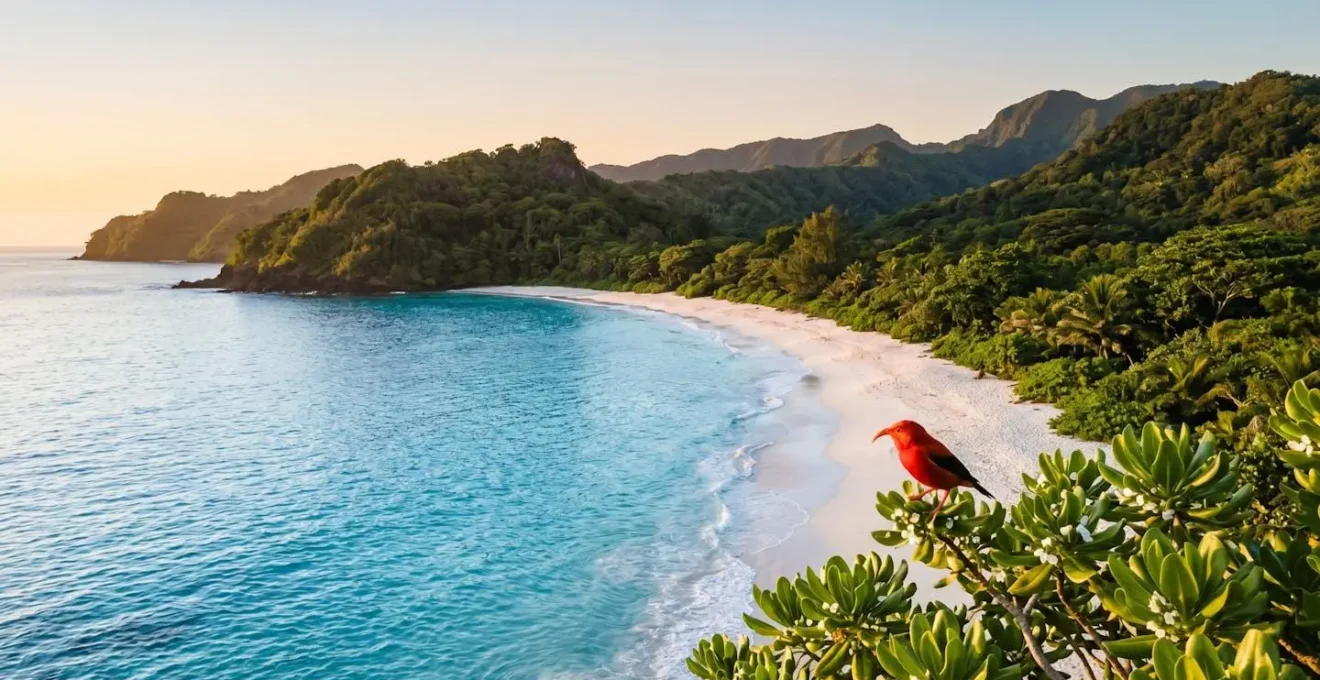
Your trip to paradise could be its undoing—or its salvation. The difference lies not in simple checklists, but in a profound shift of mindset from extractive tourist to regenerative guardian.
- Understand the science of island fragility: high endemism and low ecological redundancy mean small disturbances have outsized consequences.
- Scrutinise « eco » claims to identify and support accommodations and businesses that are genuinely regenerative, not just greenwashing.
- Choose longer, more immersive stays over frequent, short trips to reduce your carbon footprint and ensure your spending directly benefits the local community.
Recommendation: Before you book, become a student of the island’s unique ecosystem. This pre-trip education transforms your visit from a potential footprint into a powerful, positive handprint.
The dream of an island escape—pristine beaches, turquoise waters, a slower pace of life—is a powerful one. For the environmentally conscious traveller, however, this dream is often tinged with anxiety. We are told to pack a reusable water bottle, use reef-safe sunscreen, and choose the « green » hotel option. While well-intentioned, this advice barely scratches the surface of a complex reality. The survival of these delicate environments hinges on something far deeper than a checklist of sustainable behaviours.
The conventional wisdom often fails to address the core vulnerabilities of island ecosystems and economies. It presents simple solutions, like carbon offsetting, without exploring more impactful alternatives, and it doesn’t equip travellers with the tools to see through the pervasive greenwashing that plagues the tourism industry. The truth is, our presence in these fragile places can be a powerful force for either degradation or regeneration. The choice depends entirely on the depth of our understanding.
But what if the goal wasn’t just to ‘do no harm,’ but to actively contribute to an island’s ecological and economic health? This guide is built on that premise. It moves beyond the platitudes to explore the fundamental « why » behind regenerative travel. We will delve into the unique science of island vulnerability, dissect the economics of tourism, and provide you with the critical thinking tools needed to make choices that genuinely support the places you love. This is not about sacrificing the magic of travel; it’s about amplifying it by becoming an informed, empowered, and truly conscious visitor.
This article provides a comprehensive framework for transforming your approach to island travel. By exploring the interconnectedness of ecological health, economic stability, and tourist behaviour, you will gain the knowledge to ensure your next journey is a positive force for the destination.
Summary: A Guide to Regenerative Island Tourism
- Why Does Individual Tourist Behaviour Cumulatively Determine Island Ecosystem Survival?
- How to Verify Island Accommodations Genuinely Protect Ecosystems Rather Than Greenwash?
- Carbon Offset Your Island Flight or Travel Less Frequently: Which Reduces Impact More?
- The Souvenir Mistake That Funds Illegal Harvesting From Fragile Island Ecosystems
- When Should You Visit Fragile Island Ecosystems to Minimise Environmental Disturbance?
- Why Are Island Ecosystems More Vulnerable to Damage Than Continental Environments?
- Why Does Touching Coral Cause Reef Damage That Takes 50 Years to Recover?
- How to Understand Island Ecosystems Before Your Visit to Travel More Consciously?
Why Does Individual Tourist Behaviour Cumulatively Determine Island Ecosystem Survival?
It’s easy to think of our own actions as a single drop in the ocean, too small to matter. On a fragile island, however, this is a dangerous misconception. Island ecosystems are defined by their isolation and limited scale, which means the cumulative impact of individual choices—hundreds, then thousands, then millions of them—is magnified exponentially. The single plastic bottle dropped, the small piece of coral broken, the extra-long shower taken, all add up to a systemic pressure that these contained environments cannot withstand.
The stakes are extraordinarily high. Islands are hotspots of unique life, but this also makes them epicentres of extinction. A comprehensive scientific assessment confirms that while islands make up just 6.7% of Earth’s land, they are home to an astonishing 20% of its biodiversity. Tragically, this concentration of life is mirrored by a concentration of risk; islands also account for 75% of known extinctions since the age of European expansion. Each species lost from an island is often a global extinction, a permanent erasure of a unique evolutionary story.
This is not a historical problem. The pressure from tourism is a primary driver of modern threats. When thousands of visitors descend on a small island, their collective demand for water, energy, and waste disposal can overwhelm local infrastructure. Their physical presence can cause soil compaction, disturb wildlife breeding grounds, and introduce invasive species. Therefore, every choice a traveller makes is a vote. It is a vote for an extractive model that treats the island as a disposable commodity, or a vote for a regenerative mindset that recognizes the visitor’s role as a temporary steward of a precious, irreplaceable world.
How to Verify Island Accommodations Genuinely Protect Ecosystems Rather Than Greenwash?
In response to growing environmental awareness, nearly every hotel on an island will claim to be « eco-friendly. » They’ll point to a sign encouraging towel reuse or boast about their « green » practices. Unfortunately, many of these claims are a form of marketing known as greenwashing—a superficial gloss of environmentalism that conceals unsustainable operations. The challenge for the conscious traveller is to look past the marketing and identify genuine commitment.
The problem is systemic; even official-looking certifications can be misleading. In fact, research on over 200 tourism certification studies found that the vast majority had « negligible » environmental requirements, focusing more on procedure than on measurable impact. So, how can you tell the difference? Look for tangible evidence, not vague language. An authentically sustainable accommodation doesn’t just say it’s « green »; it proves it. It will have specific, measurable targets for waste reduction, water conservation, and energy use. It will have transparent reports on its progress and be happy to answer detailed questions about its supply chain.
One of the most visible indicators is landscaping. A hotel that plants water-intensive, exotic flowers is prioritising a generic tropical aesthetic over the health of the local ecosystem. A genuinely sustainable property, in contrast, will champion native flora. These plants are adapted to the local climate, require less water, support local wildlife, and celebrate the island’s unique botanical heritage. This is a small but powerful signal of a deeper commitment.
This landscape choice represents a philosophy that extends to all operations. Instead of vague claims, look for these signs: credible, internationally recognised certifications (like EarthCheck or Green Key Global), published sustainability reports, and a focus on multiple areas of impact, not just a single, highly-marketed action. The truly « eco » hotel is the one that integrates sustainability into its very design and operation, not just its brochure.
As the image illustrates, the choice of indigenous, drought-resistant plants is a clear indicator of a hotel’s deep-seated commitment to working with, rather than against, the local environment. It’s a detail that speaks volumes about an establishment’s authenticity and respect for the island’s fragile resources.
Carbon Offset Your Island Flight or Travel Less Frequently: Which Reduces Impact More?
The long-haul flight to an island destination is often the largest single component of a trip’s carbon footprint. The airline industry’s popular solution is carbon offsetting: paying a small extra fee to « cancel out » your emissions by funding a green project elsewhere. While seemingly a neat fix, offsetting is a deeply flawed and controversial practice. It encourages a sense of absolution, allowing high-consumption behaviour to continue under a veneer of responsibility, without fundamentally addressing the problem: the immense energy required for air travel.
A far more impactful, and regenerative, approach is to change the pattern of travel itself. This is the core of the « Travel Less, Stay More » philosophy. Instead of taking three separate one-week island holidays in a year, consider taking one three-week trip. The immediate benefit is a two-thirds reduction in your flight-related carbon emissions. But the positive effects ripple far beyond carbon. Short, frequent trips often fuel an extractive model of tourism where a majority of the money spent flows to international airlines, booking conglomerates, and hotel chains. Indeed, research on island tourism economics shows that up to 80% of tourist money can « leak » out of the local economy.
Longer stays fundamentally change this dynamic. They allow you to immerse yourself in the destination, move beyond the tourist bubble, and spend your money directly with local guides, family-run restaurants, and independent artisans. This shift from high-turnover, resource-intensive visits to longer, slower, and more engaged travel has a profoundly positive net effect.
Case Study: The « Travel Less, Stay More » Paradigm
Emerging in forward-thinking island destinations, the « Travel Less, Stay More » model advocates for a shift from high-turnover visits to longer, immersive stays. Rather than encouraging brief stopovers, these destinations design tourism packages around community-driven experiences, local storytelling, and participatory workshops. These trips allow visitors to engage meaningfully with island life while distributing tourism benefits more evenly and sustainably, demonstrating that a single, longer trip with low daily consumption and high local economic contribution can have a more regenerative net effect than multiple short, resource-intensive trips.
Ultimately, the choice isn’t just about emissions. It’s about where your money and time create value. Offsetting may ease your conscience, but travelling less frequently and staying longer actively rebuilds the local economy and fosters a more meaningful connection with the place you’ve chosen to visit.
The Souvenir Mistake That Funds Illegal Harvesting From Fragile Island Ecosystems
Bringing home a memento of a beautiful island trip is a natural desire. However, this simple act can have devastating consequences if the wrong item is chosen. The most common and damaging souvenir mistake is purchasing products made from the island’s natural treasures. This includes jewellery made from coral, polished shells, items crafted from sea turtle shells, or carvings from rare, slow-growing hardwoods. These are not harmless trinkets; they are the end products of an illegal and destructive supply chain.
For every perfect shell or piece of black coral for sale in a market stall, countless others were damaged during harvest. Entire sections of a reef might be destroyed to find a few marketable pieces. Poachers may kill sea turtles solely for their shells, and unsustainable logging of endemic trees for tourist carvings can decimate a forest that took centuries to grow. When you buy these items, you are not just acquiring an object; you are directly funding and creating demand for the illegal harvesting that is crippling the very ecosystems you came to admire.
This does not mean you must forego souvenirs. The regenerative choice is to shift your mindset from buying a piece of the island’s *nature* to investing in a piece of its *culture*. Seek out items that represent the skill, tradition, and creativity of the local people, made from sustainable materials.
Instead of a shell, consider a hand-woven basket from local palm fronds. Instead of a coral necklace, choose pottery shaped from local clay or a textile dyed with natural plant extracts. As this image of an artisan’s hands suggests, the most valuable souvenirs are those that embody human skill and cultural heritage. By purchasing directly from the artisan, you ensure your money supports local families, preserves traditional crafts, and provides a sustainable economic alternative to environmental destruction. Your souvenir becomes a story of cultural exchange, not ecological extraction.
When Should You Visit Fragile Island Ecosystems to Minimise Environmental Disturbance?
The question of « when » to visit an island is often seen through the lens of weather and prices. But for a regenerative traveller, the timing of a visit is a critical environmental decision. The concept of tourist carrying capacity is central here. This isn’t just about the number of people on a beach; it’s about the maximum threshold of resource use and physical presence an ecosystem can handle before it begins to degrade. During the peak tourist season, this capacity is systematically and severely exceeded.
The strain is immense. Peak season puts an unsustainable demand on the island’s finite resources: the water table is depleted for showers and swimming pools, the power grid groans under the load of air conditioners, and landfill and sewage systems are overwhelmed. Wildlife is stressed by constant human presence, coastal paths are eroded by overuse, and the sheer volume of traffic pollutes the air and water. Visiting during the « shoulder seasons » (the months just before and after peak season) or the off-season is one of the most effective ways to reduce this pressure.
As researchers on the topic state, the issue is about the system’s absolute limits.
Tourist carrying capacity isn’t just about crowds, but the maximum threshold of resource use—water, energy, waste—and physical presence an ecosystem can handle before degrading. Peak season systematically exceeds this capacity.
– Island Tourism Sustainability Research, Promoting Sustainable Island Tourism Through Environmentally Responsible Behavior
Furthermore, visiting during quieter periods can provide a more powerful economic benefit. Many island economies are dangerously dependent on tourism. According to SIDS economic data from 2023, tourism accounted for an average of 38% of total exports in Small Island Developing States, reaching a staggering 85% in some nations. Your spending during the off-season can provide a vital, year-round income stream for local businesses that might otherwise struggle to survive, making the economy more resilient and less reliant on the destructive boom-and-bust cycle of peak season.
Why Are Island Ecosystems More Vulnerable to Damage Than Continental Environments?
At first glance, an island might seem like a miniature continent. In ecological terms, however, it is a completely different world, governed by rules that make it profoundly more fragile. The key to understanding this vulnerability lies in two concepts: endemism and low ecological redundancy. Islands are natural laboratories for evolution, and their isolation has allowed life to develop in unique ways, resulting in a high number of endemic species—plants and animals found nowhere else on Earth.
The sheer scale of this uniqueness is staggering. As scientific research on island biogeography demonstrates, the richness of endemic species on islands surpasses that of mainland areas by a factor of 9.5 for plants and 8.1 for vertebrates. This incredible biodiversity is concentrated in tiny, isolated pockets of the world. While this makes them fascinating, it also makes them incredibly precarious. A single threat—an invasive species, a new disease, habitat loss from a new resort—can wipe out an entire species globally because it has nowhere else to go.
This leads to the second critical factor: low ecological redundancy. On a large continent, if one species of pollinator disappears, there are often several other species that can step in to fill that role. The system has backups. Island ecosystems, however, often lack this safety net.
As this solitary bird illustrates, many island species exist without substitutes. Their evolutionary story is one of specialization, often in a community with fewer players. If this one bird is the sole pollinator for a specific plant, its disappearance means the plant is also doomed, triggering a cascade of collapse through the food web.
Island ecosystems are often characterized by low species diversity, resulting in low ecological redundancy within communities. Generally, low ecological redundancy increases the vulnerability of a system to further change.
– Nature Communications Research Team, Future climate change vulnerability of endemic island mammals
This inherent fragility means that disturbances that would be minor on a continent can be catastrophic on an island. There is simply no buffer. Understanding this fundamental difference is the first step toward treating these special places with the care and respect they demand.
Why Does Touching Coral Cause Reef Damage That Takes 50 Years to Recover?
« Look, but don’t touch » is a common refrain for snorkellers and divers, but few understand the profound biological reasons behind this crucial rule. To the naked eye, coral may look like a colourful, textured rock. In reality, it is a colony of thousands of tiny, fragile animals called polyps. Each polyp is covered by a thin, transparent layer of tissue and a crucial protective coating of mucus. This mucus is the reef’s first line of defence, shielding it from UV radiation, drying out at low tide, and, most importantly, bacterial infection.
When a human hand, fin, or knee touches a piece of coral, two things happen. First, the sheer physical pressure can crush and kill the delicate polyps instantly. Second, and more insidiously, the touch wipes away the vital mucus layer. This is akin to scraping off a large patch of your skin, leaving the underlying tissue exposed and vulnerable to every pathogen in the water. An infection can set in, leading to tissue death that can spread across the entire colony, a process known as « white band disease » or « brown jelly syndrome. » A single touch can initiate a lethal chain reaction.
The timescale for recovery is daunting. While research on coral reef resilience indicates that a reef might recover from a bleaching event in 10-15 years if conditions are perfect, recovery from physical, structural damage can take decades or even centuries. A branch of staghorn coral that took 50 years to grow can be snapped by a careless fin in a split second. This damage is happening on a global scale already under immense stress from climate change. The world is losing its reefs at an alarming rate; approximately 14% of the world’s coral has been lost since 2009 alone, adding to a total loss of 30-50% overall.
Your responsibility as a visitor is therefore absolute. Maintain perfect buoyancy, secure all your gear, never stand on or brace yourself against any part of the reef, and keep your hands to yourself. A moment of carelessness can undo decades of natural growth, contributing to the degradation of an ecosystem vital for marine life and coastal protection.
Key Takeaways
- Island ecosystems are not miniature continents; their high endemism and low redundancy make them exceptionally vulnerable to disturbances that would be minor elsewhere.
- Your role as a traveller is not passive. Your choices regarding accommodation, activities, and spending directly either fund extraction or fuel regeneration.
- The most impactful actions involve systemic shifts: travelling less frequently but for longer durations, visiting in the off-season, and investing your time in pre-trip education to become an informed ecosystem steward.
How to Understand Island Ecosystems Before Your Visit to Travel More Consciously?
True regenerative travel begins long before you pack your bags. The most powerful tool at your disposal is knowledge. By investing time in understanding the specific ecological and cultural landscape of your chosen island, you transform yourself from a passive consumer of scenery into an active, respectful, and welcome guest. This pre-trip research is not a chore; it is the first and most crucial step of your journey, empowering you to make informed decisions on the ground that have a real, positive impact.
This isn’t about becoming a PhD-level biologist overnight. It’s about targeted curiosity. It’s about learning enough to appreciate the island’s unique story and its specific pressure points. Which bird call will you be hearing in the morning, and is it an endemic species threatened by feral cats? What are the key conservation projects on the island, and are there opportunities to support them through donations or responsible tourism? Who are the local cultural leaders or artisans you should seek to learn from? Answering these questions deepens your experience immeasurably while ensuring your presence is a benefit, not a burden.
The digital age makes this research more accessible than ever. You can move beyond generic travel blogs and tap into a wealth of expert information. Following local conservation NGOs on social media provides real-time insight, while tools like Google Earth can reveal long-term environmental changes. This proactive learning is the antidote to the passive, extractive tourism that harms so many island communities.
Your Regenerative Research Toolkit: A Pre-Trip Checklist
- Access scientific papers: Use Google Scholar to find peer-reviewed research on your specific island destination’s key conservation issues and endemic species vulnerabilities.
- Follow local conservation NGOs: Connect on social media with island-based environmental organizations for real-time updates on current threats and seasonal sensitivities.
- Use historical imagery: Employ Google Earth Pro’s timeline feature to observe coastal erosion, deforestation, or coral bleaching patterns over the past decade.
- Learn keystone species: Identify the 5 most important native species (endemic birds, keystone plants) and the 5 most threatening invasive species before arrival.
- Connect with local experts: Respectfully reach out to the island’s university biology department or conservation project managers to ask about the most pressing visitor-awareness issues.
By undertaking this research, you are honouring the destination. You are arriving not with a set of demands, but with a foundation of respect and a genuine desire to contribute positively. This preparation is the ultimate expression of a regenerative mindset, setting the stage for a journey that is as enriching for the island as it is for you.
Your next island trip is an opportunity. By embracing this deeper understanding, you can move beyond being a mere tourist and become a valued partner in the preservation of the world’s most precious and fragile places. The journey begins now, before you even pack your bags.