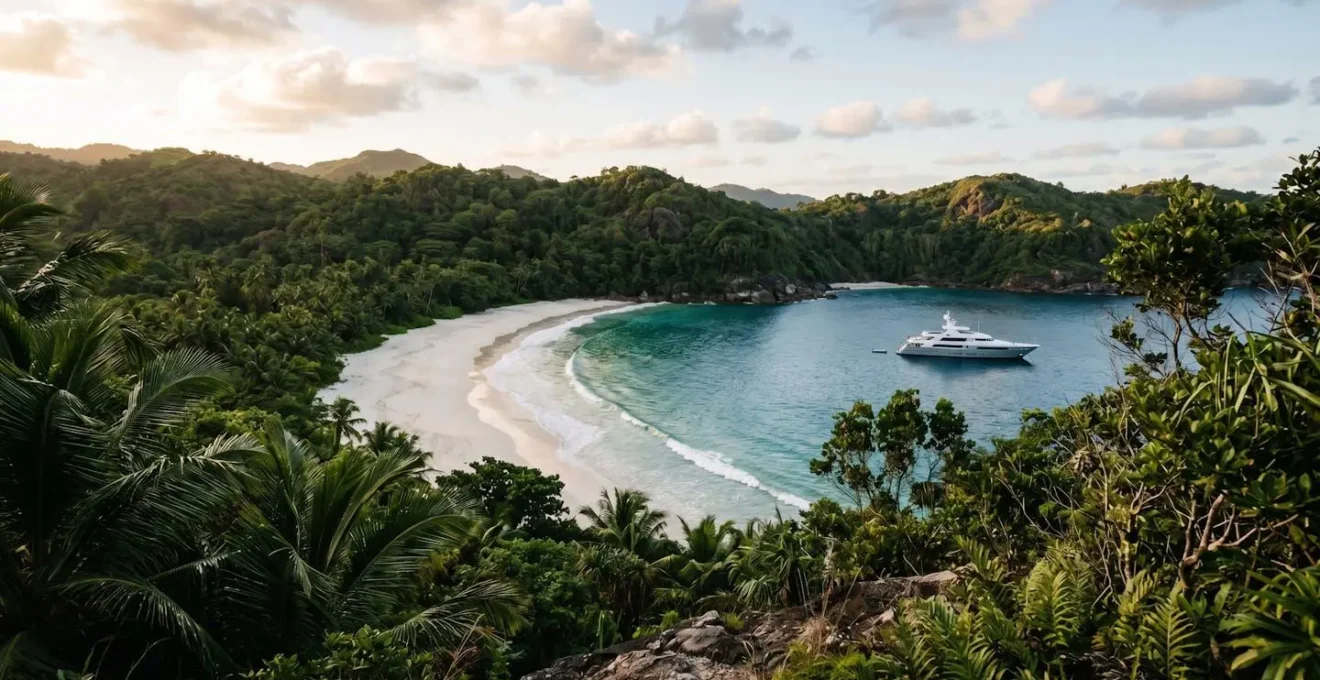
True island exclusivity is dictated not by price, but by access architecture—the non-negotiable legal, conservation, and logistical barriers that premium tours are designed to navigate.
- This involves understanding permit-based entry systems and distinguishing them from superficial ‘VIP’ marketing.
- It also means recognizing that the highest value often lies in privileged access to protected ecosystems, not just private property.
Recommendation: Prioritize tour operators who provide transparent proof of permit-based access and can document how premium fees contribute directly to conservation efforts.
For the discerning traveller, the term « exclusive » has become diluted, often serving as a marketing veneer for experiences that are, upon closer inspection, widely accessible. You see advertisements for premium tour packages promising entry to secluded coves and private islands, yet the nagging question remains: what separates genuine, restricted access from a simple, costly upgrade? The common approach is to weigh the price tag, but this often leads to costly mistakes. The real currency of exclusivity isn’t just financial; it’s informational.
Many travellers assume that a higher price guarantees a more private experience. However, the world’s most coveted island destinations are often shielded not by a paywall, but by a complex fortress of legal statutes, strict conservation mandates, and formidable logistical hurdles. Understanding this « access architecture » is the true key to unlocking these locations. The challenge is not simply to afford the ticket, but to discern which tickets open doors that are genuinely closed to the public.
This guide moves beyond the brochure. It is designed to equip you with the strategic knowledge of a luxury access consultant. We will dissect the legal frameworks that restrict entry, reveal the booking mechanisms for permit-based experiences, and provide a clear methodology for authenticating claims of exclusivity. By understanding these systems, you will be able to justify the premium, avoid deceptive offers, and secure passage to locations defined by their inaccessibility.
This article provides a detailed breakdown of the systems that govern access to the world’s most protected and sought-after island destinations. The following summary outlines the key topics we will explore to help you master the art of securing truly exclusive travel experiences.
Summary: A Strategic Guide to Unlocking Exclusive Island Access
- Why Are Some Island Locations Legally Restricted to Guided Tour Access Only?
- How to Secure Bookings for Exclusive Island Experiences With Strict Daily Visitor Limits?
- Private Island Access or Protected Reserve Tour: Which Offers More Genuine Exclusivity?
- The Exclusivity Mistake: Paying Premiums for « Exclusive » Locations Anyone Can Visit
- When Do Exclusive Island Location Tours Justify Their Premium Prices?
- Why Do Luxury Island Vacation Homes Require Booking 18 Months Ahead for Peak Dates?
- Private Island Activity Guide or Group Tour: Which for Better Safety and Experience?
- How to Book Luxury Island Vacation Homes for Weddings and Milestone Birthday Celebrations?
Why Are Some Island Locations Legally Restricted to Guided Tour Access Only?
The most profound form of exclusivity is often not a product of private ownership but of sovereign law and conservation science. In ecologically priceless locations, governments and international bodies implement strict regulations to protect fragile ecosystems from the pressures of tourism. For instance, 95% of the land area in the Galápagos Islands is designated as a protected national park, a status that legally forbids independent access. This restriction is not arbitrary; it is a core component of a conservation strategy.
This approach is underpinned by a global framework. At high-pressure sites, the UNESCO World Heritage Committee mandates the implementation of strategic plans to manage tourism’s impact. As detailed in their compendium on sustainable tourism, this requires identifying a site’s « carrying capacity »—the maximum number of visitors an environment can sustain without degradation. This transforms visitor limits from a simple rule into a science-based necessity, with sites from the Galápagos to Dubrovnik legally required to calculate and enforce these capacities. The premium tour, in this context, becomes the sole licensed vehicle for entry, with its structure and pricing directly linked to these conservation imperatives.
This regulatory framework fundamentally redefines access. It is no longer a question of what a visitor can afford, but what the ecosystem can bear. The role of the premium tour operator shifts from a simple service provider to a licensed custodian, responsible for ensuring compliance. As the Machu Picchu Travel Organization clarifies in its guide, this is absolute: for most protected sites, « All landing sites except those in island towns require certified naturalist guides—visitors cannot explore most areas independently. » The guided tour is not an option; it is the law.
How to Secure Bookings for Exclusive Island Experiences With Strict Daily Visitor Limits?
For islands where access is governed by strict daily visitor quotas, securing a booking is less a transaction and more a strategic competition. These locations often use lottery-based permit systems, where demand vastly outstrips the legally mandated supply. Success requires meticulous preparation and an understanding of the system’s mechanics, as simply having the funds is insufficient when only a few hundred permits are available per day.
The process demands a level of readiness far beyond typical travel planning. Official lottery dates change annually and must be monitored vigilantly. Platforms like Recreation.gov require pre-registration, and having an account fully set up is a non-negotiable first step. Furthermore, since permits are almost always non-transferable, the initial application must be flawless, often requiring the designation of a backup trip leader in case the primary applicant cannot travel. This is a game of speed, precision, and flexibility.
Once a lottery window is granted, the race continues. A later access time means fewer choices of dates and campsites remain. Having multiple pre-selected date ranges and group configurations is essential to adapt to dwindling availability. The final booking confirmation is often a time-sensitive dash requiring immediate input of specific details like vehicle license plates. This entire access architecture is designed to manage high demand fairly, but it rewards only those who have prepared their information with military precision. For many, delegating this complex, high-stakes process to a specialized tour operator is the most reliable path to success.
Private Island Access or Protected Reserve Tour: Which Offers More Genuine Exclusivity?
A common strategic question for the discerning traveler is where to find the most authentic form of exclusivity. The choice often comes down to two distinct models: leasing an entire private island for personal use versus joining a premium tour to a legally protected, limited-access natural reserve. While both offer a retreat from the crowds, the nature of the exclusivity they provide is fundamentally different, and the « better » option depends entirely on your objective.
Private island access offers an exclusivity of presence. It guarantees absolute privacy, a sovereign-like bubble where your group are the only guests. However, the quality of the natural environment can be variable, sometimes consisting of cultivated landscapes rather than pristine, wild ecosystems. In contrast, a protected reserve tour offers an exclusivity of access. You may share the experience with a small, vetted group of 10-16 fellow travelers, but you are granted the privilege of witnessing a world-class, untouched ecosystem that millions of others are legally barred from entering. The value here derives not from being alone, but from being one of the chosen few.
The following table breaks down the key differences in their exclusivity architecture, helping to clarify which model aligns best with your goals.
| Exclusivity Factor | Private Island Access | Protected Reserve Tour |
|---|---|---|
| Type of Exclusivity | Exclusivity of Presence – Guaranteed total privacy with no other guests | Exclusivity of Access – Privilege of witnessing ecosystems millions cannot access |
| Ecosystem Quality | May feature standard or cultivated natural environments | World-class pristine ecosystems with rare endemic species |
| Social Experience | Complete privacy, no sharing with other tourists | Small vetted groups (typically 10-16 guests) with certified guides |
| Regulatory Framework | Private ownership covenants, minimal conservation mandates | UNESCO protocols, national park regulations, strict carrying capacity limits |
| Value Perception | Absolute but self-contained exclusivity | Relative exclusivity deriving value from access denial to general public |
The Exclusivity Mistake: Paying Premiums for « Exclusive » Locations Anyone Can Visit
The most significant error in luxury travel is paying a premium for what can be termed « marketed exclusivity »—experiences branded as exclusive but which lack any verifiable access restrictions. Operators often use sophisticated language to create the illusion of a private encounter at a location that is, in reality, open to the general public. Authenticating the provenance of the exclusivity claim is therefore the most critical piece of due diligence a traveler can perform.
These deceptive offers prey on the assumption that price equals access. Phrases like « private section of a public beach » or « exclusive entry time » are common red flags. While a tour might secure the first time slot of the day at a famous viewpoint, this is a logistical advantage, not true exclusivity, especially if multiple other operators offer the same slot. True exclusivity is defined by legal barriers: does the location require a government-issued permit? Is access physically restricted to a set number of people per day? Is it managed by a national park authority with certified-guide-only policies?
Answering these questions is non-negotiable. It requires looking past the glossy marketing and examining the tour’s documentation for specific permit numbers, governmental authorization, or named-guide credentials. An operator offering genuine access will be transparent about these details as they are the very source of their value proposition. The absence of such proof should be considered a major warning sign.
Your Verification Checklist: How to Spot Fake Exclusivity
- Marketing Language: Question phrases like « private section of a public beach. » Verify if the location has any actual legal access restrictions beyond a specific time of day.
- Entry Time Claims: Check if multiple tour operators offer identical early-morning or sunset slots to the same publicly accessible site, which negates exclusivity.
- Nature of « VIP » Access: Determine if the premium provides access to genuinely restricted areas requiring permits, rather than just marginally better viewing positions.
- Itinerary Dissection: For multi-day tours, analyze each stop to identify how many are standard public attractions versus verifiable permit-required locations.
- Documentation Scrutiny: Look for the absence of specific permit numbers, certified guide credentials, or governmental authorization references in tour documents and contracts.
When Do Exclusive Island Location Tours Justify Their Premium Prices?
A premium price tag is justified when it directly correlates to a verifiable and tangible value that is inaccessible through other means. In the context of exclusive island tours, this value is most clearly demonstrated when a significant portion of the cost is a direct contribution to the conservation and management of the fragile environment being visited. The price becomes a fee for service, a permit cost, and a philanthropic investment rolled into one.
A prime example is the fee structure for protected national parks. For instance, the Galápagos National Park entry fee, which rose to $200 per foreign visitor in August 2024, is not an arbitrary profit center. This cost is a transparent conservation fee. It is the price of admission required by the government to manage the very asset you are paying to see. When a tour’s cost includes such non-negotiable, government-mandated fees, the premium is immediately legitimized.
The justification becomes even stronger when operators can show precisely how these funds are allocated. When the Galápagos fee was increased, the Ministry of Tourism specified its purpose: to fund conservation initiatives, infrastructure upgrades, and community programs designed to mitigate tourism’s ecological footprint. This transparent allocation transforms the premium price from a mere expense into a measurable investment in the destination’s legacy. The cost is justified because it ensures the pristine nature of the location for future generations. Therefore, a premium tour justifies its price when the cost grants access to a legally restricted area and demonstrably contributes to its preservation.
Why Do Luxury Island Vacation Homes Require Booking 18 Months Ahead for Peak Dates?
For the world’s most sought-after private island homes, securing a reservation during peak season is a long-term strategic endeavor. It is not uncommon for these properties to be fully booked for key holiday weeks or summer months far in advance. According to luxury island rental specialists, elite properties frequently require booking 18 to 24 months in advance for the most desirable dates. This extended timeline is not an arbitrary policy but the result of powerful, often hidden, logistical systems that favor established clients.
This reality is openly communicated by top-tier properties. The private island resort Coco Plum Cay, for example, explicitly advises clients on its booking page to « Please reserve the island at least 12 – 24 months in advance of your stay. » This is necessary because new renters are not competing on a level playing field. The primary mechanism driving this scarcity is the « Right of First Refusal » system employed by many elite property managers.
Case Study: The ‘Right of First Refusal’ System
Elite private island properties often grant the previous year’s guests an exclusive booking window to reserve the same weeks for the following year. This « Right of First Refusal » happens before the calendar is ever opened to the public. When combined with the long planning horizon for milestone events like destination weddings and major anniversaries—which are themselves planned 18-24 months out—it creates a closed booking loop. This system effectively locks out new renters from the most premium peak-season weeks for years, explaining why availability seems to vanish before the general public even begins its search.
Understanding this logistical bottleneck is crucial. It means that for new clients, the strategy is not to wait for availability but to plan multiple years ahead or to engage a specialist broker who has the relationships to potentially intercept a week if a repeat renter declines their option.
Private Island Activity Guide or Group Tour: Which for Better Safety and Experience?
Once on a private island, a key decision is how to structure activities: engage a single private guide for maximum flexibility or opt for the organized infrastructure of a group tour operator, even if it’s for your private party. While the allure of a fully customized itinerary with a personal guide is strong, the choice carries significant implications for both safety and the quality of the experience, particularly when undertaking technical or high-risk activities.
A private guide offers unparalleled personalization. The pace, focus, and schedule are entirely yours, making it a superior option for low-risk activities like guided nature walks, beach exploration, or cultural tours where intimate local knowledge enhances the experience. However, this model has a critical vulnerability: it is a single point of failure. If the guide becomes ill or injured in a remote location, the activity—and potentially the trip—is over. There is limited backup equipment and no redundant personnel.
In contrast, a certified group tour operator, even when chartered for a private group, brings institutional depth. They operate with systematized safety protocols, redundant equipment, and multiple certified guides. This logistical depth is non-negotiable for high-risk technical activities like cave diving, remote expeditions, or technical climbing. Their established emergency evacuation plans and backup staff ensure trip continuity and provide a level of safety infrastructure that a single guide cannot match.
| Factor | Private Island Guide | Group Tour Operator |
|---|---|---|
| Personalization | Unparalleled flexibility – fully customized itinerary and pace | Fixed itinerary designed for group consensus, limited customization |
| Safety Infrastructure | Single guide expertise, limited backup equipment, vulnerable to single point of failure | Systematized protocols, redundant equipment, multiple certified guides, institutional depth |
| Best For Low-Risk Activities | Superior – guided nature walks, beach exploration, cultural tours benefit from personalized attention | Adequate – standardized experience may lack intimate local knowledge |
| Best For High-Risk Technical Activities | Risky – limited backup support for activities like cave diving, technical climbing, remote expeditions | Superior – certified operators with team redundancy and established emergency evacuation protocols |
| Remote Location Risk | High vulnerability – guide illness or injury ends trip with no backup personnel | Logistical depth – backup guides and support staff ensure trip continuity |
Key Takeaways
- Genuine exclusivity is rooted in verifiable legal restrictions and conservation-based carrying capacities, not just marketing claims.
- Comprehensive due diligence is essential to distinguish authentic, permit-required access from « marketed exclusivity » that offers little real value.
- The highest premiums are justified when they directly fund the preservation of the destination, transforming the cost into a measurable conservation investment.
How to Book Luxury Island Vacation Homes for Weddings and Milestone Birthday Celebrations?
Booking a luxury island home for a milestone event like a wedding or a significant birthday involves a layer of logistical due-diligence that goes far beyond a standard vacation rental. The stakes are higher, with non-refundable deposits often in the range of 30-50% of the total rental cost. The success of the event hinges not just on the beauty of the property, but on its operational capacity to function as an event venue. This requires a forensic examination of policies, permits, and practical constraints.
The primary task is to verify the entire logistical chain. You must confirm the property’s policies on vendor access: can your chosen caterers, photographers, and entertainers physically and legally access the island? Many exclusive properties have preferred vendor lists or require extensive advance clearance and insurance certificates for any external staff. Furthermore, local island jurisdictions often have strict noise ordinances and require special event permits for gatherings that exceed a certain size or run past a specific time. Ignoring these can result in fines or a premature end to your celebration.
Transport and privacy are also critical. You must assess whether island access roads can accommodate guest shuttles, particularly at night, and if ferry schedules align with your event timing. Contingency plans for inclement weather are essential. Finally, it’s vital to ensure the property’s layout provides the « exclusive event bubble » you are paying for, with adequate control over sight-lines from public areas. For a truly unique experience, it is often possible to negotiate with owners or local authorities for temporary, permitted use of adjacent private beaches or docks, creating a completely bespoke event space.
Your Event Due Diligence Checklist for Island Venues
- Vendor Access Policies: Confirm if external caterers, florists, and staff can access the island and what advance clearance is required.
- Local Ordinances and Permits: Research local noise restrictions and special event permit requirements for your guest count and event type.
- Liability Insurance: Determine if the property mandates additional event insurance and what coverage limits are necessary for you and your vendors.
- Guest Transport Feasibility: Evaluate if access roads, ferry schedules, and weather contingencies are compatible with your event plan.
- Acoustic and Visual Privacy: Ensure the property layout provides sufficient privacy and control over sight-lines from any public areas.
To ensure your next journey delivers genuine, verifiable exclusivity, the next step is to apply this framework of due diligence to your prospective tour operators and destinations. By asking the right questions and demanding transparent proof of access, you transform yourself from a passive consumer into an informed investor in extraordinary experiences.