A meaningful temple visit isn’t about ticking off sights; it’s about understanding the invisible architecture of respect that gives them life.
- Respectful dress codes, like Bali’s sarong and sash, are based on a « sacred logic » of spiritual purity, not arbitrary rules.
- The most profound temple experiences reveal a « spiritual symbiosis » between architecture, community life, and the natural environment, like Bali’s Subak irrigation system.
- Your presence as a visitor can either support or disrupt a centuries-old sacred balance, making mindful engagement essential.
Recommendation: Prioritize learning the ‘why’ behind local customs to transform your visit from tourism into a genuine cultural pilgrimage.
For the cultural and spiritual traveller, an island temple is more than a destination; it is a pilgrimage site where architecture, nature, and belief converge. Standing before ancient stones carved with divine stories, one feels a sense of awe, but often, also a quiet uncertainty. How does one move through such a space with genuine reverence? The common advice—wear a sarong, be quiet, don’t use flash—is a starting point, but it barely scratches the surface. It treats sacred sites like museums with a dress code, overlooking the living, breathing traditions they embody.
The true essence of a spiritual journey lies not in following a checklist of rules, but in understanding the invisible architecture of respect that underpins them. This is the sacred logic that connects a simple sash to concepts of purity, that transforms an irrigation ditch into a divine channel, and that makes a quiet village a sanctuary. Many travel guides focus on the visual splendour of temple complexes, detailing their history and architectural marvels. This guide, however, goes a step further. It seeks to reveal the « why » behind the « how »—the spiritual and cultural reasoning that gives these practices meaning.
By exploring this invisible framework, a visitor ceases to be a mere spectator. They become a mindful participant, capable of engaging with a place not just for its beauty, but for its soul. This article will deconstruct the layers of respectful travel, from the symbolism of temple attire and the nuances of visitor etiquette to the profound connection between sacred agriculture and community well-being. Ultimately, it offers a pathway to transform your visit from a simple tour into a deeply resonant and respectful cultural immersion.
To help you navigate these profound cultural landscapes, this guide is structured to build your understanding layer by layer. The following sections will explore the essential aspects of visiting sacred island temples, providing both the practical knowledge and the deeper context needed for a truly meaningful experience.
Summary: A Deeper Guide to Visiting Sacred Island Temples
- Why Do Balinese Temples Require Sarongs and Sashes for All Visitors?
- How to Behave Respectfully in Island Temples: Etiquette for Non-Religious Visitors?
- Buddhist Temples in Sri Lanka or Hindu Temples in Bali: Which Offer Greater Architectural Diversity?
- The Temple Photography Behaviour That Violates Sacred Space and Religious Respect
- When Should You Visit Island Temples: During Active Ceremonies or Quiet Contemplation Hours?
- The Tourist Behaviour That Damages Rice Crops and Offends Terrace Farmers
- How to Engage Respectfully With Remote Island Village Residents as a Day Visitor?
- How to Visit Remote Island Villages Without Accelerating Their Tourist Transformation?
Why Do Balinese Temples Require Sarongs and Sashes for All Visitors?
The requirement to wear a sarong and sash (known as a *kamen* and *selendang*) before entering a Balinese temple is often the first cultural encounter for many visitors. While it may seem like a simple dress code, it is deeply rooted in the island’s spiritual philosophy. This is not about modesty in the Western sense, but about adhering to a sacred logic of purity and respect. The Balinese Hindu belief system, Tri Hita Karana, emphasizes harmony between humans, the environment, and the divine. Entering a temple, or *pura*, is to enter the domain of the gods, and one must be appropriately attired to honour that space. In fact, as tourism has surged, reports confirm that the Balinese provincial government has strengthened the code of conduct for tourists visiting temples as of 2024 to preserve this sanctity.
The sarong serves the primary purpose of covering the lower body, which is considered impure. The critical element, however, is the sash. As the Merusaka Cultural Education Team explains, the purpose is spiritually significant:
The sash symbolically separates the ‘impure’ lower body from the ‘pure’ upper body, maintaining the sanctity required within the temple.
– Merusaka Cultural Education Team, Bali Etiquette Tips Guide
This simple act of tying a sash creates a symbolic boundary on the body, aligning the individual with the temple’s own tripartite division of space: an outer, middle, and sacred inner courtyard. The clothing is therefore not a costume but a tool for spiritual preparation, an outward sign of the visitor’s intention to respect the invisible architecture of the holy site. The intricate patterns and colours of the textiles themselves often carry further meaning, representing balance and protection.
Understanding this context transforms the act of renting or buying a sarong from a tourist chore into a meaningful gesture. It is the first step in acknowledging that you are not just entering a building, but participating, however briefly, in a living spiritual tradition. It is a physical demonstration of your respect for the profound beliefs that give the temple its power and purpose.
How to Behave Respectfully in Island Temples: Etiquette for Non-Religious Visitors?
Beyond attire, respectful behaviour within a temple is guided by an understanding of its function as a house of worship, not a tourist attraction. For non-religious visitors, navigating this space requires a shift in mindset from passive observation to active, mindful presence. Every element within the temple grounds, from statues to walls to the small offerings on the ground, is considered sacred. The most common breaches of etiquette often stem from a lack of awareness of this pervasive sanctity. Simple actions like leaning against a shrine for a photo or pointing one’s feet towards an altar are seen as deeply disrespectful, as feet are considered the most impure part of the body.
Visitors are typically welcome in the outer (*jaba pisan*) and middle (*jaba tengah*) courtyards, which are zones for social and preparatory activities. However, the innermost courtyard (*jeroan*), the most sacred space reserved for prayer, is generally off-limits to those not actively worshipping. Adhering to these spatial boundaries is a critical sign of respect. Furthermore, one must be careful not to step on the small, woven palm-leaf baskets filled with flowers and incense, known as *canang sari*. These are daily offerings, and treading on them is equivalent to trampling on a prayer.
Maintaining a quiet atmosphere is paramount. Loud conversations and phone notifications disrupt the contemplative environment essential for prayer. Temple guardians, known as *pecalang*, are often present to ensure rules are followed, and their instructions should be heeded without question. By understanding and following these guidelines, you contribute to preserving the serene and sacred ambiance that makes these places so special.
Your Temple Visit Etiquette Checklist: Key Points to Remember
- Modest Attire: Ensure shoulders and knees are covered. Avoid tank tops or revealing clothing. The temple will provide a sarong and sash if needed.
- Respect Sacred Objects: Refrain from climbing on, sitting on, or leaning against any temple walls, statues, or shrines. They are consecrated objects, not props.
- Mind Your Feet: Never point the soles of your feet towards altars, priests, or sacred objects. When sitting on the floor, tuck your feet to the side or behind you.
- Observe Spatial Boundaries: Stay within the outer and middle courtyards designated for visitors. The innermost sanctuary (*Utama Mandala*) is exclusively for worshippers.
- Watch Your Step: Carefully avoid stepping on the *canang sari* (small flower offerings) placed on the ground and on shrines. Walk around them.
Buddhist Temples in Sri Lanka or Hindu Temples in Bali: Which Offer Greater Architectural Diversity?
Comparing the architectural diversity of Sri Lanka’s Buddhist temples with Bali’s Hindu *puras* is like comparing two rich, distinct languages of faith. Neither is « greater, » but each offers a unique architectural vocabulary. Sri Lankan Buddhist temples are often dominated by the brilliant white, bell-shaped stupa or *dagoba*, a structure designed to house sacred relics. These are complemented by image houses with serene Buddha statues and Bodhi trees, grown from saplings of the original tree under which the Buddha attained enlightenment. The island’s history also includes incredible rock-cut temples like Dambulla, where caves are transformed into painted galleries of divine figures.
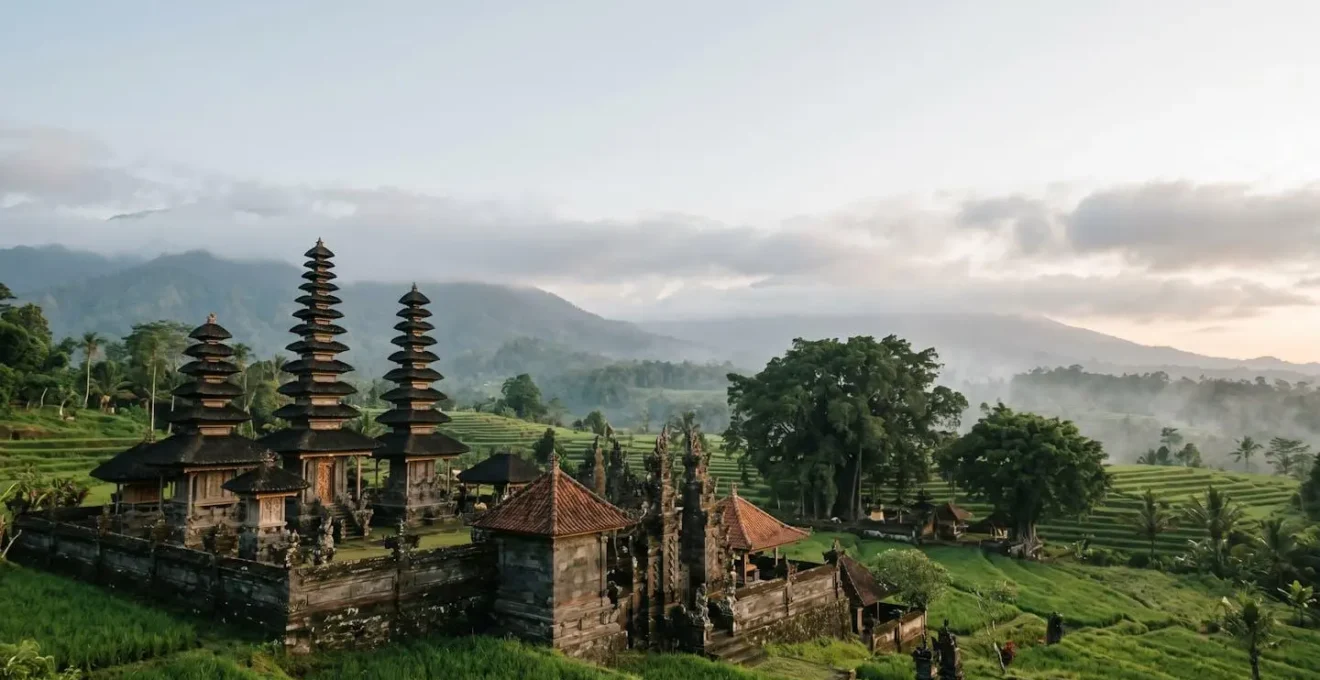
Balinese Hindu temples, in contrast, are typically open-air complexes designed as a series of courtyards leading progressively toward the most sacred inner realm. Their most iconic features are the towering, multi-tiered shrines known as *meru*, whose layered thatched roofs represent the cosmic mountain and home of the gods. Intricately carved stone gates (*candi bentar* or split gates) mark the transition between realms, symbolizing the balance of opposing forces. The architecture is a physical manifestation of the spiritual symbiosis between the divine, human, and natural worlds, often incorporating water features and lush gardens.
However, the diversity of island temples extends far beyond this binary. A third, equally fascinating model is found in modern syncretic temples that blend ancient philosophy with contemporary design, particularly in Japan. These sites often showcase a powerful integration with nature, a principle shared with Balinese design but expressed through a minimalist aesthetic.
Case Study: Honpukuji Water Temple, Japan
Designed by renowned architect Tadao Ando on Awaji Island, the Honpukuji Temple offers a startlingly different vision of sacred space. Instead of a grand roof, the temple’s entrance is a vast, oval pond of water covered in lotus flowers. To enter, visitors descend a staircase that cuts directly through the water, a symbolic act of purification before reaching the sacred vermilion-lit chamber below. The design brilliantly merges Shinto and Buddhist principles, using nature not as a backdrop but as the primary architectural element, demonstrating how island temple diversity continues to evolve in breathtaking ways.
The Temple Photography Behaviour That Violates Sacred Space and Religious Respect
In the age of social media, the line between documentation and desecration has become dangerously blurred. Many of Balinese temples are some of the most Instagrammed locations in the world, a trend that has unfortunately led to a rise in disrespectful photography behaviour. The pursuit of the « perfect shot »—posing in yoga stances, climbing on sacred structures, or flying drones over praying congregations—transforms a place of worship into a personal photo set. This behaviour fundamentally misunderstands the purpose of the temple and violates the sanctity of the space for worshippers.
The most egregious violation is the intrusive photography of people during prayer. A ceremony is a deeply personal and communal spiritual act, not a performance for tourists. Using a flash, getting too close, or positioning oneself in front of a worshipper to capture their devotion for a social media post is a profound act of disrespect. It disrupts their connection with the divine and commodifies their faith. As professional photographer Stefano Politi Markovina emphatically states in his guide on the topic:
Respect should always come before the shot. Poor behaviour inside a religious building, regardless of religion, simply for the sake of getting a photo is unacceptable.
– Stefano Politi Markovina, Photographing Religious Buildings
Responsible temple photography requires mindful presence and empathy. The goal should be to capture the atmosphere and architectural details without disturbing the peace or the people. This means using a long lens from a distance, never using flash, turning off shutter sounds, and, most importantly, asking for permission before taking a portrait. Often, the most powerful images are those taken during quiet moments, focusing on the play of light on stone, the texture of an offering, or the rising smoke of incense—details that tell a story without violating anyone’s privacy or sacred space.
When Should You Visit Island Temples: During Active Ceremonies or Quiet Contemplation Hours?
Choosing when to visit a temple involves a trade-off between two vastly different but equally valid experiences: the vibrant energy of a community ceremony or the profound stillness of solitary contemplation. There is no single « best » time; the ideal choice depends on your personal travel goals. Witnessing a temple festival, or *odalan*, is an unforgettable immersion in living culture. You will see the temple come alive with colour, sound, and devotion, as locals dressed in traditional white attire arrive bearing towering offerings of fruit and flowers. It’s a spectacular display of communal faith and artistic expression.
However, these ceremonies can be crowded and overwhelming. For a more personal spiritual connection or for architectural photography, the best times are often the « quiet hours. » Arriving at dawn (between 7:00 and 9:00 AM) or visiting near dusk allows you to experience the temple in a state of serene tranquility. The soft light is ideal for photography, and the lack of crowds creates space for quiet reflection. You can absorb the intricate details of the carvings, feel the history in the stones, and experience the temple’s atmosphere without distraction.
A highly effective approach is the « two-visit strategy. » Visit an iconic temple once during the early morning for quiet contemplation and photography. Then, if your timing aligns with a local ceremony, return for a second visit to witness the cultural festivities. Finding information on ceremony schedules can be difficult as they are often not published online. The best method is to ask staff at your guesthouse, hire a local guide, or observe the community for signs of preparation, such as the erection of decorations or increased activity. This dual approach allows you to appreciate both the temple’s architectural soul and its vibrant, beating heart.
The Tourist Behaviour That Damages Rice Crops and Offends Terrace Farmers
The iconic, emerald-green rice terraces of islands like Bali are more than just beautiful landscapes; they are living monuments to a sacred agricultural system. The tourist behaviour of walking directly on the rice paddies or the narrow mud walls (*galengan*) that separate them, often for a better photo, is not just agricultural damage—it is a spiritual offense. These terraces are part of the Subak system, a complex, community-managed irrigation network rooted in a philosophy of harmony that dates back over a thousand years. In recognition of its cultural significance, 19,500 hectares across five rice terraces and their water temples were designated a UNESCO World Heritage site.
The Subak system is a perfect example of spiritual symbiosis, where water, land, and community are inextricably linked to the divine. It is governed by a series of « water temples » that manage the allocation of water to different farming cooperatives. This is not merely an engineering feat but a social and religious institution.
Case Study: Bali’s Subak System as a Sacred Landscape
The Subak system is founded on the Tri Hita Karana philosophy, ensuring harmony with God, humans, and nature. Water distribution is managed through rituals and offerings at water temples dedicated to Dewi Danu, the goddess of lakes and irrigation. Farmers in Subak associations make collective decisions about planting, irrigation, and harvesting. When a tourist walks on the delicate mud walls or through a growing paddy, they risk compacting the soil and disrupting the precisely engineered irrigation channels. This act directly interferes with the water flow shared among farmers, transforming what seems like minor trespass into a disruption of a cooperative, sacred system recognized for its outstanding universal value.
To respect this system, visitors must stay on designated paths and viewing platforms. The farmers are not landscape gardeners; they are custodians of a sacred tradition, and their crops are their livelihood. Trampling on their fields for a selfie is an act that disrespects their work, their culture, and their faith. Appreciating the terraces from a distance, understanding the intricate system they represent, is a far more meaningful way to honour their beauty.
How to Engage Respectfully With Remote Island Village Residents as a Day Visitor?
Visiting a remote island village offers a precious glimpse into a way of life that is often vastly different from our own. As a day visitor, the key to respectful engagement is to approach the community with humility, curiosity, and the mindset of a guest, not a consumer. The goal is to be a cultural bridge, fostering positive interaction rather than treating the village as a living museum. This begins before you even arrive, with small but significant efforts to learn a few words in the local language. A simple « hello, » « thank you, » or a compliment like « delicious » can break down barriers and signal your respect and genuine interest.
Photography is one of the most sensitive areas. A person’s home, workspace, or likeness is not a public commodity. The golden rule is to always ask for permission before taking a photo, a principle perfectly captured in the Jamaica Community Tourism Guidelines as « Ask Before You Photo. » This means engaging in conversation first, making the photograph a shared memory rather than a stolen moment. This principle extends to their homes and livelihoods; always ask before you click.
Ask Before You Photo: Remember that these are people’s homes, not sets. Engaging in conversation first makes every photograph a shared memory rather than a stolen moment.
– Jamaica Community Tourism Guidelines, Heart of the Island: How Jamaica’s Community Tourism is Becoming the World’s Sustainable Blueprint
Supporting the local economy is another powerful form of respectful engagement. Whenever possible, purchase crafts, food, or services directly from local residents rather than from outside vendors. Pay the requested price without aggressive haggling, which devalues their skills and labour. Hiring a local guide is one of the best investments you can make. They act as more than just navigators; they are cultural translators who can facilitate authentic interactions, share nuanced insights, and ensure your presence is a positive one. Ultimately, respectful engagement is about prioritizing human connection over content creation, being mentally present, and leaving a place and its people better, or at least no worse, for your visit.
Key Takeaways
- Temple etiquette (sarong, behaviour) is rooted in a « sacred logic » of purity and respect, not arbitrary rules.
- True architectural appreciation goes beyond aesthetics to understand the temple’s « spiritual symbiosis » with its community and environment (e.g., Subak system).
- Mindful engagement—visiting at quiet times, interacting respectfully, and supporting community-owned tourism—transforms a trip into a meaningful pilgrimage.
How to Visit Remote Island Villages Without Accelerating Their Tourist Transformation?
The paradox of cultural travel is that our very presence can unintentionally accelerate the erosion of the authenticity we seek. Visiting a remote island village requires a conscious effort to mitigate this impact. The most effective strategy is to actively support Community-Based Tourism (CBT) models. Unlike traditional tourism where profits are extracted by external companies, CBT ensures that economic benefits flow directly to the community. This empowers residents to become guardians of their own cultural and natural heritage, giving them a vested interest in its preservation rather than its commodification for mass tourism. The global demand for these authentic experiences is growing, with the CBT market projected to reach over $2 trillion by 2032.
This means making deliberate choices: staying in locally-owned guesthouses, eating at family-run eateries, and hiring guides from the village itself. By doing so, your tourist dollars contribute to sustainable livelihoods, allowing families to thrive without having to abandon their traditional homes or practices for work in overcrowded tourist hubs. This approach helps maintain the social fabric of the village and ensures that development, when it occurs, happens on the community’s own terms.
Fiji provides a powerful, large-scale example of how this model can succeed, proving that local ownership is not just a niche concept but a viable and sustainable economic engine that preserves cultural integrity.
Case Study: Fiji’s Community-Owned Tourism Success
In Fiji, local communities now own approximately 80% of tourism properties and businesses. Visitor fees are paid directly to the landowning units (*Mataqali*) and villages, creating tangible, shared financial benefits. Initiatives like the Natalei Eco Lodge and Bula Coffee create jobs within remote villages, allowing cultural heritage to be maintained while fostering economic independence. This model demonstrates that when a community has ownership and control over its tourism assets, it becomes the most passionate and effective protector of its environment and traditions, ensuring that the island’s soul is not sold for short-term profit.
Choosing to support these models is the most significant action a traveller can take. It shifts the dynamic from extractive to reciprocal, ensuring that your visit contributes to the resilience and continuity of the very culture you have travelled so far to experience.
By choosing to be a mindful guest rather than just a visitor, you actively participate in preserving the very sanctity and cultural richness you came to experience. Plan your next spiritual journey with this principle of reciprocity at its heart, ensuring that the world’s sacred islands can continue to inspire generations of travellers to come.