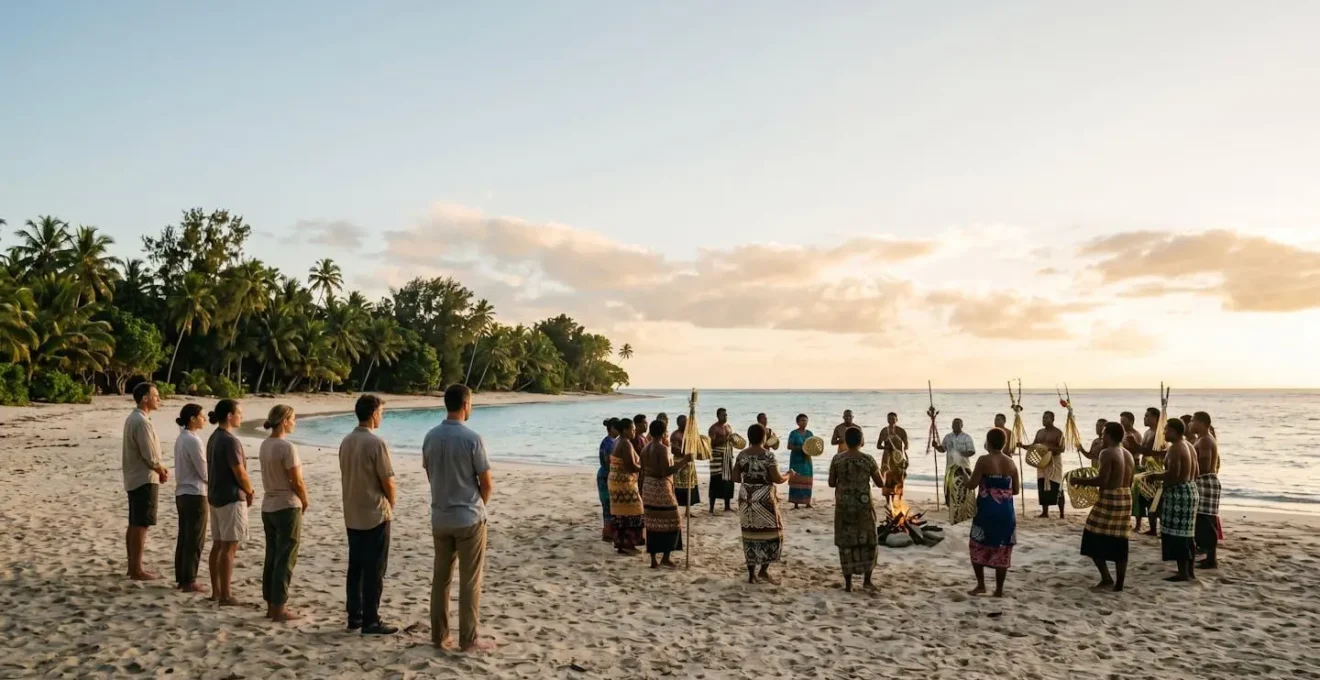
The key to respectfully attending a traditional island festival is to shift your role from an active participant to a passive, humble witness, understanding that your very presence is an intervention.
- Most conflicts arise when visitors treat sacred ceremonies as tourist spectacles or personal photo opportunities.
- Genuine respect is demonstrated through pre-arrival research into cultural meanings, not just surface-level etiquette.
Recommendation: Default to quiet observation from the periphery unless an explicit, personal invitation to participate is extended by a community member.
The allure of a traditional island festival is powerful. The vibrant colours, the ancient rhythms, the raw expression of a living culture—it’s an experience many culturally curious travellers dream of. Yet, there is a fine, often invisible line between being a respectful guest and an intrusive tourist. The common advice—dress modestly, ask before taking photos—is a starting point, but it barely scratches the surface of a much deeper responsibility. These tips often fail to address the core issue: the fundamental difference between a community’s sacred ceremony and a performance for outsiders.
The growing desire for authentic cultural connection is undeniable. Market research shows that 64% of tourists in 2024 actively seek engagement with indigenous cultures, a significant rise from previous years. This growing interest, however, puts immense pressure on communities, who must navigate the complex terrain of sharing their heritage without seeing it commodified or diluted. The real challenge for the visitor isn’t learning a few local phrases, but unlearning the consumer mindset that treats culture as a product to be captured and consumed.
But what if the key to respectful attendance wasn’t about a checklist of actions, but a radical shift in mindset? What if, instead of asking « How can I participate? », the better question is « How can I be present without disrupting? » This guide moves beyond the platitudes to explore the ethics of observation. We will examine why some communities welcome visitors while others close their doors, how to prepare meaningfully for the experience, and how to define your role not as a participant, but as a humble and temporary witness to something sacred.
To navigate this complex but rewarding journey, this article breaks down the essential principles of respectful observation. The following sections will guide you through understanding community boundaries, preparing for your visit, and conducting yourself with the awareness required to protect the integrity of these invaluable cultural celebrations.
Summary: A Guide to Respectful Observation at Island Festivals
- Why Do Some Island Festivals Welcome Tourists Whilst Others Prohibit Outside Attendance?
- How to Learn Festival Cultural Meanings Before Attending to Appreciate Properly?
- Active Festival Participation or Respectful Observation: Which Role for Outside Visitors?
- The Festival Mistake: Treating Sacred Celebrations as Personal Photo Opportunities
- When Do Islands Hold Traditional Festivals: Annual Calendar of Cultural Celebrations?
- Why Do Some Island Cultures Consider Direct Eye Contact Rude or Aggressive?
- When Should You Visit Island Temples: During Active Ceremonies or Quiet Contemplation Hours?
- How to Learn Island-Specific Customs Before Arriving to Avoid Embarrassing Mistakes?
Why Do Some Island Festivals Welcome Tourists Whilst Others Prohibit Outside Attendance?
The distinction between an open invitation and a closed ceremony is not arbitrary; it’s a direct reflection of a community’s history, economic reality, and relationship with the outside world. The core of the issue lies in the tension between cultural preservation and economic necessity. For some island communities, festivals are a vital source of income. They have developed specific, public-facing events designed to share a managed version of their culture with visitors. These are often spectacular, well-organized, and explicitly welcoming to tourists, providing a crucial revenue stream that supports the community.
Conversely, many festivals are not performances but deeply sacred, intimate ceremonies. They may mark agricultural cycles, honour ancestors, or serve as rights of passage. For these events, the presence of outsiders—especially those who don’t understand the context—can feel like a profanation. The spiritual integrity of the ritual is paramount, and it cannot be compromised for tourist dollars. The goal is community cohesion, not public entertainment.
The decision to restrict access is often a defensive measure born from negative experiences. In places like Bali, the overt commercialization of certain ceremonies led to widespread feelings of exploitation. As detailed in an analysis of travel photography ethics, photographers infiltrating sacred spaces without consent created deep resentment, directly prompting communities to close previously open events. This reaction is a community’s attempt to reclaim its cultural sovereignty and protect its traditions from being hollowed out into a mere spectacle.
Understanding this distinction is the first step for any respectful visitor. Your responsibility is to discern whether an event is a « spectacle » (for you) or « sacred » (for them). If it’s the latter, your presence is a privilege, not a right, and may not be appropriate at all.
How to Learn Festival Cultural Meanings Before Attending to Appreciate Properly?
True appreciation is born from understanding, not just observation. Arriving at a festival with zero context reduces a rich cultural tapestry to mere exotic visuals. The responsibility to learn falls on you, the visitor. This pre-arrival research is the most significant act of respect you can offer. It transforms your experience from passive consumption to informed witnessing. However, the quality of your sources is critical, as misinformation can be more damaging than ignorance.
Prioritize information from the source. Seek out websites run by the local community or indigenous cultural centres, official tourism boards, and academic papers or anthropological studies. Be wary of generic travel blogs, which can oversimplify or perpetuate stereotypes. Your goal is to understand the « why » behind the festival: Is it celebrating a harvest, honouring a deity, or commemorating a historical event? Knowing the story elevates what you see from a simple dance to a powerful narrative.
This research should go beyond the festival’s meaning to include broader cultural norms. Learn about the local etiquette regarding dress, social interactions, and gestures. What is the appropriate way to greet someone? Is there a specific dress code for sacred sites that applies during the festival? Approaching these exchanges with humility and curiosity will lead to far more enriching experiences.
This careful study allows you to understand the significance of the objects, clothing, and actions you will witness. It’s about recognizing the intricate textures of a living culture, both literally and metaphorically. Instead of asking « What is this for? », you arrive with a foundational knowledge that allows for deeper, more meaningful observation. This preparation is the bedrock of ethical attendance, ensuring you arrive not as an empty vessel, but as an informed and respectful guest.
Active Festival Participation or Respectful Observation: Which Role for Outside Visitors?
The desire to connect and « join in » is a natural human impulse. At a vibrant festival, it can be tempting to jump into the dance or join the procession. However, for an outside observer, this is often the most significant misstep. The default, and most respectful, role for a visitor is that of a humble witness, not an active participant. Your goal should be to minimize your « observer footprint » and absorb the experience without altering it. Participation, in this context, is an intervention that can disrupt the spiritual or social fabric of the event.
The line between participation and observation is defined by invitation. A general « everyone is welcome » at a public square is not a personal invitation to join a sacred ritual. A true invitation is explicit and comes from a community member directly to you. Without this, your place is on the periphery. Observe the social cues: if other visitors are present, where are they standing? Are they silent and still? Mirror the behaviour of the most respectful person in the room.
There are, however, forms of supportive participation that are often appreciated. This includes:
- Making a donation to the festival costs if there is a designated mechanism to do so.
- Purchasing crafts or food directly from local artisans and vendors associated with the festival. This is a form of economic participation that is often welcome.
- In very rare, long-term stay situations, offering to help with non-ritualistic tasks like setup or cleanup, but only if this support is clearly requested.
The guiding principle is cultural relativism: understanding practices within their own cultural context, not judging them by your own. Never attempt to « improve » or « help » with a ritual. Your role is to be a quiet, supportive presence in the background, appreciating the honour of being allowed to witness the event at all.
The Festival Mistake: Treating Sacred Celebrations as Personal Photo Opportunities
In the digital age, perhaps the most common and damaging mistake is viewing a sacred festival through a camera lens. The impulse to document and share is strong, but it fundamentally changes your role from a witness to a consumer. It puts a barrier between you and the experience, and more importantly, it can objectify the very people you are there to appreciate. The « ask for permission » rule is a baseline, but it doesn’t address the deeper ethical problem: presence over proof. Your priority should be the experience itself, not the evidence of it.
Even with consent, photography is fraught with peril. A single photo, stripped of its context and shared online, can cause significant harm. As one case study on the impact of social media virality highlights, images from ceremonies can be misinterpreted, leading to cultural appropriation and misrepresentation that cause outrage within the community. The constant documentation can dehumanize participants, turning them into subjects in your travel story rather than people living their culture. The digital afterlife of a photo can cause offence long after you have left.
The most respectful approach is often to leave the camera behind entirely. Engage your senses. Listen to the music, smell the incense, feel the energy of the crowd. Close your eyes and be fully present in the moment. This allows for a deeper, more personal connection to the event than any photograph could ever provide. If photography is explicitly permitted for certain public-facing festivals, be discreet. Use a small camera without a flash, take shots from a distance, and never interrupt a moment or a person to get your shot. The best memories are the ones etched in your mind, not just on a memory card.
When Do Islands Hold Traditional Festivals: Annual Calendar of Cultural Celebrations?
Unlike holidays fixed to a universal calendar, many island festivals are tied to lunar, agricultural, or spiritual cycles. This makes planning a trip around a specific event a challenge, but also a rewarding endeavour that requires deeper research. The economic significance of these events is substantial; a market analysis reveals that festival activities are expected to account for 55% of the Indigenous Tourism market revenue share in 2025, making it the leading activity.
While some of the most sacred or localised ceremonies have no fixed public dates, many larger cultural celebrations have become annual fixtures, especially in regions with a long history of tourism. The Caribbean, for example, has a vibrant and well-documented calendar of carnivals and festivals that are a cornerstone of their cultural and tourism landscape. These events are often designed to be inclusive of visitors and offer a spectacular glimpse into island heritage.
The following table provides a sample of major Caribbean festivals, illustrating how they are distributed throughout the year. Note that Pacific island festivals often follow more fluid, traditional calendars and require more specific, localized research.
| Time Period | Featured Islands | Major Festivals | Cultural Significance |
|---|---|---|---|
| January-February | Bahamas, Aruba | Junkanoo Festival, Aruba Carnival | Winter celebrations with elaborate street parades and goatskin drums |
| July | St. Lucia, Antigua | St. Lucia Carnival, Antigua Carnival | Summer peak with streets transformed into rivers of feathers and beads |
| July-August | Nevis, St. Vincent | Cultura, Vincy Mas | Heritage festivals honouring island traditions and emancipation history |
| August | Barbados, Grenada | Crop Over, Spicemas | Legendary festivals rooted in sugar cane harvesting with traditional characters |
| Year-round | Pacific Islands | Festival of Pacific Arts, Pan-Pacific Festival | Based on lunar, agricultural, or spiritual cycles rather than fixed dates |
To find the right festival for your trip, start with official tourism board websites for the specific island you wish to visit. They often publish calendars of events well in advance. For more local or less commercialized festivals, you may need to connect with local cultural foundations or even expatriate forums, always approaching the information with the respectful understanding that not all events are open to outsiders.
Why Do Some Island Cultures Consider Direct Eye Contact Rude or Aggressive?
In many Western cultures, direct eye contact is a sign of honesty, confidence, and engagement. In numerous island cultures, particularly in parts of the Pacific and Asia, the opposite can be true. Sustained, direct eye contact can be interpreted as rude, confrontational, or aggressive. This is not about dishonesty; it is a deeply ingrained form of non-verbal communication tied to social structure and respect for hierarchy.
In these cultural contexts, eye contact functions as a language of social standing. Sustained eye contact is often reserved for interactions between equals. To hold a prolonged gaze with an elder, a village leader, or someone of a higher social status can be seen as a challenge to their authority—a profound sign of disrespect. The appropriate action is to avert your gaze, often by looking down or to the side while listening or speaking. This is a non-verbal signal that you recognize and respect their position.
It’s crucial to differentiate this respectful aversion from the « shifty » glances associated with dishonesty in the West. It is a deliberate, calm gesture of deference. In some belief systems, the meaning is even deeper, with intense eye contact being associated with the « evil eye » or the potential for soul-stealing. While a visitor is not expected to understand the full spiritual cosmology, knowing the behavioural norm is essential. Before you arrive, research the specific customs of your destination. Understanding these nuances prevents you from inadvertently causing offence and demonstrates a level of cultural sensitivity that will be deeply appreciated by your hosts.
When Should You Visit Island Temples: During Active Ceremonies or Quiet Contemplation Hours?
The question of when to visit a sacred site like a temple mirrors the festival dilemma. Is your presence supportive or disruptive? The answer depends entirely on your intention and the temple’s current function. Before entering any sacred space, ask yourself a simple question: « Is this place primarily for worship or tourism right now? » Your behaviour must align with the answer.
Visiting during quiet contemplation hours is almost always the most respectful choice for a first-time visitor. This allows you to appreciate the architecture, art, and serene atmosphere without interfering with the community’s spiritual life. You can move at your own pace, reflect, and observe without feeling like an intruder. This timing is ideal if your intention is architectural appreciation or personal, quiet spirituality.
Attempting to visit during an active ceremony is a much more delicate matter. This should only be done if there is an explicit, open invitation for the public to observe, and even then, your role is to be as invisible as possible. Look for cues. Are there physical or human barriers guiding you to a specific observation area? Note the posture of worshippers—are they deeply engrossed in prayer? The absence of any other observers is a strong signal that you should keep your distance. If you do enter, stay at the back, remain silent, ensure you are dressed appropriately (shoulders and knees covered is a common requirement), and never, ever take photos unless a sign explicitly permits it.
Ultimately, match your timing to your intent. If you wish to witness a living faith in action for anthropological understanding, you must accept the strictest behavioural constraints. If you wish to simply appreciate a beautiful and historic place, choose the quietest time. Either way, you are a guest in someone else’s house of worship.
Key Takeaways
- The most respectful act is thorough pre-arrival research into a festival’s specific cultural meaning and rules of conduct.
- Adopt the mindset of a « humble witness » rather than an « active participant. » Your default role is quiet observation from the periphery.
- Prioritize being fully present in the moment over documenting it. Leave the camera behind to avoid objectifying people and disrupting sacred moments.
How to Learn Island-Specific Customs Before Arriving to Avoid Embarrassing Mistakes?
Avoiding embarrassing mistakes—or more importantly, avoiding causing offence—begins long before your plane touches down. A comprehensive pre-arrival preparation strategy is the hallmark of a truly respectful traveller. This goes far beyond learning « hello » and « thank you. » It involves a deep dive into the specific norms of the island you are visiting, as customs can vary significantly even between neighbouring islands. This preparation demonstrates your commitment to being a considerate guest.
This is particularly critical given the high concentration of tourism on many islands. A 2023 study on overtourism highlighted a sobering fact: a staggering 77% of all tourist overnight stays occur on just 5% of island land area. This immense pressure on small areas means your individual actions, positive or negative, have a magnified impact. Your preparation is not just for you; it’s a service to the strained communities you visit.
Your research should cover several key areas: economic interactions (is haggling expected or insulting?), dining etiquette (are there rules for sharing meals?), and social protocols (how are elders addressed?). One of the most powerful tools for a respectful visit is asking the right questions of your tour operators or hosts: « How does this tour directly benefit the local community? » The answer will reveal much about their ethical commitment. The following audit provides a structured approach to your preparation.
Your 5-Point Pre-Arrival Cultural Respect Audit
- Foundational Research: Identify key points of contact for authentic information. List official tourism boards and community-run websites. Collect a list of key respectful phrases (e.g., « Excuse me, is it okay if I watch? ») and documented dress codes.
- Non-Verbal Communication Audit: Inventory the non-verbal customs. Research norms around eye contact, personal space, and physical touch. Confront information from travel blogs with details from academic or local sources to ensure accuracy.
- Economic Interaction Protocol: Understand the local economic culture. Determine the local customs on tipping, haggling, and gift-giving. Identify one unique local custom (e.g., bringing a small gift when visiting a home) and plan how to honour it.
- Ethical Operator Vetting: Prepare to assess your providers. Create a short list of specific questions to ask tour operators about their community-benefit practices and their guidelines for festival interaction before you book.
- Digital Footprint Plan: Define your post-trip responsibilities. Decide on a personal policy for ethical social media sharing before you go, including a commitment to avoid geotagging sensitive locations or posting close-up photos of individuals without explicit, ongoing consent.
This structured preparation transforms you from a passive tourist into a proactive, responsible visitor. It ensures you arrive not just with a suitcase, but with the awareness and knowledge needed to engage respectfully and leave a positive, or at least neutral, impact on the community you have the privilege to visit.
Embarking on a journey to witness a traditional festival is the first step. Committing to do so with humility, awareness, and a dedication to leaving no negative trace is the journey itself. Start planning your next cultural immersion with these principles at the forefront of your mind.