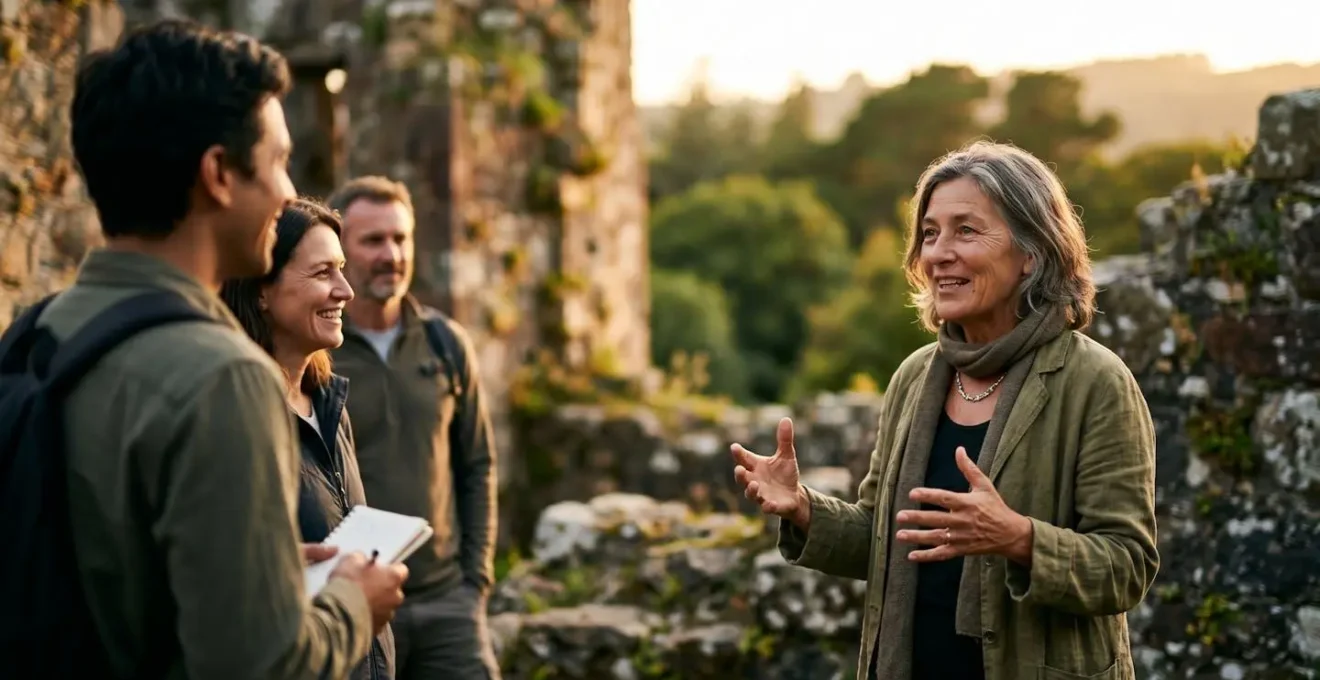
The most memorable historical encounters don’t come from guided tours or audio guides, but from learning how to read the silent stories a place is already telling.
- True engagement is created by actively investigating a site’s material and untold histories, not by passively consuming information.
- Simple contemplative techniques can transform a 20-minute rush into a profound, hours-long connection with the past.
Recommendation: Before your next trip, practice the « historical detective » mindset outlined here to unlock a deeper layer of meaning at any heritage site.
You stand before the weathered stones of an ancient island fortress. A plaque tells you the name, the date, and the king who built it. You read the facts, you take a photo, but you feel… distant. For history enthusiasts, this is a familiar frustration: the gap between knowing about the past and truly feeling connected to it. We travel to these sacred, story-filled places longing for an emotional encounter, a whisper from the ghosts of history, but are often met with the dry silence of academic summaries and crowded tour schedules.
The standard solutions—audio guides, pamphlets, even large group tours—are primarily information delivery systems. They fill our heads with names and dates, but they rarely touch our hearts. They treat heritage sites as a collection of facts to be consumed, rather than as a living stage for the human drama that unfolded there. This approach often leaves us as passive spectators, looking at history through a pane of glass, never truly stepping inside.
But what if the secret to a profound connection isn’t about receiving more information, but about changing how we listen? What if we could learn to read the stories etched into the very stones, landscapes, and silences of a place? This guide is built on that premise. It’s for the traveler who wants to move beyond the plaque and become an active participant in the story. We will explore a framework for transforming your visits, turning you from a tourist into a historical detective, equipped with the tools to decode the past and forge a personal, resonant connection with any island heritage site you encounter.
This journey will equip you with a new way of seeing. We will delve into why narrative engagement surpasses static information, how to conduct your own pre-visit research to uncover hidden stories, and on-site techniques to slow down and listen to what the stones themselves have to say. The following sections offer a comprehensive roadmap to a richer, more meaningful way of experiencing history.
Summary: A Guide to Experiencing Island Heritage Through Story
- Why Do Storytelling Historic Site Tours Create Deeper Engagement Than Audio Guides?
- How to Research Island Historic Site Histories to Enrich Your Visit Experience?
- Preserved Ruins or Reconstructed Historic Sites: Which Offer Better Historical Understanding?
- The Heritage Site Mistake: Rushing Through Historic Locations in 20 Minutes
- When Can You Visit Island Historic Sites During Living History Events and Re-Enactments?
- Why Do UNESCO World Heritage Island Sites Justify Visits Despite Heavy Tourist Traffic?
- Buddhist Temples in Sri Lanka or Hindu Temples in Bali: Which Offer Greater Architectural Diversity?
- Which Island Cultural Sites Offer Genuine Heritage Beyond Tourist-Focused Attractions?
Why Do Storytelling Historic Site Tours Create Deeper Engagement Than Audio Guides?
The conventional wisdom suggests that technology enhances our experience. Audio guides, for instance, are often touted as a modern improvement over simple plaques. Indeed, research from Seneca College demonstrated that audio guide usage can increase a visitor’s session duration by 74%. We stay longer, but are we connecting more deeply? The evidence suggests that the human element of storytelling creates a fundamentally different, and more powerful, kind of engagement that technology struggles to replicate.
The magic lies in a neurological phenomenon called « neural coupling. » A 2023 EEG study published in eNeuro revealed that as a person tells a story, the listener’s brain activity begins to mirror the storyteller’s. This brain-to-brain synchrony means the listener isn’t just processing words; they are vicariously living the emotional and cognitive journey of the narrative. An audio guide delivers information; a human storyteller shares an experience. This creates an emotional resonance and a sense of shared understanding that a pre-recorded, one-way stream of facts simply cannot achieve.
This connection is what transforms a visit. A great guide does more than recite a script; they read the group, adjust their pacing, and use tone and gesture to build suspense and evoke emotion. They are crafting a live performance tailored to their audience. This interactive, human-centered approach moves us from the role of passive data consumer to active participant in a shared historical moment. The goal is not just to learn what happened, but to feel a glimmer of what it was *like* when it happened.
How to Research Island Historic Site Histories to Enrich Your Visit Experience?
The most profound historical encounters begin long before you set foot on the island. Arriving at a site armed with specific stories, characters, and questions transforms you from a passive tourist into an informed investigator. Generic overviews are a start, but the real magic comes from digging deeper into primary sources and marginalized narratives. This detective work allows you to see the « invisible » history—the lives, struggles, and triumphs that are rarely captured on a bronze plaque.
The digital age has made this work more accessible than ever. University archives, museum databases, and specialized historical projects offer a wealth of information that goes far beyond a typical travel guide. Instead of just learning about the castle, you might find the digitized diary of a soldier garrisoned there or the shipping logs that detail the origin of its stones. This process is about collecting narrative threads that you can weave into your on-site experience, turning abstract ruins into a deeply personal landscape populated with real people.
As the Europeana Storytelling Task Force noted in their work on digital heritage, « So much cultural history remains untold. Bringing hidden heritage to light engages audiences and creates a sense of community, identity and shared history. » By doing this research, you are not just enriching your own trip; you are participating in the vital work of remembering a more complete and honest version of the past. The following framework provides a practical starting point for your own historical investigations.
Your Digital Research Plan: Uncovering Hidden Island Histories
- Search university digital humanities archives for primary sources like digitized diaries, ship logs, and letters from the historical period relevant to your island destination.
- Use Google Earth’s historical imagery slider combined with digital naval chart archives to trace the physical evolution of the site and its surrounding landscape over decades.
- Investigate academic databases for papers focusing on marginalized narratives—indigenous populations, enslaved people, women, and laborers whose stories are often absent from official plaques.
- Research the material provenance of the site itself: geological surveys about local stone, clay properties, and construction materials that connect human history to the island’s natural environment.
- Look for hidden heritage in digital platforms by exploring items stuck in museum storage or difficult to access physically, as these often reveal untold stories.
Preserved Ruins or Reconstructed Historic Sites: Which Offer Better Historical Understanding?
A common debate among history lovers is the value of a crumbling, authentic ruin versus a polished, fully reconstructed site. Reconstructions offer a clear, immediate sense of scale and function, making the past feel tangible and easy to understand. However, they risk presenting a single, sanitized, and often conjectural version of history. Preserved ruins, in their beautiful and honest decay, often provide a deeper, more intellectually stimulating experience. They invite questions rather than just providing answers.
Ruins demand more from the visitor. They require imagination, interpretation, and the knowledge you’ve gathered beforehand. They don’t hide the passage of time; they showcase it. A weathered stone tells a story of centuries of wind and rain, a story that is erased by a new coat of plaster. The way a structure has collapsed can be as historically informative as its original design. This layered history is what heritage professionals call a narrative palimpsest—a single place where multiple stories are written on top of each other.
The Isles of Scilly, located off the Cornish coast, exemplify this approach. English Heritage manages a landscape dotted with sites from the Bronze Age to the English Civil War. Their preservation philosophy focuses on maintaining these visible layers. At a site like Bant’s Carn, you see not only the original Bronze Age burial chamber but also the evidence of Victorian-era archaeological work. You are experiencing two histories at once: the ancient one and the story of how we have studied and tried to understand that ancient past. This approach trusts the visitor to appreciate complexity and find beauty in the authentic, incomplete story the ruins tell.
The Heritage Site Mistake: Rushing Through Historic Locations in 20 Minutes
Perhaps the greatest barrier to a meaningful historical experience is our own modern pace. We live in a world of checklists, and it’s easy to treat a trip the same way: « See the castle, take the picture, move on. » A heritage site becomes just another item to tick off. This rushed approach, driven by a fear of missing out on the *next* thing, guarantees we miss out on the very thing we are standing in front of. A profound connection with a place is impossible in 20 minutes. It requires stillness, observation, and a deliberate slowing of time.
The antidote is to practice contemplative engagement. Instead of trying to see everything, choose to experience one thing deeply. This means shifting your focus from the grand and impressive to the small and overlooked. The worn-down threshold that countless feet have crossed, the faint chisel mark left by a mason centuries ago, the specific quality of light falling through an empty window frame—these are the details that hold the most intimate stories. By focusing your attention on a single, mundane element, you open a portal to the human experience behind it.
This is not about meditation in a formal sense, but about using your senses and imagination to build a bridge to the past. The goal is to move from a visual, intellectual appreciation to a full-body, sensory mapping of the place. What does the air smell like near the sea wall? What is the echo like in the chapel? How does the rough stone feel under your fingertips? These techniques create personal, anchor points of memory that will stay with you long after the facts from the plaque have faded.
- Technique 1 – One-Object Meditation: Select a single mundane element (a worn threshold stone, a tool mark, a window view) and spend 20 minutes contemplating who made it, who used it daily, and what transformations it has witnessed.
- Technique 2 – Sensory Mapping Exercise: Find a central spot, close your eyes for five minutes, and catalog every sound, smell, temperature change, and tactile sensation to create a non-visual connection to the place’s atmosphere.
- Technique 3 – Protagonist Role-Play Method: Mentally adopt the persona of a historical figure who lived there (a guard, a cook, a priest, a child) and walk the site asking: What would my daily concerns be? Where would I feel safe or vulnerable?
- Technique 4 – Anti-Tour Path: Deliberately explore in reverse of the suggested route or focus exclusively on ‘in-between’ spaces tourists ignore—drainage channels, boundary walls, weed patches—that tell honest stories of time and decay.
When Can You Visit Island Historic Sites During Living History Events and Re-Enactments?
For those seeking a truly immersive experience, nothing compares to seeing a historic site populated by people, bringing the space to life with the sounds and activities of the past. Living history events and re-enactments can be powerful tools for understanding, but it’s crucial to know the difference and how to find authentic experiences. Many tourist-focused « shows » are more about entertainment than historical accuracy. The most valuable events are often those driven by a deep commitment to education and authenticity.
A key distinction is between « living history » and « re-enactments. » As the Authentic Texas Historical Organization explains, « Living history events seek to convey a sense of the everyday life of a certain period in history in a certain place. In contrast, reenactments seek to follow a plan that re-creates a historical event. » Living history focuses on the mundane and the typical—the smell of bread baking in a period oven, the sound of a blacksmith’s hammer. It’s about process, not just a single event. This focus on daily life often provides a richer, more relatable connection to the people of the past.
So how do you find high-quality events? Research indicates that the most authentic experiences often happen outside of peak tourist season. These are frequently sponsored by local historical societies, museums, or universities, and staffed by dedicated volunteer historians who have spent years researching their specific impression. Their goal is educational accuracy, not just spectacle. Look for events that emphasize hands-on demonstrations and first-person interpretation, where interpreters remain in character. These events are not just shows to be watched; they are temporary worlds to be stepped into, offering the closest we can get to a conversation with the past.
Why Do UNESCO World Heritage Island Sites Justify Visits Despite Heavy Tourist Traffic?
The UNESCO World Heritage seal can be a double-edged sword. It identifies a site of « Outstanding Universal Value, » but it also paints a target for mass tourism. For the history enthusiast who craves quiet contemplation, the prospect of navigating crowds at a famous site can be daunting. Is it worth it? The answer is an emphatic yes. The UNESCO designation is not a mere popularity prize; it is a rigorous certification that the site holds a significance that transcends national and cultural boundaries.
The scale of the program is vast: as of late 2024, UNESCO officially recognizes 1,248 properties across 170 countries. To be inscribed on this list, a site must meet at least one of ten stringent criteria, proving it is a masterpiece of human creative genius, bears exceptional testimony to a cultural tradition, or is an outstanding example of a traditional human settlement, among others. This process is a multi-year, expert-driven evaluation. The label guarantees that you are visiting a place of verified, global importance.
A perfect example is the 2024 inscription of Te Henua Enata (The Marquesas Islands) in French Polynesia. It was designated as a « mixed » site, one of only 41 globally that meet both cultural and natural criteria. The archipelago not only represents an exceptional testimony to a Polynesian civilization from the 11th to the 19th century, but it is also a critical biodiversity hotspot. This dual designation highlights the profound, interwoven relationship between the island’s culture and its environment. While tourism may increase, visiting such a site with an informed perspective allows you to bear witness to a story of human and natural heritage that UNESCO has deemed essential for all of humanity to understand and protect.
Buddhist Temples in Sri Lanka or Hindu Temples in Bali: Which Offer Greater Architectural Diversity?
When exploring the sacred landscapes of Asia’s islands, the question of architectural diversity often arises. Comparing the Buddhist temples of Sri Lanka with the Hindu temples of Bali is not a matter of determining which is « better, » but of understanding how two distinct cultures responded to their unique environments and spiritual needs. Both offer immense diversity, but in fundamentally different ways. Sri Lanka’s diversity is primarily chronological, while Bali’s is functional.
Sri Lankan Buddhist architecture tells a story spanning over two millennia. You can crawl into the ancient, rock-cut cave temples of Dambulla, which date back to the 1st century BCE, and then visit the grand, colonial-era viharas of Kandy. The island’s solid landmass and available rock enabled the creation of massive, solid stupas (dagobas), which are symbolic representations of the enlightened mind, designed for circumambulation and contemplation. The materials—brick, plaster, and stone—reflect the patronage of powerful empires and a centralized religious structure. To visit Sri Lankan temples is to take a journey through time.
Balinese Hindu temples, by contrast, express their diversity through function within a remarkably cohesive architectural style. The island is dotted with thousands of temples, from the great public temples (Pura Kahyangan Jagat) to the clan temples, agricultural temples, and the ubiquitous household shrines. The volcanic landscape provided an easily carved tuff stone, leading to a preference for open-air, multi-courtyard structures designed to be earthquake-resistant. Their core metaphor is the towering, multi-tiered Meru, an aspirational representation of the cosmic mountain, home of the gods. The very material story of perishable thatch and bamboo alongside volcanic stone tells of a community-focused religion centered on constant renewal and ritual.
The following table breaks down these contrasting philosophies, showing how geography and theology were intrinsically linked in shaping these iconic architectural traditions.
| Dimension | Sri Lankan Buddhist Temples | Balinese Hindu Temples |
|---|---|---|
| Type of Diversity | Chronological diversity (ancient cave temples to colonial-era viharas spanning 2,000+ years) | Functional diversity (public, clan, agricultural, household temples within cohesive style) |
| Geography as Destiny | Solid landmass with available rock enabled monolithic stupas and cave temple excavations | Volcanic landscape provided easily-carved tuff favoring open-air multi-courtyard structures resistant to seismic activity |
| Core Architectural Metaphor | Dagoba/Stupa: solid, inward-focused symbol of Buddha’s enlightened mind and path to Nirvana | Meru tower: open, aspirational representation of cosmic mountain and Hindu pantheon’s dwelling |
| Material Story | Brick and stucco construction reflecting imperial patronage and centralized resources | Volcanic stone with perishable thatch/bamboo reflecting community effort and constant ritual renewal |
Key Takeaways
- Storytelling creates « neural coupling, » a measurable brain synchrony that audio guides cannot replicate, leading to deeper emotional engagement.
- The most rewarding experiences come from acting like a « historical detective, » using digital archives and contemplative techniques to uncover untold stories.
- Genuine heritage is often found away from tourist-focused attractions by following local cues like markets, water sources, and un-monetized community sites.
Which Island Cultural Sites Offer Genuine Heritage Beyond Tourist-Focused Attractions?
In a world of curated experiences, the search for « authentic » heritage can feel like a quest for the holy grail. How do we find places that hold genuine meaning for local communities, away from the polished veneer of the tourism industry? The answer often lies in learning to see the cultural landscape through local eyes and recognizing the signs of heritage that haven’t been monetized. It requires a shift in perspective—away from designated « attractions » and towards the living fabric of the island’s culture.
Authentic heritage is often hidden in plain sight. It resides in the bustling local market where vendors have traded for generations, not the one selling souvenirs. It flows along the ancient irrigation channels (like Bali’s Subak system) that are both an engineering marvel and a manifestation of a spiritual worldview. It walks the quiet pilgrimage trails that connect sacred sites of profound local importance, often unmarked on tourist maps. The key indicator is often a lack of commercial infrastructure: no entrance fee, no gift shop, no perfectly manicured lawn. These are the places that are cared for by a community because they matter to their identity, not because they generate revenue.
This is where your skills as a historical detective become paramount. Learning to « read » an island’s cemetery, for example, can be a profound history lesson, revealing migration patterns, social structures, and family stories. Engaging a local market vendor in conversation and respectfully asking about their favorite local spots can unlock doors no guidebook can. These methods are about building connections and showing a genuine interest that goes beyond a transactional tourist encounter.
Historic places create connections to our heritage that help us understand our past, appreciate our triumphs, and learn from our mistakes.
– National Trust for Historic Preservation
The following methods offer a framework for discovering these deeper, more genuine layers of an island’s cultural soul.
- Method 1 – Local Market Litmus Test: Identify authentic markets serving local residents; engage vendors in conversation and ask about their favorite local cultural spots rarely visited by outsiders.
- Method 2 – Follow the Water: Trace local water sources (springs, aqueducts, ancient wells, irrigation channels), which often lead to sacred sites, traditional mills, or community gathering places with deep cultural significance.
- Method 3 – Pilgrimage Trail Research: Investigate local non-touristic pilgrimage routes (religious or secular) that connect sites holding profound meaning for island residents.
- Method 4 – Un-monetized Heritage Indicator: Prioritize sites with no entrance fee, no gift shop, and minimal signage—often community-managed shrines, ancestral homes, or significant natural landmarks.
- Method 5 – Cemetery as Living Archive: Learn to ‘read’ island cemeteries through names, dates, symbols, and epitaphs, providing a direct connection to social history.