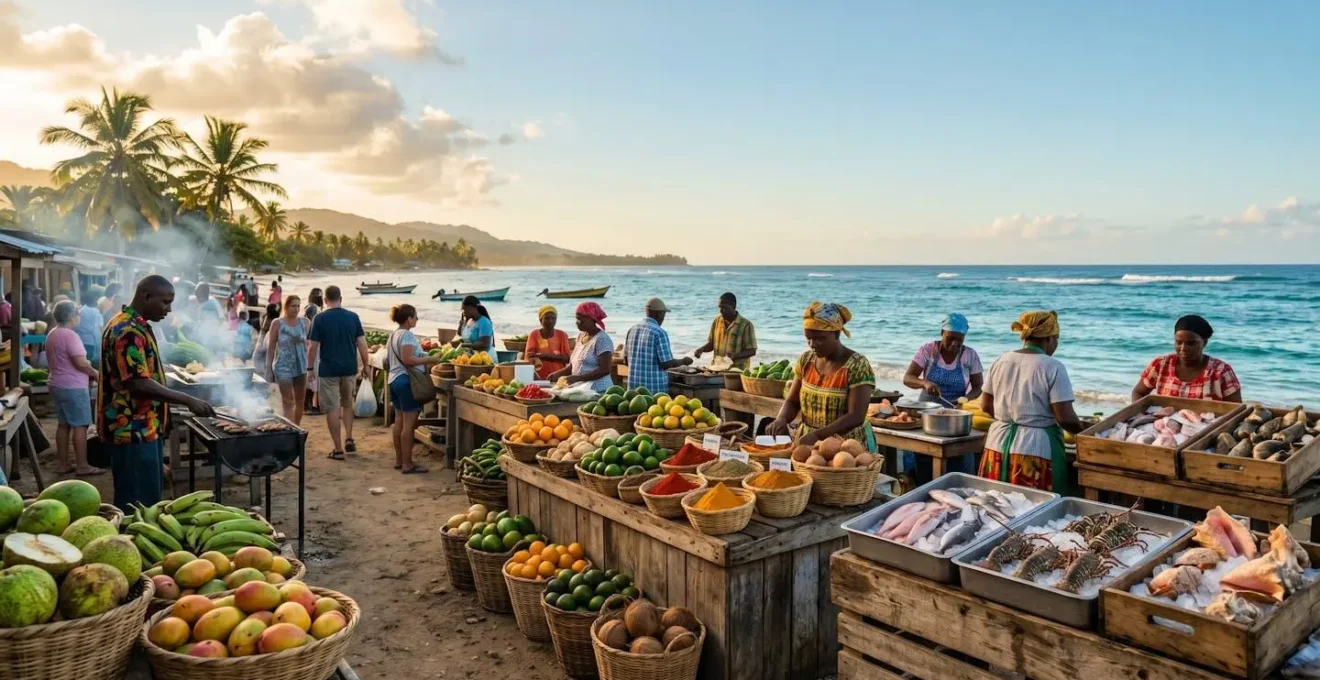
The key to finding authentic island food isn’t a map, but a mindset: you must learn to think and see like a culinary anthropologist.
- Tourist-centric restaurants often intentionally dilute traditional flavours to cater to a broader, less adventurous palate.
- Genuine local spots are identifiable by specific « tells, » such as a high percentage of local diners, menus in the native language, and peak activity during local mealtimes.
Recommendation: Move beyond location-based rules. Instead, focus on decoding the cultural signals, embrace unfamiliar ingredients, and engage respectfully with local foodways to unlock a truly genuine culinary experience.
The scene is painfully familiar. You’ve travelled thousands of miles to a sun-drenched island, dreaming of the vibrant, unique flavours you’ve read about. Yet, you find yourself staring at a laminated menu with pictures, offering the same generic club sandwich, pizza, and « local specialty » that tastes suspiciously bland. This is the great paradox of culinary travel: the more popular a destination becomes, the harder it can be to find the very soul of its cuisine. The food becomes a performance for visitors, a safe and standardized product rather than an expression of culture.
Many guides will offer simple rules: « avoid the main square » or « ask a local. » While not entirely wrong, this advice barely scratches the surface. It fails to address the underlying economic and cultural dynamics at play. The real frustration for a food-focused traveller isn’t just a bad meal; it’s the feeling of being locked out of a genuine experience, of consuming a pale imitation while the real thing is happening just around the corner. To break through this barrier requires more than a different set of directions; it demands a new way of seeing.
This guide abandons those tired platitudes. Instead, it equips you with the mindset of a culinary anthropologist. We will not just tell you where to look, but teach you *how* to look. We’ll delve into why tourist restaurants adapt their flavours, how to decode the subtle clues of an authentic eatery, and when to time your visit to coincide with the island’s own culinary celebrations. The goal is to transform you from a passive consumer into an active, respectful discoverer, capable of finding and appreciating an island’s true taste, one delicious, authentic bite at a time.
This article provides a structured path to mastering the art of culinary discovery. Below, the summary outlines each step of the journey, from understanding the problem to mastering the subtle etiquette of local dining.
Summary: A Culinary Explorer’s Path to Authentic Island Cuisine
- Why Do Island Restaurants Near Tourist Sites Dilute Regional Cuisine Flavours and Techniques?
- How to Spot Restaurants Where Island Locals Actually Eat Instead of Tourists?
- Island Market Food Stalls or Traditional Restaurants: Which Serve More Authentic Regional Cuisine?
- The Culinary Mistake: Avoiding Unfamiliar Island Ingredients That Define Regional Cuisine
- When Can You Visit Islands During Food Festivals Celebrating Regional Culinary Traditions?
- When Should You Reserve Île de Ré Restaurants: How Far in Advance for Peak Season?
- Spanish Balearic Islands or Greek Cyclades: Which for Richer Cultural Immersion?
- How to Learn Island-Specific Customs Before Arriving to Avoid Embarrassing Mistakes?
Why Do Island Restaurants Near Tourist Sites Dilute Regional Cuisine Flavours and Techniques?
The phenomenon of bland, uninspired food in high-traffic tourist areas is not an accident; it’s a calculated business decision driven by economics and risk aversion. Restaurants in prime locations face immense pressure to appeal to the widest possible audience. This often means engaging in a form of « culinary code-switching, » where complex, bold, or unfamiliar flavours are toned down to suit a perceived international palate. Strong spices, pungent fermented ingredients, and intense bitter or sour notes—hallmarks of many traditional cuisines—are often the first casualties. The goal shifts from showcasing regional identity to maximizing turnover and minimizing complaints from less adventurous eaters.
This dilution is confirmed by academic observation. According to research from the University of Central Florida, restaurants may begin to refrain from serving local cuisine and instead standardize menus to cater to tourist expectations. This creates a feedback loop: tourists frequent these accessible restaurants, reinforcing the financial incentive for owners to offer homogenized, predictable fare. The supply chain also plays a critical role. To ensure consistency and manage costs, these establishments often rely on large, year-round suppliers rather than sourcing seasonal ingredients from small local producers. This severs the vital link between the food, the land, and the time of year, which is the very essence of authentic island cooking.
Case Study: The Standardization of Tourist Food in China
An analysis of restaurant practices in China by China Highlights provides a clear example of this process. Tourist-focused restaurants are known to mass-purchase ingredients and standardize dishes to appeal to a broad audience. The result is a consistent but generic taste profile across many establishments. Consequently, local Chinese who appreciate authentic regional complexity actively avoid these places, noting that the dishes « all taste the same » and lack the character found in neighbourhood restaurants that cater to a local clientele.
Ultimately, a restaurant catering to a transient tourist population has little incentive to build the long-term loyalty that comes from uncompromising quality and authenticity. Their business model is based on location and volume, not on becoming a cherished community institution. Understanding this economic reality is the first step in learning to look past the polished facades and find the kitchens where tradition is still revered.
How to Spot Restaurants Where Island Locals Actually Eat Instead of Tourists?
Identifying a truly local restaurant is an exercise in observation, a form of culinary anthropology where you learn to read the subtle signals that separate a community hub from a tourist trap. The most powerful indicator is, unsurprisingly, the clientele. A restaurant’s authenticity is directly proportional to its local patronage. While there’s no perfect formula, some dining authenticity research suggests that a ratio of 60-80% local diners is a strong sign of a genuine establishment. This means listening for the dominant language being spoken and observing the interactions between staff and customers; a sense of familiar community is hard to fake.
Beyond the crowd, several « local tells » can guide your search. These clues require you to engage your senses and step just slightly off the beaten path:
- The Time of Day Test: Local mealtimes are a crucial clue. In many European islands, residents eat dinner well after 8 PM. A restaurant bustling with local-language speakers at 9 PM is a far more promising sign than one filled with tourists at 6 PM.
- Strategic Location: Move a few blocks away from major tourist attractions. Restaurants that can’t rely on foot traffic from landmarks must survive on quality and repeat business from residents. Eateries near office buildings are often excellent choices for an authentic lunch.
- Menu Analysis: Look for menus written primarily or exclusively in the local language, with few or no pictures. A simple, often single-page, handwritten or typed menu suggests a focus on seasonal dishes rather than a static, tourist-oriented offering.
- Facade Assessment: Don’t be deterred by an unassuming exterior. Some of the best local spots have been around for decades and prioritize their food over trendy decor. A slightly dated or modest facade can be a sign that their reputation is built on what comes out of the kitchen.
- Ask Non-Hospitality Locals: For an unbiased recommendation, ask people who have no vested interest in the tourist economy. Barbers, hardware store clerks, or taxi drivers are often excellent sources for finding the best, no-frills local food.
This next image perfectly captures the atmosphere you should be looking for: a bustling, unpretentious space filled with local workers enjoying their midday meal. It is a visual representation of an eatery that serves its community first and foremost.
These observational techniques transform the search from a game of chance into a deliberate, rewarding investigation. By learning to spot these signs, you empower yourself to bypass the performance and find the places where the island’s true culinary heart beats.
Island Market Food Stalls or Traditional Restaurants: Which Serve More Authentic Regional Cuisine?
The debate between market stalls and traditional restaurants is not about which is « more » authentic, but about understanding that they offer different *types* of authenticity. The choice between them depends entirely on the culinary experience you seek. Both are essential components of an island’s food ecosystem, serving distinct purposes for the local community.
Food stalls within a bustling local market offer an authenticity of immediacy and specialization. Here, the connection to the raw ingredient is paramount. You are often eating food prepared by vendors who may have grown, caught, or raised the primary component themselves. The menus are hyper-focused, with a vendor often perfecting just one or two dishes over generations. This is where you find the unfiltered, everyday food of the people: a quick lunch, a working-person’s snack, a taste of something incredibly fresh and seasonal. The experience is direct, unpretentious, and often a boisterous, sensory immersion. The trade-off is typically comfort and complexity; the dishes are designed for speed and simplicity, and seating is often limited or communal.
Traditional, family-run restaurants, on the other hand, provide an authenticity of craft and occasion. These establishments are the custodians of more complex recipes and cooking techniques that require time, specialized equipment, and a proper kitchen. This is where you will find the slow-braised stews, the intricate seafood preparations, and the ceremonial dishes that define an island’s culinary heritage. The restaurant setting allows for a more complete dining experience—a slower pace, a focus on shared meals, and the social rituals that surround food in that culture. The risk, as discussed, is that some restaurants may fall on the « authenticity spectrum » closer to a tourist-facing model, but the best ones serve as vital community anchors and libraries of culinary tradition.
Ultimately, a savvy culinary explorer doesn’t choose one over the other. You visit the market in the morning to understand the island’s raw ingredients and enjoy a simple, vibrant lunch. You then seek out a recommended traditional restaurant for dinner to experience how those same ingredients are transformed through the art of local gastronomy. They are two sides of the same coin, and experiencing both provides a far richer and more complete picture of the island’s food culture.
The Culinary Mistake: Avoiding Unfamiliar Island Ingredients That Define Regional Cuisine
One of the greatest barriers to a truly authentic culinary experience is our own hesitation. We scan a menu and our eyes naturally gravitate towards the familiar—chicken, beef, fish—while gliding past the words we don’t recognize: breadfruit, callaloo, uni, or taro. To avoid these ingredients is to miss the very essence of a place. An island’s cuisine is defined by its unique pantry, the native plants and sea life that have sustained its people for centuries. To truly understand the food, you must be willing to taste it on its own terms.
Of course, diving headfirst into the most exotic item can be intimidating. The key is to employ an « Ingredient Gateway » strategy, easing your palate from the familiar to the more adventurous. This approach builds confidence and context, making the journey of discovery more enjoyable. This isn’t about forcing yourself to eat something you dislike; it’s about giving your palate a fair chance to connect with a new world of flavour. The visual richness and unique textures of these ingredients, as seen in the image below, are a prelude to their taste.
Instead of avoidance, adopt a strategy of curiosity and gradual exploration. Here are some ways to approach unfamiliar ingredients:
- Caribbean Gateway: Start with plantains. Their banana-like flavour, sweet when ripe (maduros) and savory when green (tostones), provides a comfortable entry point before trying more unique starches like cassava or yams.
- Mediterranean Islands Gateway: Try fresh sea urchin (uni). Often served simply with pasta or bread, its creamy, oceanic flavour is a direct taste of the local sea, preparing you for more complex seafood like salted or cured fish.
- Southeast Asian Islands Gateway: Begin with a coconut milk-based dish like Tahitian poisson cru. The familiar, rich coconut milk softens the experience of trying raw fish, a staple preparation in the region.
- Apply the « One Bite Rule »: Commit to one proper taste before making a judgment. Many ingredients that seem intimidating, from fermented fish sauce to unique tubers, reveal their beloved qualities after the initial hesitation.
- Use the ‘Strategic Server Inquiry’: Don’t just ask « what’s good? » Ask a more targeted question: « What is the most traditional dish that visitors rarely order? » or « Which ingredient is most unique to this island? » This signals your genuine interest and turns your server into a culinary guide.
By embracing this mindset, an unfamiliar menu transforms from a minefield of uncertainty into a map of delicious possibilities. Every unknown ingredient becomes an invitation to deepen your understanding of the island’s culture and environment.
When Can You Visit Islands During Food Festivals Celebrating Regional Culinary Traditions?
One of the most effective strategies for immersing yourself in an island’s food culture is to time your visit with a local food festival. These events are living expressions of culinary heritage, offering unparalleled access to seasonal ingredients, traditional dishes, and the community that celebrates them. Unlike a standard restaurant meal, a festival provides context, connecting the food to harvest cycles, religious observances, or cultural milestones. It’s an opportunity to see a cuisine in its most vibrant and concentrated form, enjoyed by the very people who created it.
Many islands have strategically developed their festival calendars to attract culinary tourists, providing a structured way to experience their best offerings. These events often focus on a signature ingredient at its absolute peak, from mango and breadfruit festivals in the Caribbean to shellfish and oyster celebrations in more temperate climates.
Case Study: Prince Edward Island’s Autumn Food Festival Calendar
Prince Edward Island, marketed as « Canada’s Food Island, » provides an excellent model. It hosts a series of back-to-back autumn festivals designed to showcase its harvest. The calendar includes events like the PEI Shellfish Festival and the Fall Flavours Festival. These festivals celebrate world-class seafood and farm-fresh produce, giving both locals and visitors direct access to regional ingredients at their peak and fostering interaction with the island’s top chefs and producers.
However, navigating a food festival requires its own strategy to separate the authentic from the purely commercial. Not all stalls or events are created equal, and applying a critical eye will lead you to the most genuine experiences.
Action Plan: Navigating a Food Festival for Authenticity
- Categorize and Target: Before you go, research the festival’s nature. Is it a Harvest Festival (focused on peak-season ingredients), a Cultural Feast (serving symbolic dishes), or a Modern Chef-Driven Event (showcasing innovation)? Target the type that aligns with your goal for authenticity.
- Time Your Arrival: Arrive early in the day, typically between 7 AM and 10 AM. This is when locals often do their shopping and eating, and vendors have their full, fresh inventory before the main tourist crowds descend.
- Follow the Local Line: Your most reliable guide is the crowd. Seek out the stalls with the longest lines of people speaking the local language. These are often the family-run, highly specialized vendors with a loyal community following.
- Inquire About Symbolism: At cultural or religious festivals, many dishes carry deep meaning. Politely ask the vendor about the story behind the food. Understanding its significance (e.g., for prosperity, remembrance) elevates the experience from consumption to cultural participation.
- Assess the ‘Authenticity Spectrum’: Learn to distinguish between community-serving vendors and those performing for tourists. The latter often have generic food, higher prices, and elaborate, multilingual signs. The former are usually more specialized, affordable, and focused on the food itself.
By treating a food festival as a destination in itself, you gain a powerful lens through which to view and taste the heart of an island’s culture.
When Should You Reserve Île de Ré Restaurants: How Far in Advance for Peak Season?
On seasonal islands with a global reputation for gastronomy, such as France’s Île de Ré, Nantucket in the US, or Spain’s Formentera, securing a table at a top restaurant during peak season is a competitive sport. The demand from discerning travellers, coupled with a limited supply of high-quality establishments, creates a booking frenzy. This is especially true as the World Food Travel Association estimates that 81% of international tourists want to explore local cuisine, and they are willing to dedicate a significant portion of their budget to do so. For these sought-after destinations, spontaneity is a luxury you often can’t afford.
For islands with a short, intense peak season (typically July and August), the booking window for high-demand restaurants opens months, not weeks, in advance. A proactive and flexible approach is essential to avoid disappointment. Relying on walking in or booking a day before will likely leave you with only the most mediocre, tourist-focused options. Planning your key dining experiences should be as integral to your trip preparation as booking flights and accommodation.
Here is a strategic approach to securing those coveted reservations:
- Book Months in Advance: For the most celebrated restaurants on seasonal islands like Île de Ré, St. Barts, or Sylt, you must book 2-3 months in advance for peak season reservations. Set a calendar reminder for when booking windows open.
- Use the Telephone: Don’t rely solely on online booking platforms, which may not show full availability. A direct phone call to the restaurant, ideally during off-peak hours (e.g., 4 PM local time), can often reveal cancellations or unlisted tables.
- Be Flexible with Times: When you call or book, explicitly state that you are flexible. Offering to take « the first table » (around 6 PM) or « the last table » (after 9:30 PM) dramatically increases your chances of getting a spot.
- Leverage the Concierge In-Person: A good hotel concierge can be invaluable, but an email request is easily ignored. Upon arrival, speak with them in person. Explaining your culinary interests and passion can motivate them to use their personal contacts to secure a difficult reservation.
- Create a Balanced Itinerary: Don’t overschedule. Secure reservations for 2-3 « must-try » high-end restaurants well in advance, but leave at least 50% of your meals open for spontaneous discoveries at local bistros, markets, and no-reservation spots you’ll uncover using the observational skills discussed earlier.
This balanced strategy ensures you experience the pinnacle of the island’s fine dining scene while still leaving room for the joy of authentic, unplanned culinary discovery.
Spanish Balearic Islands or Greek Cyclades: Which for Richer Cultural Immersion?
Choosing between two iconic Mediterranean archipelagos like the Spanish Balearics and the Greek Cyclades for cultural immersion is a delightful challenge, as both offer profound experiences rooted in ancient history. The « richer » destination depends entirely on the type of cultural and culinary philosophy you wish to explore. While both share a devotion to the sea and sun, their approaches to food, socialization, and daily rhythm diverge significantly. As one piece of academic research on traditional restaurants in PLOS One notes, these establishments are crucial as they « revitalize the production of local ingredients, the taste of the regional cuisine, the gastronomic tradition and the consumers’ dining experience. »
Traditional restaurants revitalize the production of local ingredients, the taste of the regional cuisine, the gastronomic tradition and the consumers’ dining experience.
– Academic research on traditional restaurants, PLOS One: The role of traditional restaurants in tourist destination loyalty
The Balearic Islands (Ibiza, Mallorca, Menorca, Formentera) present a rich, layered tapestry of influences. Their cuisine reflects a history of Catalan, Moorish, and mainland Spanish contact, resulting in complex flavour profiles. The concept of ‘mar i muntanya’ (sea and mountain) brings seafood and inland produce together in a single dish. The culture is energetic, with late dinners (often after 10 PM), a vibrant tapas and pintxos scene, and bustling indoor market halls like Palma’s Mercat de l’Olivar. For deeper authenticity, islands like Menorca, with its agroturismos and famous caldereta de langosta (lobster stew), offer a quieter, more agrarian cultural immersion.
The Greek Cyclades (Santorini, Mykonos, Naxos, Sifnos) champion a more minimalist philosophy. Here, the purity of the ingredient is king. The culture revolves around the family-run taverna, the ritual of sharing ‘meze’ with ouzo, and a slower, more contemplative pace of life. Cooking techniques are often simpler—grilling, sun-drying, pickling—designed to elevate the natural flavour of hyper-local cheeses, vegetables, and impeccably fresh seafood. For a richer experience, islands like Sifnos, known as the birthplace of modern Greek chefs, or Folegandros, with its traditional matsata pasta, offer a profound connection to timeless Hellenic foodways.
The following table breaks down these distinct culinary and cultural philosophies to help guide your choice.
| Culinary Aspect | Spanish Balearic Islands | Greek Cyclades |
|---|---|---|
| Core Food Philosophy | Rich tapestry: Catalan, Moorish, mainland Spanish influences (‘mar i muntanya’ – sea and mountain) | Minimalist philosophy: purity of ingredient (hyper-local cheese, sun-dried vegetables, fresh seafood) |
| Food Socialization Culture | Late dinners (10 PM+), shared tapas/pintxos, vibrant market halls (Mercat de l’Olivar, Santa Catalina) | Family-run taverna culture, importance of ‘meze’ with ouzo, slower pace of shared meals, outdoor dining |
| Signature Techniques | Complex spice blends, saffron-based dishes, sobrasada (cured sausage), ensaimadas (pastry) | Simplicity: grilling, sun-drying, pickling, fava purées, traditional cheese-making (Naxos graviera) |
| Lesser-Known Islands for Authenticity | Menorca (agroturismos, Mahón cheese, caldereta de langosta), Formentera (traditional fishing culture, simple grills) | Sifnos (birthplace of notable Greek chefs, chickpea dishes), Folegandros (matsata pasta, local wine) |
| Dining Pace | Energetic, multiple courses, social and late-night oriented | Contemplative, fewer courses, emphasis on conversation and relaxation |
| Wine & Spirits Culture | Local wines (Binissalem, Pla i Llevant), hierbas ibicencas (herb liqueur) | Local wines (Santorini Assyrtiko, Naxos), ouzo ritual, raki |
Key Takeaways
- Authentic food is often hidden due to economic pressures on restaurants in tourist areas to standardize their menus.
- Finding genuine local eateries is a skill of observation, requiring you to decode signals like clientele, mealtimes, and menu language.
- True culinary immersion involves embracing unfamiliar ingredients and understanding the cultural etiquette surrounding food.
How to Learn Island-Specific Customs Before Arriving to Avoid Embarrassing Mistakes?
The final and most profound step in your journey as a culinary anthropologist is understanding and respecting local dining etiquette. Food is never just fuel; it’s a language, a ritual, and a cornerstone of social interaction. Arriving with a basic understanding of an island’s customs demonstrates respect and opens doors to a more genuine experience. Ignoring them, even unintentionally, can create awkwardness or cause offense, marking you as just another oblivious tourist. A small amount of pre-trip research is an investment that pays immense dividends in cultural connection.
This research goes beyond learning to say « please » and « thank you. » It involves understanding the unspoken rules that govern the table. Many of these customs are tied to deeply held cultural values about community, generosity, and respect for elders or tradition. Your effort to learn them will not go unnoticed and can transform a simple meal into a moment of shared humanity.
Here are essential methods for researching and understanding island-specific culinary etiquette:
- Master Tipping Customs: This varies wildly. Research if a service charge is already included (common in many Mediterranean islands) or if a tip is expected (standard in the Caribbean). In places where it’s included, rounding up the bill is a common gesture of appreciation.
- Understand Dish-Sharing Protocols: In many cultures, particularly in Greece, Southeast Asia, and parts of Spain, ordering multiple dishes for the table to share is the norm. Ordering an individual entrée for yourself can seem isolating or even a bit selfish. Observe how local families eat.
- Learn the Role of Post-Meal Beverages: A coffee or digestif is often not an optional add-on but an integral part of the dining ritual. Rushing this process can be seen as rude. Understand the social importance of a slow-sipped Greek coffee, an Italian amaro, or a Caribbean rum.
- Research Toasting Etiquette: Simple gestures carry weight. Making eye contact during a toast is crucial in many European cultures. Learn the local word for « cheers » (‘Yamas’ in Greece, ‘Salut’ in French islands) and be aware of customs like never toasting with water.
- Practice ‘Digital Anthropology’: A few weeks before your trip, follow local food bloggers, chefs, and popular restaurants from your destination on social media. Observe not just what they eat, but how they eat—the timing, the combinations of dishes, the social setting.
- Respect ‘The Sacredness of the Dish’: Signature national or regional dishes carry the weight of cultural identity. Never request inappropriate modifications (like adding ketchup to a traditional pasta or jerk chicken) or dismiss a dish without trying it. It’s more than food; it’s heritage.
By internalizing these customs, you move beyond being a mere spectator. You become a respectful participant in the island’s culture, earning the warmth and authenticity you traveled so far to find.
Your journey to find authentic island cuisine is now equipped with a new framework. By acting as a respectful observer, asking curious questions, and bravely tasting the unfamiliar, you unlock the true, vibrant soul of a place. The most memorable meals are not just about what’s on the plate, but about the stories, traditions, and human connections they represent.