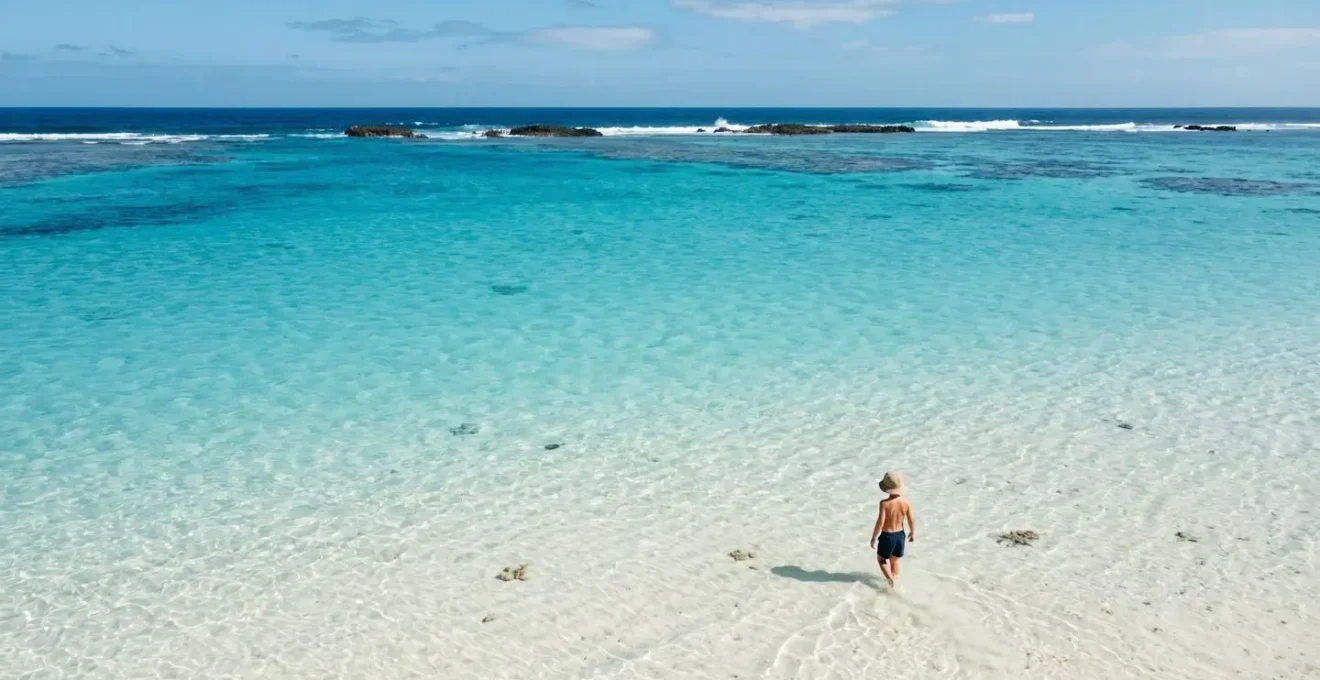
True lagoon safety for young children is less about a specific destination and more about a parent’s ability to assess the environment like an expert.
- The calmest, clearest lagoons are created by specific geological shields—like barrier reefs or limestone seabeds—that prevent open-ocean waves and keep sediment from clouding the water.
- Empowering yourself with a simple 5-minute safety scan to check for reef breaks, surface texture, and tidal flows is more reliable than just trusting a travel brochure.
Recommendation: Instead of just searching for the « perfect » island, focus on learning the key environmental signals that guarantee a safe and serene water experience for your toddlers.
The image is a powerful one for any parent: your young child, laughing and splashing in a shimmering, turquoise lagoon so calm it looks like glass. It’s the dream that fuels countless family vacation searches. But beneath this idyllic picture often lies a current of parental anxiety. Is the water truly as safe as it looks? Are there hidden currents? What about unseen hazards on the seafloor? The search for the perfect family-friendly island is, at its core, a search for peace of mind.
Many guides will offer simple lists of destinations, promising « calm waters » and « gentle waves. » But as a family beach safety consultant, I can tell you that genuine safety isn’t found in a brochure’s description—it’s found in understanding the environment. The key isn’t just knowing *where* to go, but knowing *why* a place is safe and *how* to verify it for yourself. True security comes from developing a degree of « safety literacy » regarding coastal environments.
This guide is designed to equip you with that knowledge. We’ll move beyond simple lists and delve into the science that creates these pristine environments. We will explore the geological differences that make Caribbean waters exceptionally clear, teach you how to perform a quick but effective safety scan of any lagoon, and address the specific risks, like coral cuts, that are often overlooked. By the end, you won’t just have a list of potential islands; you’ll have the confidence and expertise to make the safest choice for your family, wherever you go.
To navigate this crucial topic, this article breaks down the essential elements of lagoon safety, from understanding the water’s color to identifying the right snorkeling spots for beginners.
Summary: Your Guide to Finding Child-Safe Turquoise Lagoons
- Why Are Some Island Lagoons Crystal Turquoise Whilst Others Are Murky Brown?
- How to Identify Whether a Turquoise Lagoon Is Safe for Swimming or Has Hidden Currents?
- Barrier Reef Lagoon or Volcanic Crater Lagoon: Which Offers Better Snorkelling for Beginners?
- The Lagoon Wading Mistake That Causes Coral Cuts Leading to Infections
- When Are Turquoise Lagoons Clearest for Underwater Photography: Seasonal and Tidal Patterns?
- Why Are Caribbean Waters Clearer Than the Mediterranean Despite Similar Warm Climates?
- How to Snorkel Coral Reefs Without Damaging Them: Buoyancy and Reef-Safe Sunscreen?
- Which Islands Have the Clearest Waters for Snorkelling: Visibility Beyond 30 Metres?
Why Are Some Island Lagoons Crystal Turquoise Whilst Others Are Murky Brown?
The iconic turquoise hue of a perfect family lagoon is not just an aesthetic bonus; it’s a direct indicator of water quality and composition, which are fundamental to safety. A lagoon’s clarity is your first and most important safety tool, allowing you to easily gauge depth, spot potential hazards on the seafloor, and keep a constant, clear view of your child. The color itself comes from sunlight reflecting off a bright, sandy bottom in shallow, clean water.
The primary factor determining this clarity is geology. As a case study reveals, the Caribbean seabed is predominantly composed of calcium carbonate from coral and mollusc remains. This ‘sand’ is heavy and settles quickly, unlike the fine silt or mud found in areas with significant river runoff, which stays suspended and makes the water murky. This stable composition means that even if the water is disturbed, it clears rapidly, maintaining the visibility that is crucial for parental supervision.
This natural clarity is also a sign of a healthy ecosystem. For coral reefs to thrive, they require extremely clear water to allow sunlight to penetrate. In fact, a minimum of 10-15 m of Secchi depth visibility is considered a benchmark for healthy reef ecosystems. When you find water this clear, you’re not just looking at a pretty scene; you’re looking at a stable, low-sediment environment, which is inherently safer for a child’s first ocean adventures.
How to Identify Whether a Turquoise Lagoon Is Safe for Swimming or Has Hidden Currents?
While a turquoise lagoon is a promising start, its beautiful appearance can sometimes mask hidden dangers like subtle currents. Developing your « safety literacy » means learning to perform a quick, systematic check before your family even touches the water. It’s a simple habit that provides immense peace of mind. As a parent, your primary tool is observation. Take a few minutes to stand at the water’s edge and actively scan the environment, looking for clues that reveal how the water is behaving.
The goal is to identify the « no-wave zone »—the most protected part of the lagoon where the water is calmest and safest. This zone is typically created by a natural barrier, like an outer reef, that absorbs the energy of the open ocean. By understanding what to look for, you can confidently guide your children to the most secure spot. The following checklist formalizes this observation process into a reliable, repeatable routine.
Your 5-Minute Lagoon Safety Scan:
- Look for breaks in the outer reef barrier where water channels out, creating potential currents—avoid these exit points.
- Observe the water surface texture—glassy and calm indicates protected conditions; rippled or choppy suggests wind or current.
- Identify the no-wave zone created by the protective barrier reef—this indicates the safest swimming area.
- Check for shallow sandy flats with a visible bottom—clear visibility of the seafloor means you can monitor depth and footing.
- Ask local staff specific questions: ‘Where do tides flow?’ ‘Are there stonefish or urchins?’ ‘Which spot stays calm when the wind picks up?’
Barrier Reef Lagoon or Volcanic Crater Lagoon: Which Offers Better Snorkelling for Beginners?
Once you’ve identified a generally safe island, you’ll often face a choice between two common types of protected lagoons: those formed by a barrier reef and those formed within a volcanic crater. Both can offer calm, turquoise water, but they provide distinctly different experiences, especially for young children and beginner snorkelers. Understanding the difference helps you match the destination to your family’s specific age, skill, and confidence level.
Barrier reef lagoons, like those in the Maldives or the Cook Islands, are typically characterized by vast expanses of shallow, sandy-bottomed water. Volcanic crater lagoons, such as Hawaii’s famous Hanauma Bay, are often deeper and have a quicker drop-off. The following comparison breaks down the key features for a family considering their first snorkeling trip.
| Feature | Barrier Reef Lagoon (e.g., Cook Islands, Maldives) | Volcanic Crater Lagoon (e.g., Hanauma Bay, Hawaii) |
|---|---|---|
| Water Depth | Vast shallow areas, often knee-deep for 50+ meters | Quicker drop-offs, depth increases rapidly |
| Entry Type | Gradual sandy slope, toddler-friendly | Steeper entry, requires confident swimming |
| Fish Visibility | Colorful fish venture into ankle-deep flats | Abundant marine life but in deeper zones |
| Best Age Group | Ages 1-5 (first-time mask wearers) | Ages 6+ (confident swimmers) |
| Current Risk | Minimal, protected by outer reef barrier | Moderate, depends on tidal flow through crater opening |
| Confidence Building | Excellent—children see fish without full snorkel gear | Moderate—requires swimming ability first |
For families with toddlers and preschoolers (ages 1-5), a barrier reef lagoon is almost always the superior choice. The ability to sit and play in ankle-deep water while colorful fish swim by is an unparalleled confidence-builder. Volcanic craters become a better option for older children (ages 6+) who are already confident swimmers and ready for a more immersive, deeper-water snorkeling adventure.
The Lagoon Wading Mistake That Causes Coral Cuts Leading to Infections
One of the most common and preventable injuries in a tropical lagoon environment is the coral cut. The mistake is simple: wading barefoot across what appears to be a sandy bottom. Even in the calmest lagoons, the seafloor is often littered with small, sharp fragments of coral rubble. A seemingly minor scrape from this living organism can introduce bacteria and foreign proteins into the wound, leading to painful infections and prolonged healing times that can disrupt a vacation.
The severity of these injuries should not be underestimated. According to medical research from the Divers Alert Network, even minor coral scrapes can take weeks to months to heal fully if not treated properly. The single most effective preventative measure is also the simplest: never allow anyone in your family to walk barefoot in a lagoon. A good pair of closed-toe water shoes or neoprene booties provides an essential protective barrier, turning a potentially dangerous misstep into a non-event.
Despite best precautions, accidents can happen. Being prepared with a basic first-aid kit is a crucial part of your role as a family safety lead. Your kit should be specifically tailored for treating coral cuts, as standard bandages are often inadequate. Here are the essentials:
- Antiseptic wipes (sting-free formulation for children) to clean wounds immediately
- A small bottle of clean fresh water (not seawater) for thorough wound flushing
- Waterproof dressings or adhesive strips to seal cuts while allowing drainage
- A tube of topical antibiotic ointment (like bacitracin) to apply 3-4 times daily
- Betadine solution diluted with water for deep cleaning of stubborn wounds
- Instructions to seek medical attention if redness spreads, pus develops, or the wound shows no improvement after 48 hours
When Are Turquoise Lagoons Clearest for Underwater Photography: Seasonal and Tidal Patterns?
Capturing that perfect photo of your child’s first magical encounter with tropical fish is a treasured goal for many families. To achieve this, timing is everything. The clarity of a lagoon’s water is not static; it’s a dynamic system influenced by seasons and, more immediately, by tides. Understanding these patterns allows you to plan your beach time to coincide with moments of maximum visibility and calm.
The most critical factor for day-to-day clarity is the tide. The clearest conditions are found during slack tide—the brief period (usually around 30-60 minutes) at the peak of high tide or the bottom of low tide when water movement ceases. During slack tide, no tidal currents are actively stirring up sand or sediment from the bottom. The water becomes exceptionally still and clear, creating gin-clear visibility perfect for underwater photos. For families, combining this with a mid-morning window (9-11 am) often creates the ideal scenario: the sun is high enough to make the water sparkle, but the crowds are low and toddlers are at their best.
On a broader scale, seasonality also plays a significant role. As noted by travel experts focusing on regional patterns, the water is often at its clearest during the dry season. For the Caribbean, as one guide points out, « The dry season from December through April typically offers the clearest water conditions, » primarily due to reduced rainfall and runoff from the land. Planning your trip during these months can significantly increase your chances of experiencing those postcard-perfect conditions.
Why Are Caribbean Waters Clearer Than the Mediterranean Despite Similar Warm Climates?
For families seeking the ultimate clear-water experience, the Caribbean consistently outperforms many other beautiful destinations, including the Mediterranean. While both regions boast warm climates and inviting seas, the difference in water clarity is stark, and it comes down to two fundamental environmental factors: geology and tides. Understanding this distinction reinforces why the Caribbean is so often the gold standard for safe, family-friendly lagoons.
The first and most important factor is the composition of the seabed. The Caribbean basin is built on a limestone platform, meaning its « sand » is primarily pulverized coral (calcium carbonate). These particles are relatively large and heavy, so they settle quickly after being disturbed. In contrast, the Mediterranean is a geologically older sea that is fed by numerous major rivers carrying fine, lightweight sediment. This sediment remains suspended in the water column for longer, scattering sunlight and significantly reducing clarity. For a parent, this means Caribbean lagoons offer more predictable visibility, a key safety feature.
The second factor is the tidal range. As family travel safety experts highlight, « The Caribbean is largely micro-tidal with small differences between high and low tide, creating predictable shallow beaches. » This minimal tidal fluctuation means the shoreline remains relatively stable and predictable throughout the day. You can set up your beach spot with confidence, knowing that the water’s edge won’t dramatically recede or advance, which is a major advantage when supervising small children who are fascinated by the water’s edge.
How to Snorkel Coral Reefs Without Damaging Them: Buoyancy and Reef-Safe Sunscreen?
Introducing your children to the vibrant world of a coral reef is a magical experience, but it comes with a profound responsibility to protect the fragile ecosystem they are exploring. As a safety consultant, this extends to the safety of the reef itself. The two biggest threats posed by snorkelers are physical damage from poor buoyancy control and chemical damage from sunscreen. Teaching your children reef-safe practices from their very first snorkel is a critical lesson in environmental stewardship.
The most important physical skill is buoyancy control. The goal is to float horizontally on the surface, observing the reef from above without ever touching it. Frantic kicking and vertical-standing motions are the primary causes of accidental coral breakage. You can build these skills before you even leave home.
- Practice floating motionless in a pool with a mask on to build core buoyancy skills in a controlled environment.
- Teach the « Lazy Starfish » technique: floating horizontally and using slow, small hand movements instead of big kicks.
- Gamify reef protection by challenging kids to avoid touching the « fish’s house » (coral).
- Ensure you maintain a horizontal body position and only use fins gently when in deeper water, well away from the reef.
Equally important is chemical protection. Common sunscreens contain chemicals like oxybenzone and octinoxate that are devastating to coral reefs. Always choose a « reef-safe » sunscreen that uses non-nano zinc oxide or titanium dioxide as its active ingredient. Timing is also crucial; as reef conservation experts recommend, sunscreen should be applied at least 30 minutes before entering the water. This allows it to bind to the skin so it doesn’t wash off immediately into the marine environment.
Key Takeaways
- True water safety for children comes from a parent’s ability to assess the environment, not just from picking a location off a list.
- The safest lagoons are geologically protected by barrier reefs or limestone seabeds, creating calm, clear conditions where visibility is your best safety tool.
- Proactive prevention, such as using a 5-minute safety scan before swimming and always wearing water shoes, is more effective than reacting to hazards.
Which Islands Have the Clearest Waters for Snorkelling: Visibility Beyond 30 Metres?
We arrive back at the central question, but with a new, more educated perspective. The impulse is to seek out islands famed for « the clearest water, » often defined by divers as visibility exceeding 30 metres. However, as a family beach safety consultant, I must be clear: for families with young children, this is the wrong goal. Extreme visibility is typically found in deep, open water—the exact opposite of the shallow, protected, and predictably calm environment a toddler needs.
The right question is not « Which island has the clearest water? » but rather, « Which island has the *right kind of clear water* for my child’s age and ability? » The answer lies in a tiered approach, matching the environment to your family’s developmental stage. Rather than a single destination, think of it as a family clarity roadmap.
A Family-Focused Clarity Roadmap
Instead of chasing absolute visibility, select destinations based on age-appropriate conditions. Level 1 (Ages 1-4): The goal is safe, shallow, sandy-bottomed water. The Exumas in the Bahamas, with their vast, ankle-deep crystal-clear sandbars, are a perfect example. Here, a toddler can sit and splash safely with perfect visibility to the bottom. Level 2 (Ages 5-8): The child is now a more confident wader and ready for their first glimpse of marine life. Grace Bay in Turks and Caicos is ideal, offering gentle beach-entry snorkeling in calm, shallow lagoons protected by a barrier reef. Children can stand in knee-deep water and see fish for the first time. Level 3 (Ages 9+): For confident young swimmers ready for a bigger adventure, destinations like Cozumel, Mexico, offer boat trips to world-class reefs with 30m+ visibility, providing a true deep-water snorkeling experience under careful supervision.
By reframing the goal, you can make a much more appropriate and ultimately safer choice. The perfect lagoon is not the one that’s clearest on an absolute scale, but the one that is clearest and calmest for your child’s specific needs at that moment in their life.
Now that you are equipped with the knowledge to assess and select the safest environments, the next logical step is to begin planning your trip with this new, expert-level confidence.