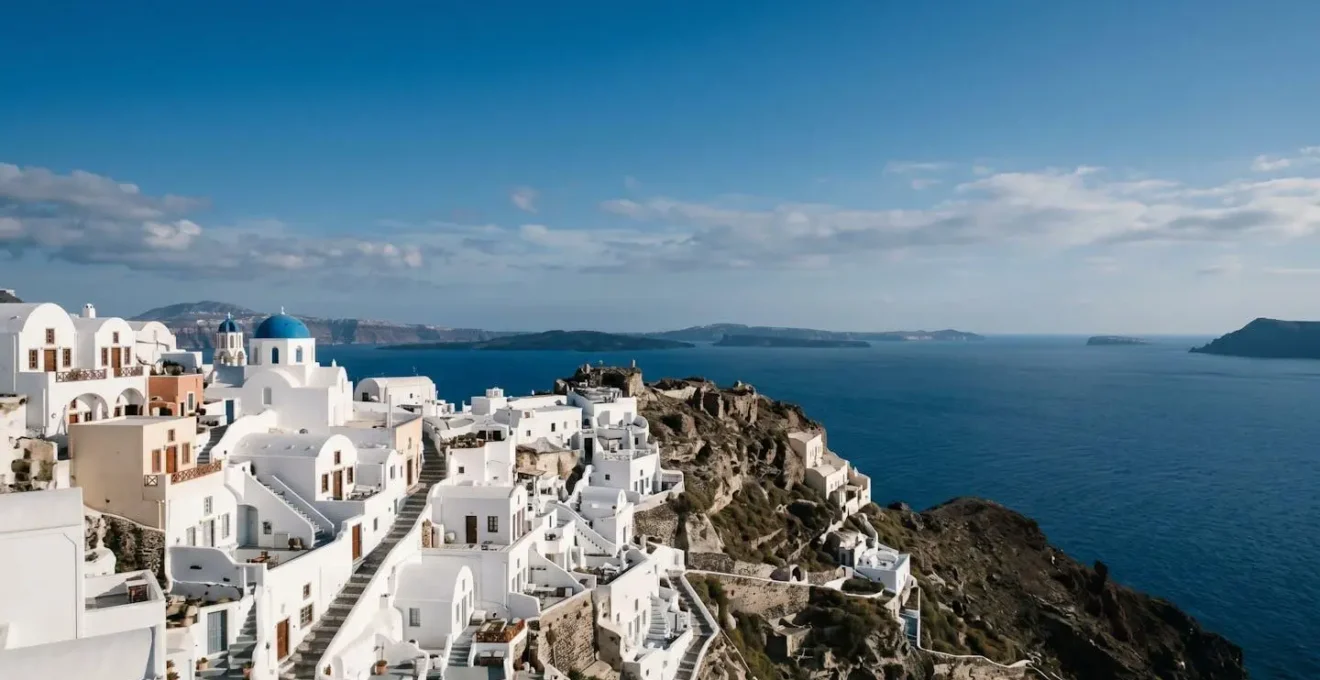
This guide goes beyond typical travel advice to reveal the architectural DNA and photographic secrets of Mediterranean whitewashed villages.
- Understand the historical ‘why’ behind the iconic white aesthetic to capture more meaningful and compelling photographs.
- Master specific techniques to conquer harsh Mediterranean light and practice respectful photography etiquette in living communities.
Recommendation: The most photogenic villages are not just seen, but understood. Plan your visit around authenticity and light, not just a famous location.
The allure of a whitewashed Mediterranean village is a powerful one. We’ve all seen the images: a cascade of brilliant white cubes tumbling down a cliffside, punctuated by the electric blue of a church dome and the vibrant pink of bougainvillea, all set against an impossibly azure sea. This vision is a cornerstone of travel dreams for photography-focused travellers and cultural enthusiasts alike. The immediate impulse is to book a flight to Santorini or Mykonos, camera in hand, ready to replicate the postcard.
But the common advice— »go for the golden hour, » « find a good viewpoint »—barely scratches the surface. It treats these ancient villages as static backdrops, ignoring the complex history, cultural significance, and living communities within them. Relying on these platitudes often leads to frustration: blown-out highlights in your photos, overwhelming crowds, and a sense that the ‘authentic’ experience remains just out of reach. You might return with pretty pictures, but will they have soul?
What if the key to truly breathtaking photography wasn’t just finding the right spot, but understanding the very soul of the place? This is our core philosophy: the most compelling photographs are earned by understanding the architectural DNA, cultural context, and light science that define these villages. It’s about moving beyond simply documenting beauty to interpreting it with depth and respect.
This guide is structured to take you on that journey. We will explore why these villages are built where they are, how to master the challenging light, where to find authenticity, the critical etiquette to observe, and how the architectural language of Greece compares to its Spanish counterparts. By the end, you’ll be equipped not just to take better photos, but to see these iconic landscapes with a richer, more appreciative eye.
Summary: A Photographer’s Guide to the Iconic Whitewashed Villages in Greece and Spain
- Why Are Santorini’s Whitewashed Villages Built Precariously on Volcanic Cliff Edges?
- How to Photograph Whitewashed Villages Without Harsh Shadows and Blown Highlights?
- Santorini or Mykonos: Which Island Offers More Authentic Whitewashed Village Experiences?
- The Photography Etiquette Mistake That Offends Residents in Whitewashed Villages
- When Should You Visit Whitewashed Villages for Golden Light Without Cruise Ship Crowds?
- Why Do Greek Cycladic Islands Maintain Whitewashed Architecture Despite Modern Paint Options?
- How to Tell the Difference Between Handmade Island Crafts and Factory Imitations?
- Which Islands Have the Most Elegant Architecture Worth Travelling to Photograph?
Why Are Santorini’s Whitewashed Villages Built Precariously on Volcanic Cliff Edges?
The iconic cliff-hugging villages of Santorini, like Oia and Fira, are a marvel of human ingenuity born from a history of peril and geological opportunity. Their precarious position is not an aesthetic choice but a direct response to two primary historical threats: piracy and geology. For centuries, the Aegean Sea was plagued by pirates, forcing inhabitants to build their settlements high up and inland, invisible from the sea. The caldera’s steep cliffs offered a perfect natural fortress, providing a commanding view of any approaching ships and making surprise attacks nearly impossible.
Beyond defense, the very fabric of the island dictated this unique architectural style. Santorini’s cliffs are composed of layers of soft volcanic material, primarily a soil known as « aspa. » As described by the Aspa Caves Heritage Site, this soil consists of volcanic ash, basalt, sand, and pumice. This material was soft enough to be excavated with simple tools, allowing islanders to carve their homes directly into the cliff face. These cave dwellings, or « yposkafa, » provided exceptional insulation—cool in the blistering summer heat and warm during the winter. This method was also resource-efficient on an island with scarce timber and building materials.
Today, this vertical architecture creates a stunning visual spectacle, but it also creates intense challenges. The limited space has led to an incredible population density for tourism. With an astonishing 44,737 tourists per square kilometer annually, the island’s infrastructure is under immense strain. This density, a legacy of defensive building, is now a double-edged sword: the very thing that makes Santorini so uniquely photogenic is also what makes a peaceful visit so difficult to achieve. Understanding this historical context transforms a simple photo of a cliffside house into a story of survival, adaptation, and modern-day pressure.
How to Photograph Whitewashed Villages Without Harsh Shadows and Blown Highlights?
Photographing a whitewashed village under the Mediterranean sun is one of the most technically challenging scenarios a photographer can face. The extreme contrast between the brilliant white walls, deep blue sea, and dark, narrow alleyways creates a massive dynamic range that overwhelms most cameras. The common results are « blown-out » highlights (pure white with no detail) and « crushed » shadows (pure black with no detail). Simply waiting for the golden hour isn’t enough; you need a specific toolkit of techniques to master the light.
The key is not to fight the harsh light, but to learn how to manipulate and use it. One of the most powerful professional techniques is to seek out reflected light. Instead of shooting a wall directly hit by the sun, find a narrow alley where the sun strikes one side. That sun-drenched wall becomes a giant, natural softbox, casting beautiful, diffused light onto the shaded wall opposite it. By placing your subject in this soft, reflected light, you get gentle illumination without the harsh shadows and squinting eyes, creating a much more flattering and balanced image.
As this image demonstrates, working within the shadows and using the architecture itself as a light modifier is fundamental. Furthermore, technical camera settings are your best friends. Shooting in RAW format is non-negotiable. A RAW file captures far more information in the brightest and darkest parts of the scene than a standard JPEG, giving you the latitude to recover seemingly lost details in post-processing. This, combined with techniques like exposure bracketing, ensures you capture the entire scene’s beauty.
Your Action Plan: Conquering Harsh Mediterranean Light
- Use reflected light technique: Position yourself in narrow alleys where sunlight hits one white wall, creating a natural softbox effect that illuminates the opposite wall without harsh shadows.
- Apply Auto Exposure Bracketing (AEB): Shoot 3-5 exposures at different exposure values to capture the full dynamic range—one for bright whites, one for deep blue skies/domes, one for mid-tones—then merge in post-processing for perfectly balanced HDR images.
- Embrace the blue hour advantage: Shoot 20-40 minutes after sunset when soft cool ambient light reduces contrast dramatically, prevents blown highlights, and allows warm artificial village lights to create a magical glowing atmosphere.
- Shoot in RAW format: RAW files contain significantly more image data in highlights and shadows than JPEGs, giving far more flexibility to recover blown-out highlights and crushed shadows in post-processing.
- Use ND filters strategically: A 10-stop neutral density filter allows long exposures in bright sunlight to smooth water and blur clouds, turning harsh midday conditions into creative opportunities.
Santorini or Mykonos: Which Island Offers More Authentic Whitewashed Village Experiences?
When dreaming of whitewashed Cycladic villages, Santorini and Mykonos are the two titans that immediately come to mind. While they share a similar aesthetic on the surface, they offer fundamentally different experiences when it comes to authenticity. Choosing between them depends entirely on your definition of « authentic. » A 2024 survey of 86,211 US travelers found that 58% agree Santorini is the destination most similar to Mykonos, yet this similarity is often purely visual.
Santorini’s main villages, particularly Oia, feel like perfectly preserved, open-air museums. The experience is meticulously curated for high-end tourism, focusing on luxury boutiques, infinity pools, and caldera views. This perfection comes at a price: during the off-season (November to March), Oia can feel like a beautiful ghost town, as much of its population is seasonal. Its authenticity lies in the preservation of its dramatic architecture, but less so in its present-day, year-round community life.
Mykonos, specifically its main town (Chora), presents a different kind of authenticity. While it certainly caters to luxury tourism and has a world-famous nightlife, it maintains a larger permanent population and a more vibrant, lived-in feel throughout the year. Here, you’re more likely to find a local bakery tucked between designer shops. The authenticity of Mykonos is that of a cosmopolitan, year-round community that has integrated tourism into its fabric rather than being entirely defined by it. For a truly genuine experience on either island, the key is to look inland. Villages like Pyrgos on Santorini or Ano Mera on Mykonos offer a glimpse into a more traditional, less-curated way of life.
This comparative table helps clarify the nuanced differences for travelers seeking a specific type of experience.
| Authenticity Factor | Santorini (Oia) | Mykonos (Chora) |
|---|---|---|
| Character Type | Perfectly preserved, seasonal open-air museum | Lived-in authenticity, year-round community |
| Off-Season Activity | Feels like ghost town (Nov-Mar) | Maintains vibrant local pulse |
| Permanent Population | Lower year-round residents | Larger permanent population |
| Tourist Experience | High-end boutiques + curated spaces | Mix of luxury shops + local bakeries |
| Inland Villages | Pyrgos, Emporio (genuine, less-curated) | Ano Mera (authentic local experience) |
| Primary Attraction | Caldera views, dramatic cliff architecture | Cosmopolitan atmosphere, nightlife |
The Photography Etiquette Mistake That Offends Residents in Whitewashed Villages
The single biggest mistake photographers make in these idyllic villages is forgetting that they are not film sets; they are people’s homes. The relentless pursuit of the « perfect shot » often leads to behavior that is deeply disrespectful and damaging to the community. The most egregious and symbolic of these acts is climbing on church roofs and blue domes. These are not public viewpoints or photo props; they are sacred religious structures and private property. Walking on them not only causes physical damage to the fragile plaster but is seen as a profound sign of disrespect by the local, often devout, residents.
This sense of entitlement extends to private property. The charming doorways, flower-filled courtyards, and colourful staircases that look so inviting are, in fact, the entrances to private homes. For residents, the daily reality is navigating tourists who block their doorways for impromptu photoshoots, peer into their windows, and treat their front steps as a public bench. This constant intrusion shatters the peace of their daily lives. A beautiful photo is never an excuse for trespassing, and the line between a public alley and a private courtyard must be respected.
As this image illustrates, there is a clear threshold between the public path and the private domain. True cultural tourism and ethical photography hinge on recognizing and honoring this boundary. A respectful photographer understands that their access is a privilege, not a right. To ensure your presence is a positive one, it’s crucial to adhere to a clear set of etiquette rules that prioritize the community over the photograph.
- Never climb on blue domes or church roofs: These are sacred religious structures or private property, not public viewpoints.
- Respect private entrances and courtyards: The picturesque doorways and flower-filled courtyards are entrances to private homes. Do not block them or peer inside.
- Avoid drone flights through village streets: Drone noise shatters the peaceful atmosphere and represents a significant invasion of privacy for residents.
- Ask permission before photographing individuals: Always seek consent before taking close-up photos of people, especially older residents. A simple gesture with your camera goes a long way.
- Dress modestly and be mindful of noise: Cover shoulders and knees when entering religious sites and keep your voice low in quiet residential neighborhoods.
When Should You Visit Whitewashed Villages for Golden Light Without Cruise Ship Crowds?
The dream of watching a Santorini sunset is often met with the harsh reality of thousands of other people having the same idea. The secret to experiencing these magical moments in relative peace lies in strategic timing, both within the day and within the year. It requires out-thinking the crowds, particularly those from cruise ships, which can swell a village’s population by thousands in a matter of hours.
One of the most effective tactics is the « Reverse Sunset » strategy. Instead of joining the masses in Oia for sunset, visit for sunrise. At dawn, the village is almost empty, the light is just as magical, and the experience is infinitely more serene. For sunset, escape Oia and head to the villages of Imerovigli or Firostefani. They offer equally spectacular caldera views but attract a fraction of the crowds, allowing you to enjoy the golden light in peace. This simple switch allows you to experience the best of both worlds.
On a larger scale, timing your visit to avoid peak cruise traffic is essential. You can monitor the port authority websites for Santorini (Athinios) and Mykonos to see the daily cruise ship schedule. Planning your visits to popular villages on days with zero or only one small ship scheduled makes a monumental difference. The good news is that authorities are taking action. Greece is implementing a new system, and in Santorini, this means the peak-day cruise crowds are reduced from 17,000 to a maximum of 8,000 starting in 2025. While still a significant number, this cap will noticeably reduce congestion compared to previous years.
For the ultimate combination of good weather, soft light, and minimal crowds, the sweet spot is the last two weeks of October. By then, the vast majority of tourists have departed, the sea is still warm enough for swimming, and the sun sits lower in thesky, providing beautiful, soft golden light for longer periods throughout the day. It’s the ideal time for photographers who prioritize light and tranquility over the buzz of high season.
Why Do Greek Cycladic Islands Maintain Whitewashed Architecture Despite Modern Paint Options?
The brilliant white-and-blue aesthetic of the Cyclades feels so timeless it’s easy to assume it was always an aesthetic choice. The reality is a fascinating journey from public health mandate to political symbol and finally, to a priceless economic brand. The widespread use of whitewash began not for beauty, but for sanitation. The traditional lime wash, known as asvestis, has powerful antiseptic properties. Its use became law in the 1930s during a cholera outbreak under the government of Ioannis Metaxas, who mandated that all homes be whitewashed to help curb the spread of the disease.
This practical beginning soon took on a political dimension. The Metaxas dictatorship enforced uniformity as a symbol of national order and pride. Later, during the military junta of 1967-1974, the color scheme was further codified, with blue and white being promoted as patriotic colors reflecting the Greek flag. What started as a disinfectant had become a statement of national identity.
Today, the tradition is maintained by strict building codes, but the motivation is primarily economic. The whitewashed aesthetic is now a globally recognized « brand identity, » the visual cornerstone of Greece’s tourism industry. Traditional lime wash also offers a critical functional advantage that modern acrylic paints lack: it is breathable. It allows moisture to escape from the stone walls, preventing dampness and structural damage in the humid island climate—a crucial feature for preserving these old homes. In this context, the whitewashed look has become a collective economic asset, where a single non-conforming house can diminish the photogenic appeal—and therefore the tourism-based income—of an entire neighborhood.
Case Study: Evolution of Santorini’s Whitewash from Disinfectant to Brand Identity
The architectural style of Santorini evolved through three distinct phases. First was the practical disinfectant era, where a 1930s cholera outbreak led to a mandate for using antiseptic lime wash. This was followed by a period of political enforcement under the Metaxas dictatorship and the 1967-1974 junta, which enforced the blue-and-white color scheme for nationalistic reasons. Today, it has transitioned into an economic asset. As detailed in documents like those from the Santorini-View historical archives, the look is legally protected by building codes as a priceless ‘brand identity’ for tourism. The traditional, breathable lime wash (asvestis) remains superior to modern paints for preventing dampness in stone walls, creating immense social and legal pressure to maintain this collective economic asset.
How to Tell the Difference Between Handmade Island Crafts and Factory Imitations?
In the bustling tourist shops of a Greek island village, it can be difficult to distinguish authentic, locally made crafts from mass-produced souvenirs imported from afar. Yet, for the discerning traveler, supporting local artisans is a vital part of a meaningful cultural exchange. The key to telling the difference lies in training your eye, your hands, and your questions to detect the « signature of the hand. »
Authentic handmade items are characterized by their subtle, beautiful imperfections. No two pieces are ever identical. When examining pottery, look for slight asymmetries in the form, tiny variations in the glaze, or the feel of variable thickness in the walls. Factory-made ceramics, by contrast, are flawless, lightweight, and perfectly uniform—a tell-tale sign of a mould. In woodwork or metal, look for visible tool marks. In textiles, you might see the slight irregularities of a hand-operated loom. These are not flaws; they are the fingerprints of the creative process.
As this macro photograph reveals, the texture of a handmade object tells a story of its creation. Beyond visual inspection, the most powerful tool is a simple question: « Where is this made? Can I meet the artist? » A seller of genuine crafts will be proud to tell you about the local workshop, often just around the corner. A reseller of imitations will be vague or evasive. This question cuts through the noise and quickly separates the artisans from the souvenir peddlers. To find the real deal, dare to wander off the main tourist thoroughfares. Explore the quieter backstreets and inland villages, where you’re far more likely to find the actual workshops where pottery is thrown, sandals are stitched, and true artistry is alive and well.
- Look for the ‘Signature of the Hand’: Examine items for subtle imperfections—slight asymmetry, visible tool marks, tiny variations in glaze.
- Ask ‘Where is it made?’: Sellers of genuine crafts will proudly tell you about the local workshop or artist.
- Explore backstreet workshops: Genuine artisan studios are rarely on high-rent tourist streets.
- Examine material quality and weight: Authentic handmade items have a satisfying weight and texture that mass-produced goods lack.
Key takeaways
- The iconic whitewashed aesthetic is a complex mix of public health history, political symbolism, and modern economic branding.
- Great village photography requires both technical skill to manage harsh light and social grace to practice respectful etiquette.
- True authenticity is often found away from the crowds, in inland villages or during the off-season, in both Greece and Spain.
Which Islands Have the Most Elegant Architecture Worth Travelling to Photograph?
While the Greek Cyclades are the undisputed champions of the whitewashed aesthetic, Spain offers its own enchanting version with the pueblos blancos of Andalusia and the distinct architectural styles of the Balearic and Canary Islands. For a photographer, understanding the different « architectural DNA » of each region opens up a world of new creative possibilities. The choice is not about which is « better, » but which visual language speaks to you.
Greek Cycladic architecture is a study in minimalist cubism and high contrast. The style is stark, with simple geometric forms designed to diffuse the harsh sun. The color palette is famously limited to brilliant white and a vivid blue, echoing the national flag and creating a dramatic, graphic look against the deep blue sea. This is an architecture of drama, perfectly suited for wide-angle shots emphasizing its relationship with the dramatic cliffs and sea.
Spanish whitewashed villages, by contrast, offer a feeling of rustic warmth and softer tones. Influenced by Moorish roots, they often feature more intricate layouts with hidden courtyards, and the color palette is warmer, pairing the whitewash with terracotta roof tiles and earthy tones. As the travel guide « It’s Not About the Miles » notes, « With their whitewashed houses, tiled roofs, and colorful pots of flowers, Spain’s pueblos blancos are the stuff of picture postcards. » This style is about intimacy and texture, ideal for photographers who love capturing details: flower-filled patios, ornate tilework, and the interplay of light in narrow, winding streets. Beyond the classic Greek and Spanish styles, other islands offer unique gems. The Venetian and Neoclassical influences in Corfu Town or the colorful, grand facades of Symi in Greece, and the honey-toned sandstone elegance of Ciutadella in Menorca, Spain, provide rich alternatives for the architecturally curious photographer.
This table highlights the core differences in architectural character, helping you choose the destination that best matches your photographic style.
| Architectural DNA | Greek Islands | Spanish Islands |
|---|---|---|
| Dominant Style | Cycladic Cubism (minimalist, stark) | Moorish-influenced pueblos blancos |
| Color Palette | White + vivid blue (flag colors) | White + terracotta + earth tones |
| Historical Influence | Venetian overlays (colorful balconies, town squares) | Moorish roots (courtyard layouts, tile work) |
| Architecture Example | Folegandros (Cycladic), Corfu Town (Neoclassical) | Menorca (British Georgian + sandstone), Lanzarote Teguise |
| Building Materials | Volcanic rock, white plaster, blue-painted wood | Honey-toned sandstone, whitewash, ceramic tiles |
| Photographic Character | High contrast, dramatic cliffs, azure sea backdrop | Rustic warmth, flower-filled courtyards, softer tones |
| Lesser-Known Gem | Symi (colorful facades, grand neoclassical) | Ciutadella, Menorca (historic sandstone elegance) |
Ultimately, capturing the soul of a whitewashed village—whether in Greece or Spain—is an act of engaged observation. It requires moving beyond the surface-level beauty to appreciate the history etched into the walls, the light that shapes the day, and the living culture that flows through the narrow streets. By equipping yourself with technical skill, historical context, and a profound sense of respect, you transform yourself from a mere tourist into a thoughtful visual storyteller. Your photographs will cease to be simple souvenirs; they will become authentic reflections of a place’s enduring spirit. The next step is to choose the architectural narrative that calls to you and begin planning a journey that prioritizes depth and understanding.