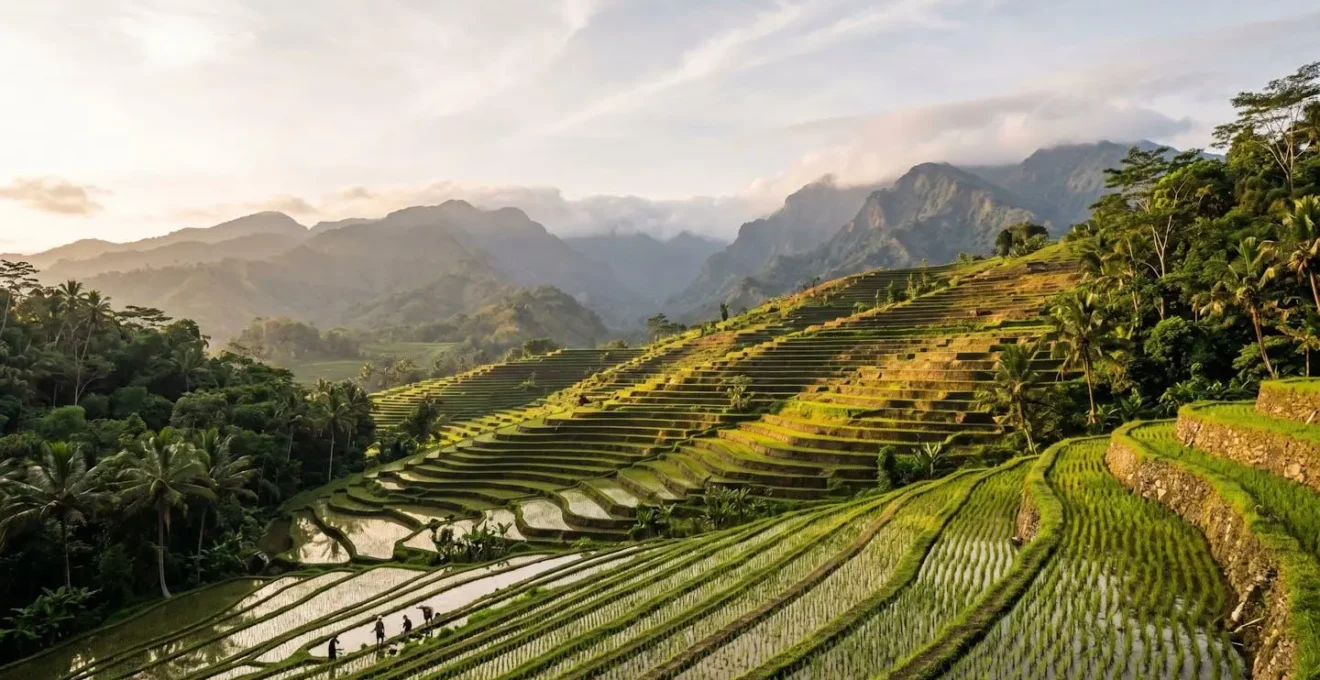
The most dramatic rice terraces are not just beautiful landscapes, but complex agricultural-spiritual engines; a truly rewarding visit depends on understanding their inner workings.
- Fame is a result of infrastructure and accessibility (Bali) versus raw, demanding immersion (Ifugao), not a measure of spectacle.
- Masterful photography requires aligning with the agricultural calendar (flooded, green, or golden seasons) and respecting the landscape’s infrastructural fragility.
Recommendation: Instead of just seeing the terraces, learn to read them—by hiring a local guide who can explain the hydrological engineering and cultural rhythms that make them a living wonder.
For the dedicated landscape photographer or agricultural tourism enthusiast, the image of perfectly sculpted rice terraces cascading down a mountainside is a powerful lure. It evokes a sense of timeless harmony between humanity and nature. The immediate question is often which island offers the most breathtaking spectacle, a debate that frequently pits popular destinations against hidden gems. This pursuit of the « best » view, however, often overlooks a more profound reality.
Most travel advice focuses on the superficial: go at sunrise, find a good viewpoint, and maybe visit a famous café. But this approach treats these living landscapes as static monuments. It misses the intricate story told in the shimmer of a flooded paddy, the whisper of wind through maturing rice stalks, and the sacred geometry of the irrigation channels. It fails to recognize that these terraces are not merely scenery; they are functional, millennia-old agricultural-spiritual engines, each with its own rhythm, rules, and vulnerabilities.
What if the key to a truly justified visit—and to capturing images with soul—was not just finding the most dramatic panorama, but understanding the forces that created it? This guide moves beyond the surface. We will deconstruct the fame of Bali’s terraces, compare photographic strategies, and explore the cultural protocols that separate a tourist from a respectful observer. This is about learning to see the terraces not just as a place, but as a process—a masterpiece of hydrological engineering and community spirit that has been centuries in the making.
This comprehensive guide will explore the critical nuances that make a rice terrace visit truly remarkable. By examining the infrastructure, cultural significance, and natural cycles, you will be equipped to choose your destination and plan your visit with an expert’s eye.
Summary: Decoding the World’s Most Spectacular Rice Terrace Islands
- Why Are Bali’s Rice Terraces More Famous Than the Philippines’ Equally Spectacular Ifugao Terraces?
- How to Photograph Rice Terraces: Flooded Mirror Season or Green Growing Period?
- Guided Rice Terrace Tour or Independent Walking: Which for First-Time Visitors?
- The Tourist Behaviour That Damages Rice Crops and Offends Terrace Farmers
- When Can You Visit Rice Terraces During Harvest Festivals and Planting Ceremonies?
- Why Do Balinese Temples Require Sarongs and Sashes for All Visitors?
- How to Recognise Endemic Island Species That Exist Nowhere Else on Earth?
- Which Islands Have Sacred Temples Worth Visiting for Architecture and Spiritual Atmosphere?
Why Are Bali’s Rice Terraces More Famous Than the Philippines’ Equally Spectacular Ifugao Terraces?
The global recognition of Bali’s rice terraces is not solely a matter of beauty, but a direct consequence of accessibility and highly developed tourist infrastructure. The numbers paint a stark picture: in 2024, Bali welcomed over 16 million visitors, whereas the entire Ifugao province, home to its eponymous terraces, saw roughly 70,000 tourists in 2017. This disparity isn’t because the Ifugao terraces are less magnificent—they are a 2,000-year-old UNESCO World Heritage site often called the « Eighth Wonder of the World »—but because they demand a different level of commitment from the visitor.
The journey itself defines the experience. Bali’s famous terraces like Tegallalang are a short drive from the cultural hub of Ubud, surrounded by cafes, swings, and purpose-built viewing platforms. They are packaged for easy consumption. In contrast, reaching the iconic amphitheater of Batad in the Philippines requires a 9-10 hour overland journey from Manila, followed by a demanding trek on rugged mountain paths. This fundamental difference in accessibility shapes everything from the type of visitor to the nature of the encounter.
The following table breaks down the key factors that contribute to Bali’s fame versus Ifugao’s more niche, hardcore appeal, based on an analysis of tourist infrastructure.
| Factor | Bali Rice Terraces (Tegallalang/Jatiluwih) | Ifugao Rice Terraces (Batad/Banaue) |
|---|---|---|
| Distance from Major Airport | 20-30 min from Ubud (90 min from Denpasar) | 9-10 hours overland from Manila |
| Road Quality | Paved roads with tourist signage | Multi-day overland travel, rugged mountain roads |
| Tourist Infrastructure | Cafes, swings, viewing platforms, entrance fees ~IDR 25,000-50,000 | Limited facilities, homestays, entrance fees ~PHP 50-100 |
| UNESCO Status | Jatiluwih: UNESCO World Heritage (Subak System) | 5 clusters UNESCO World Heritage since 1995 |
| Experience Model | Packaged, photo-ready, easily accessible | Physically demanding trekking, authentic immersion |
Ultimately, Bali’s terraces are an accessible, beautiful feature within a broader tourist destination, making them famous by association. The Ifugao terraces, however, are the destination—a challenging pilgrimage that rewards the effort with a profound sense of scale, authenticity, and isolation that is increasingly rare.
How to Photograph Rice Terraces: Flooded Mirror Season or Green Growing Period?
This is a classic photographer’s dilemma, but the answer isn’t about which is « better, » but what story you want to tell. Each phase of the agricultural calendar offers a distinct aesthetic and mood. The choice between a water-filled « mirror » and a lush green carpet depends entirely on your creative intent. The Flooded Mirror Season (typically December-March in much of Asia) is a time of high drama. The water-filled paddies act as colossal mirrors, reflecting the sky, clouds, and surrounding mountains. This is the time to play with backlight, silhouettes, and abstract compositions. The challenge here is managing extreme contrast; shooting towards the sun can create stunning effects but requires careful exposure to avoid losing detail in the shadows.
Conversely, the Green Growing Period (March-May in Bali, for example) is about capturing life and vitality. The landscape transforms into a sea of vibrant, electric emerald. This is the time for capturing the soft, diffused light of early morning as it filters through palm trees, casting long rays across the terraces. The uniform color allows the viewer’s eye to focus on the texture, shape, and rhythm of the terraces themselves. Photographers should arrive exceptionally early, often before 6:30 AM, to catch the most ethereal light before the sun becomes harsh.
To truly capture the soul of the terraces, however, an expert photographer must think beyond the wide-angle view and appreciate the intricate details of this micro-ecosystem.
This close-up perspective reveals the delicate beauty of a single rice shoot, a world of texture and color often missed in grand landscapes. It’s a reminder that the entire spectacle is built upon these individual, life-sustaining plants. To build a complete portfolio, consider employing multiple scales: a wide lens for the overall geometry, a standard lens for the human element of farmers at work, and a macro lens for the intimate details of the plant life itself.
Guided Rice Terrace Tour or Independent Walking: Which for First-Time Visitors?
For a first-time visitor, the choice between hiring a local guide and exploring independently is pivotal. While independent walking offers freedom and spontaneity, a guided tour, particularly with a community-based guide, provides a layer of understanding that is otherwise inaccessible. A guide’s value is not in navigation—the paths are often clear—but in translation, both linguistic and cultural. They transform a beautiful walk into a narrative-rich experience.
A guide can explain the intricate social rules of water distribution, point out sacred shrines you might otherwise miss, and share the mythology tied to specific parts of the landscape. They are the key to unlocking the ‘why’ behind the ‘what’. This is perfectly demonstrated by a community tourism program in Bali.
Case Study: Jatiluwih Community-Based Tourism Model
At the Jatiluwih Rice Terraces, a UNESCO World Heritage site, the local agro-tourism program illustrates the immense value of a guide. Visitors aren’t just led along a path; they can volunteer as a farmer for a day, participating in authentic agricultural activities like rice planting (nandur) and soil leveling (melasah). As detailed in travel guides like the one provided by Bali.com, local guides facilitate these hands-on experiences while explaining the 11th-century history of the sacred Subak irrigation system. This transforms a scenic walk into a deep, participatory lesson in cultural heritage, generating sustainable income for the community while preserving knowledge that an independent walker would never encounter.
The right choice depends on your travel archetype. The solo adventurer seeking solitude may prefer to wander alone, while the culture seeker or photographer will gain exponentially more from a local expert. This framework helps clarify the decision:
| Traveler Archetype | Recommended Approach | Key Benefits | Estimated Cost |
|---|---|---|---|
| The Adventurer | Independent Walking | Freedom to explore at own pace, discover hidden paths, flexibility in timing and routes | Minimal (entrance fees PHP 50-100 or IDR 25,000-50,000) |
| The Culture Seeker | Local Guide Essential | Access to mythology tied to specific sites, understanding of social water distribution rules, insight into spiritual significance and ancestral traditions | PHP 1,500-3,000 per day (Philippines) or IDR 400,000-800,000 (Bali) |
| The Photographer | Private Guide for Timing/Locations | Guidance on optimal sunrise/sunset viewpoints, understanding of seasonal changes, access to less-crowded angles | Premium rate for specialized photo guides |
| The Family | Easy Access Guided Tour | Safety on steep paths, educational context for children, logistical support with transportation | Package tour pricing varies by group size |
| The Deep Immersion Seeker | Homestay + Family Guide Package | Sleep in terrace village, family member as guide, participate in daily farming activities, share meals with community | PHP 800-1,500 per night (Philippines) including meals and guiding |
For a first-time visitor, a local guide is a highly recommended investment. It shifts the experience from passive observation to active learning, ensuring you leave with not just beautiful photos, but a genuine appreciation for the living culture of the terraces.
The Tourist Behaviour That Damages Rice Crops and Offends Terrace Farmers
The breathtaking beauty of rice terraces belies their profound fragility. What appears as a robust, sculpted landscape is, in reality, a delicate, functional system honed over centuries. The most common and damaging tourist behavior stems from a fundamental misunderstanding of this: treating the terraces as a park rather than a farm and a sophisticated work of hydrological engineering. The single most offensive and destructive act is walking on the narrow earthen walls that separate the paddies.
These walls, known as pematang in Bali, are not footpaths. They are the critical infrastructure of the terrace system—compacted earth dikes that hold back tonnes of water and often contain the miniature, gravity-fed irrigation channels that deliver life to the plots below. A single misstep can collapse a section of the wall, triggering a cascade of problems: it can block a water channel, starving downstream paddies of their vital supply, or cause a breach that drains an entire plot, destroying weeks of a farmer’s labor.
This visual of a dike’s cross-section illustrates its delicate, hand-built nature. The narrow channel carved into its side is the lifeline for countless rice plants, and its integrity is paramount.
Beyond direct infrastructural damage, other behaviors are deeply disrespectful. Flying drones without permission can disturb farmers and livestock. Picking rice shoots as souvenirs is akin to stealing food. And leaving behind trash, especially plastic, can contaminate the water system that is the lifeblood of the entire community. This lack of awareness contributes to a pressure that communities are actively fighting, as expressed by one local leader:
What we are afraid of is that there will be buildings in the middle of the rice fields. Therefore, we made the Jatiluwih Village Regulation so that our natural sustainability is maintained.
– Ketut Purna, Operations Manager, Jatiluwih Rice Terraces Tourism Village, Bali
While this quote speaks to the larger threat of development, it originates from the same root concern: that the functional, agricultural soul of the terraces is being threatened by uninformed tourism. The best rule is simple: stick to designated paths, treat the entire area as someone’s private farm and workplace, and leave absolutely nothing behind.
When Can You Visit Rice Terraces During Harvest Festivals and Planting Ceremonies?
Timing a visit to coincide with a harvest festival or planting ceremony can elevate a trip from a visual experience to a profound cultural immersion. However, this requires flexibility and a deep respect for local traditions, as these events are dictated by the agricultural calendar and lunar cycles, not the tourist high season. The first step is understanding the annual rhythm of the rice.
The seasons of planting, growing, and harvesting vary significantly across regions and even by elevation within a single area. A visitor hoping to see the golden hues of harvest in Sapa, Vietnam, should aim for September, while the best green views in Jatiluwih, Bali, are often from February to April. This table provides a general guide to the agricultural cycles in major rice terrace destinations:
| Region/Island | Planting Season | Growing Period | Harvest Season | Post-Harvest/Irrigation |
|---|---|---|---|---|
| Bali (Wet Rice) | Nov-Mar (rainy season) | Apr-Jun (green fields) | Jun-Jul (Sasih Sada) | Aug-Oct (preparation for next cycle) |
| Bali (Jatiluwih) | Rolling cycle varies by elevation | Feb-Apr (best green views) | Jun-Jul (golden terraces) | Dec-Jan (water-filled for next planting) |
| Philippines (Ifugao) | May-Jun (terraces flooded) | Jul-Aug (rice flowering) | Sep-Oct (harvest begins) | Nov-Jan (preparation, some terraces fallow) |
| Vietnam (Sapa) | May-Jun (planting, water reflections) | Jul-Aug (lush green) | Mid-Aug to late Sep (golden peak) | Oct-Apr (various stages by elevation) |
| China (Yuanyang) | May (seedling planting) | Jun-Aug (green growth) | Sep (harvest) | Dec-Mar (irrigated, best photography with water reflections) |
Witnessing a ceremony is more complex than just showing up during the right season. Many of the most sacred rituals, like intimate planting rites performed by Ifugao priests, are private affairs where an outsider’s presence would be intrusive. The key is respectful inquiry, flexibility, and ideally, the help of a local connection.
Your Action Plan: How to Experience Rice Terrace Ceremonies Respectfully
- Distinguish Public vs. Private Ceremonies: Large-scale festivals like Bali’s Tumpek Uduh or the Philippines’ Imbayah Festival welcome visitors. Intimate village-level planting rituals are often private; presence would be disrespectful.
- Accept Date Uncertainty: Ceremony dates are often set by elders consulting lunar calendars and agricultural signs, not published online. Arrive in the region 3-5 days before the expected period and inquire locally.
- Build Flexibility Into Your Itinerary: Plan for buffer days. Rice agriculture follows nature’s schedule, not tourist calendars, so a fixed-date expectation will likely lead to disappointment.
- Learn Specific Ceremony Names: In Bali, ask about ‘Tumpek Wariga’ or ‘Ngusaba Nini’. In Ifugao, inquire about ‘Punnuk’ or ‘Tungul’. Using proper names shows cultural respect and helps locals guide you.
- Hire a Cultural Guide or Stay in Homestays: A family guide or homestay host is your best asset. They can facilitate appropriate participation, explain ritual significance, and ensure you don’t violate sacred protocols.
By approaching the opportunity with humility and preparation, you may be rewarded with a glimpse into the spiritual heart of the rice terrace culture—an experience far more memorable than any photograph.
Why Do Balinese Temples Require Sarongs and Sashes for All Visitors?
The requirement to wear a sarong (kamen) and sash (senteng) before entering a Balinese temple is far more than a simple dress code for modesty. It is a profound ritual act of purification and respect, physically marking the transition from the mundane world into a sacred space. This practice is rooted in the Balinese Hindu concept of Tri Mandala, which divides a temple compound into three distinct zones of holiness, and the philosophical dualism of sekala and niskala.
Sekala represents the seen, physical, and ordinary world, while niskala refers to the unseen, spiritual world of gods and ancestors. The temple is a gateway between these two realms. By donning the temple attire, a visitor signals their readiness to cross this threshold. The symbolism is specific and powerful: the sarong covers the lower body, associated with earthly desires and worldly activities. The sash, tied around the waist, symbolically separates this lower, « impure » half of the body from the upper half, which represents spiritual thoughts and connection to the divine. It is a conscious act of preparing oneself to be in the presence of the holy.
This practice is nowhere more relevant than in the water temples that govern the rice terraces, as they are the command centers of the entire agricultural-spiritual system.
Case Study: Pura Tirta Empul Water Temple
At Pura Tirta Empul, a key water temple in the Subak system, the dress code is a direct expression of its sacred function. As analyses of Balinese tourism show, this site is a major cultural draw. The act of wearing the sarong and sash is a prerequisite for entering a space where water purification rituals have been conducted for over 1,000 years. This temple is an integral part of the UNESCO-recognized Subak cultural landscape, managing water distribution for thousands of hectares of rice paddies. The dress code is therefore not arbitrary; it is a transformative act. Visitors physically alter their appearance to show respect and readiness to enter the very heart of the agricultural-spiritual engine, acknowledging its power to sustain life across the island.
Therefore, wearing the sarong and sash is not a chore for tourists; it is a meaningful participation in a living culture. It is the first and most fundamental gesture of respect, acknowledging that you are entering a space where the boundaries between the physical world of rice and the spiritual world of water are beautifully and purposefully blurred.
How to Recognise Endemic Island Species That Exist Nowhere Else on Earth?
While the rice itself is the dominant feature, the terraces form a complex, man-made wetland that serves as a vibrant micro-ecosystem for a host of endemic island species. Recognizing these unique creatures and plants requires shifting your focus from the grand landscape to the life teeming within it. These species, found nowhere else on Earth, are indicators of the ecosystem’s health and are deeply intertwined with the local culture.
The greatest biodiversity is often found not in the paddies themselves, but in the surrounding support systems. In the Philippines, the communally managed private forests known as muyong that cap the Ifugao terraces are biodiversity hotspots. These areas are critical watersheds, and it’s been found that the muyong forestry areas contain 264 indigenous plant species, many of which are endemic to the region. This demonstrates that the terraces are not an isolated monoculture but the centerpiece of a larger, integrated ecological system.
For the visiting naturalist or photographer, spotting these unique species requires patience and knowing where to look. Here is a field guide to help you identify the hidden life of the rice terraces:
- Focus on Paddy-Dwelling Birds: In Bali, keep an eye out for the Javan Pond Heron and Scaly-breasted Munia, which feed on insects and snails in the paddies. In the terraces of Luzon, Philippines, you might spot endemic subspecies like the Philippine Duck or various kingfishers that are unique to the islands.
- Observe Amphibian Activity at Dawn/Dusk: The flooded paddies are ideal breeding grounds for endemic frogs. Listen for their distinct calls, which often change between day and night, especially during the rainy season when the terraces become bustling amphibian nurseries.
- Examine Terrace Wall Flora: The earthen or stone walls (pematang) are not barren. They host a unique collection of ferns, medicinal plants, and edible greens often cultivated and used by local communities. A local guide can be invaluable in identifying plants with specific cultural significance.
- Look Upward to Muyong Forests: In Ifugao, the muyong forests hold the highest concentration of endemic species. These collectively managed watershed forests are the ecological foundation that sustains the entire terrace system below.
- Document Dragonfly and Butterfly Species: The abundance of water attracts a diverse population of insects, including many endemic dragonflies (Odonata) and butterflies. These species are not only beautiful photographic subjects but also serve as important bio-indicators of water quality and ecosystem health.
By training your eye to see beyond the rice, you can discover a hidden world of biodiversity that adds another layer of wonder to these already magnificent landscapes.
Key takeaways
- The fame of a rice terrace is often a function of accessibility and tourist infrastructure, not a definitive measure of its spectacle or historical significance.
- Masterful photography depends on aligning with the agricultural calendar, choosing between the dramatic reflections of the flooded season and the vibrant life of the green season.
- True respect for these landscapes means understanding their infrastructural fragility; the narrow paddy dikes are critical water channels, not footpaths.
Which Islands Have Sacred Temples Worth Visiting for Architecture and Spiritual Atmosphere?
While many islands boast beautiful temples, the most spiritually resonant and architecturally significant are often those that serve a living, functional purpose within their community. In the context of rice terrace islands, the most compelling temples are not just places of worship but integral components of the agricultural-spiritual engine that governs the landscape. Bali, with its unique Subak system, offers the most profound examples of this synthesis.
Unlike temples that are purely tourist attractions, these « water temples » or pura subak are active administrative and spiritual centers. Their atmosphere derives not from contrived performances but from their authentic role in managing a system that sustains thousands of lives. They are where the sacred and the pragmatic meet, where priests and farmers collaborate to interpret cosmic signs and determine practical irrigation schedules.
One of the most powerful examples is not a famous sea temple, but a mountain sanctuary that acts as the supreme headquarters of the entire Subak network.
Case Study: Pura Ulun Danu Batur, The Subak System’s Command Center
Perched on the crater rim of Mount Batur in Bali, Pura Ulun Danu Batur is the supreme water temple. It governs the island-wide Subak irrigation system. Its primary function is profoundly practical: the temple’s priesthood coordinates the precise water allocation and planting cycles for hundreds of farming communities across Bali. Decisions made here, through ritual consultation between priests and farmer representatives, affect the livelihoods of thousands. The temple’s architecture, featuring soaring eleven-tiered meru towers representing the sacred Mount Meru, reflects its cosmological importance. Its spiritual weight comes from its active role as the heart of a thousand-year-old agricultural democracy. Visiting at dawn or dusk allows one to witness the temple in its working context, free from crowds, and to feel the palpable sense of responsibility it holds over the verdant island below.
For a visitor, seeking out these functional temples offers a glimpse into a worldview where spirituality, community, and agriculture are inextricably linked. The beauty of their architecture is amplified by the knowledge that they are not relics, but living, breathing centers of a sophisticated and sustainable culture. Islands like Bali, therefore, offer temples that are not just worth visiting for their aesthetics, but for the profound spiritual and social systems they represent.