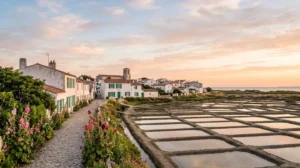
Île de Ré’s high cost is a deliberate feature, not a bug, crafting an exclusive, car-free experience that justifies the price for travellers seeking tranquillity over typical resort buzz.
- The island’s charm is a « curated ecosystem » where strict building codes and protected landscapes create a unique, unified aesthetic and preserve its natural beauty.
- The 100km+ cycling network isn’t just a leisure activity; it’s the primary mode of transport, fundamentally shaping the island’s slow-paced, serene ‘art de vivre’.
Recommendation: Embrace the island’s philosophy by leaving the car behind, renting a bicycle, and planning logistics like restaurant bookings in advance to fully appreciate its unique value proposition.
For many European travellers, Île de Ré exists as a whisper of Atlantic chic—a sun-drenched haven of sandy beaches, charming villages, and salt-weathered bicycles. Often dubbed the « French Hamptons, » its reputation for understated luxury and a Parisian holiday crowd precedes it. You’ve likely heard the praise: it’s a cyclist’s paradise, a foodie’s delight, an impossibly photogenic sliver of land connected to La Rochelle by a dramatic, curving bridge. But with this reputation comes a hefty price tag and, in high season, significant crowds, leading discerning travellers to ask a crucial question: is it truly worth it?
The typical advice involves visiting the main villages and eating oysters, but this barely scratches the surface. To truly understand Île de Ré is to look beyond the obvious attractions. But what if the key to its appeal wasn’t in any single beach or restaurant, but in the deliberate, almost invisible system that governs the entire island? This guide explores the « why » behind the « what. » We will deconstruct the island’s meticulously curated ecosystem—from property prices that rival Paris to the logistical ballet of parking and dining—to reveal how these elements combine to create a singular sense of place, an *art de vivre* that is becoming increasingly rare.
This article provides the strategic insight needed to navigate this unique environment, helping you decide not only if Île de Ré is the right destination for you, but how to experience its authentic core, far from the summer rush. We will delve into the practicalities of timing your visit, mastering the cycling network, and understanding the cultural nuances that make a trip here so much more than a simple beach holiday.
Summary: The Definitive Guide to Île de Ré’s Curated Charm
- Why Do Île de Ré Property Prices Rival Central Paris Despite Being a Remote Island?
- How to Navigate Île de Ré’s 100km Cycling Network: Route Planning for First-Time Visitors?
- Île de Ré in July-August or April-May: When to Visit for Fewer Crowds With Warm Weather?
- The Île de Ré Parking Mistake That Costs Day-Trippers £60 in Fines
- When Should You Reserve Île de Ré Restaurants: How Far in Advance for Peak Season?
- High-Speed Catamaran or Conventional Ferry: Which for Island Hopping?
- How to Plan a Mediterranean Island-Hopping Route Using Regional Ferry Connections?
- Which Mediterranean Island Should First-Time Visitors Choose for a Balanced Introduction?
Why Do Île de Ré Property Prices Rival Central Paris Despite Being a Remote Island?
The first clue to understanding Île de Ré’s unique character lies in a startling economic fact. Far from being a rustic, affordable getaway, the island boasts property values that are astonishingly high. It’s a paradox that often baffles first-time visitors: how can a small Atlantic island command prices that challenge those of a major European capital? The answer reveals the core of the island’s philosophy: deliberate scarcity and meticulous preservation. This isn’t an accidental outcome; it’s the result of a long-term strategy to protect the island’s soul.
Recent market analysis shows that property values on the island are truly exceptional. With prices that can reach an average of €8,255 per square metre, the island is more than double the French national average and nips at the heels of Paris itself. This isn’t driven by sprawling development but by its exact opposite. The high prices are a direct consequence of fiercely protected landscapes and extremely strict building regulations. This creates a finite, highly sought-after supply of homes that maintain a specific aesthetic: low-slung, whitewashed, and harmoniously integrated into the environment.
This protective stance is the key to the island’s « curated ecosystem. » As experts in the local market explain, this is a conscious choice to prioritize landscape over expansion. As noted by Eddie Lalonnier of Sotheby’s International Realty in a piece for Résidences Immobilier magazine:
Building is not permitted on a large part of the island. A decision made by the public authorities to protect its lovely landscapes.
– Eddie Lalonnier, Résidences Immobilier
This approach means that the « value » you are paying for—whether in a hotel, a rental, or simply a coffee on a harbourfront—is the preservation of this unique atmosphere. The high cost acts as a gatekeeper, ensuring the island is never overwhelmed and that the experience remains one of tranquillity and natural beauty, an investment in a protected sense of place.
How to Navigate Île de Ré’s 100km Cycling Network: Route Planning for First-Time Visitors?
If strict building codes form the structural bones of Île de Ré’s curated ecosystem, then the sprawling network of cycle paths is its circulatory system. The famous 100km+ of dedicated bike trails are more than just a tourist attraction; they are the primary, and by far the best, way to experience the island’s unique *art de vivre*. Understanding how to navigate this network is key to unlocking the slow-paced, car-free tranquillity that defines the Ré experience. It allows you to move from village to village, from beach to market, through pine forests and along ancient salt marshes, all without the stress of traffic.
As the image above so beautifully captures, cycling on Île de Ré is an immersion in its landscape. The paths are largely flat, well-maintained, and separated from roads, making them safe and accessible for all ages and abilities. For first-time visitors, the best strategy is not to try and « see it all, » but to adopt a « hub-and-spoke » approach. Choose a base village that matches your desired vibe—lively Saint-Martin-de-Ré, for instance, or the quieter, nature-focused Les Portes-en-Ré—and plan daily loops. This minimises backtracking and allows for deeper exploration.
Key routes to consider for your itinerary include:
- The Northern Coastal Route: A ride from Rivedoux towards Saint-Martin-de-Ré offers wilder landscapes, with fantastic views of the bridge and the vast Baie de l’Aiguillon.
- The Southern Forest Route: A path that meanders through Sainte-Marie-de-Ré and Le Bois-Plage-en-Ré, offering welcome shade from pine forests and constant, easy access to the island’s best sandy beaches.
- The Western Nature Loop: Starting from the picture-perfect harbour of Ars-en-Ré, this route takes you through the Lilleau des Niges nature reserve, a birdwatcher’s paradise, and out to the iconic Phare des Baleines (Whale Lighthouse) at the island’s western tip.
Before setting out, be sure to grab the official cycle map from any tourist office. It details the 138 km of paths and helps you discover hidden connectors. By embracing the bike, you aren’t just travelling through Île de Ré; you are participating in its very essence.
Île de Ré in July-August or April-May: When to Visit for Fewer Crowds With Warm Weather?
Once you’ve grasped the island’s ethos of curated nature and cycle-centric living, the next piece of logistical intelligence is timing. The experience of Île de Ré transforms dramatically with the seasons, and choosing when to visit is perhaps the single most important decision you’ll make. The central question for many is how to find the sweet spot: pleasant, warm weather without the peak-season crowds and prices. A direct comparison between the high summer months of July and August and the shoulder season of spring (April-May) reveals a clear trade-off between vibrancy and tranquillity.
While July and August guarantee the warmest temperatures and a bustling atmosphere with all activities at full capacity, they also bring a massive influx of visitors. As travel writer Justin Foulkes notes for Lonely Planet, the island is « highly seasonal and often awash with Parisians during the summer holidays. » This vibrancy can be exciting, but it means restaurant reservations are essential, beaches are busy, and the sense of quiet escape can be harder to find. Conversely, spring offers a much more local and serene experience, with a year-round population of under 18,000 providing a quiet backdrop.
The following comparison provides a clear, data-driven overview to help you decide, weighing factors from crowd density to the all-important bridge toll for cars, which doubles in price during the high season.
| Criteria | April-May | June | July-August | September-October |
|---|---|---|---|---|
| Crowd Density (1-5 scale) | 1-2 (Quiet) | 3 (Moderate, rising) | 5 (Peak: millions of visitors) | 3-4 (Easing) |
| Restaurant Availability | Limited (some closures early April) | Fully open | All open, advance booking essential | Fully open, easier bookings |
| Weather Reality | 17-18°C, risk of rain, cooler ocean | Warm, 9hrs sunshine daily | 24°C avg, most reliable, 68-77°F | Warm ocean, ‘Indian Summer’ |
| Activity Availability | Limited boat trips, salt harvest starting late May | Salt harvesting underway, all activities open | All activities at full capacity | Salt harvest ending, surfing excellent |
| The Vibe | Tranquil & Local, empty beaches | Pre-season buzz, authentic | Bustling & Vibrant, Parisian influx | Golden & Serene, fewer tourists |
| Bridge Toll (Car) | €8 (off-peak) | €16 (high season from June 20) | €16 (peak) | €8 (from Sept 12) |
Ultimately, the choice depends on your priorities. For those seeking reliable sun and a vibrant social scene, July and August deliver. However, for travellers who value the island’s intrinsic tranquillity and want to experience its more authentic, local side, the shoulder months of June and September often represent the perfect compromise, offering warm weather with more manageable crowds.
The Île de Ré Parking Mistake That Costs Day-Trippers £60 in Fines
For an island that so beautifully champions the car-free experience, the reality for many visitors, especially day-trippers, begins with a car and the imposing Pont de l’Île de Ré. Navigating the island’s driving and parking system is a crucial piece of logistical intelligence. Getting it wrong can not only lead to frustration but also significant fines. The most common error involves misunderstanding the « disque bleu » or blue disc system, which can easily result in a penalty that sours the memory of an otherwise perfect day. Understanding the complete car journey ecosystem—from toll to parking—is essential for a stress-free visit.
The journey begins at the Belvédère toll station on the mainland, where the round-trip fee is paid. This fee varies significantly by season, costing €8 in the off-peak season (mid-September to mid-June) and doubling to €16 during the peak summer months. Once on the island, the real challenge begins: parking. The historic village centres, like those of Saint-Martin, La Flotte, and Ars-en-Ré, are largely pedestrianised, especially in high season. The intended strategy is to use the large perimeter car parks (‘parcs-relais’) and walk into the centres. Some of these car parks are serviced by free shuttle buses (‘navettes gratuites’)—a smart option to avoid stress.
Where street parking is allowed, it is often in a time-limited « zone bleue » which requires the use of a parking disc. These discs must be obtained from a local ‘Tabac’ or Tourist Office and set to your arrival time. Failure to display one correctly is a common and costly mistake. By mastering these few key points, you can avoid the headache and expense that plague less-prepared visitors.
Your Action Plan: Avoiding Parking Pitfalls on Île de Ré
- Toll Awareness: Before you go, check if your visit falls in the €16 peak season (roughly June 20 – Sept 11) or the €8 off-peak period to budget accordingly.
- Park-and-Ride Priority: Identify the ‘parcs-relais’ at the island entrance or on the outskirts of your target village. Make using the free ‘navettes’ your default plan.
- Secure a Blue Disc: If you plan to attempt street parking, make your first stop a ‘Tabac’ or Tourist Office to purchase a ‘disque bleu’. Don’t get caught without one.
- Embrace the Perimeter: In major villages like Saint-Martin or La Flotte, accept that you will park on the edge and walk. The picturesque stroll is part of the experience.
- Pre-Trip Cost Calculation: Before crossing the bridge, quickly calculate the total cost (toll + parking) versus the alternative of parking in La Rochelle and taking a ferry or bus to the island.
Ultimately, the island’s parking system is another element of its « curated ecosystem, » designed to gently push visitors away from their cars and towards a slower, more sustainable mode of transport. Planning ahead is the key to aligning with this philosophy.
When Should You Reserve Île de Ré Restaurants: How Far in Advance for Peak Season?
The curated experience of Île de Ré extends deeply into its culinary scene. Just as you must plan your transport, you must also strategize your dining, especially during the bustling peak season. The island is dotted with outstanding restaurants, from simple beach shacks serving the freshest seafood to Michelin-starred establishments. However, their popularity, combined with the sheer volume of summer visitors, means that spontaneity is a luxury one can’t always afford. The question isn’t just *where* to eat, but *when* to book to avoid disappointment.
The general rule is simple: the more sought-after the restaurant and the deeper you are into July and August, the further in advance you need to book. For top-tier restaurants, reservations can be required weeks, if not months, ahead. But what surprises many visitors is that this booking culture extends even to more casual, beloved local spots. This is where planning becomes crucial intelligence.
Case Study: The ‘Secret’ That Everyone Knows
A perfect example is Les 3 Frères de la Côte in Saint-Clément-des-Baleines. Described as ‘one of the best-kept secrets of the island’, its rustic charm and simple plastic chairs belie its immense popularity. To secure a table for their signature moules-frites during peak season, a booking made days in advance is the absolute minimum. Informed locals and visitors know to arrive around 7 pm to enjoy an apéro while watching the sunset, demonstrating that even for the most casual dining, advance planning is essential to partake in the island’s most authentic culinary rituals.
Of course, there is a wonderful alternative to the reservation race: embracing the island’s incredible markets. The daily markets in villages like La Flotte and Le Bois-Plage-en-Ré are a feast for the senses, offering the chance to assemble the perfect picnic.
Here, you can buy directly from producers: a dozen glistening, freshly shucked oysters, a wedge of local cheese, a crusty baguette, and a punnet of sweet, sun-ripened tomatoes. This allows you to create your own bespoke meal to be enjoyed on a quiet beach or in a secluded spot, offering a delicious and stress-free way to savour the island’s authentic Atlantic terroir.
High-Speed Catamaran or Conventional Ferry: Which for Island Hopping?
When planning an island holiday, the question of transport between islands is often paramount. The choice between a swift, modern high-speed catamaran and a slower, more traditional conventional ferry can define the pace and style of your trip. However, this classic island-hopping dilemma applies differently to Île de Ré compared to, for example, the Greek Cyclades or the Croatian coast. Here, the « island hopping » is of a much more intimate and regional scale, and the primary transport choice is often not between two types of boat.
For Île de Ré, the main connection is the 3km bridge to the mainland at La Rochelle. This makes it a « drive-on » island, a rarity that changes the dynamic completely. The most relevant ferry question for a Ré visitor is not how to get from one island to the next, but whether to take the ferry *from* La Rochelle *to* Île de Ré as a car-free alternative to driving over the bridge. In summer, passenger ferries provide a lovely, scenic alternative for foot passengers and cyclists, landing directly in the heart of villages like Saint-Martin-de-Ré.
The true « island hopping » from Île de Ré is a much shorter affair, typically a day trip to the small, completely car-free island of Aix. This short crossing is served by conventional ferries, as the distance doesn’t warrant a high-speed catamaran. The experience is about the destination—the Napoleonic history and wild nature of Aix—rather than the speed of the journey. This contrasts sharply with Mediterranean island-hopping, where high-speed catamarans are essential infrastructure, connecting islands separated by vast stretches of open sea and allowing for complex, multi-day itineraries.
Therefore, on Île de Ré, the choice is less about the type of vessel and more about a philosophy: embrace the bridge and the car, or commit to a slower, more deliberate journey by ferry and bicycle. The latter is often the path that leads to a deeper appreciation of the island’s unique, unhurried rhythm.
How to Plan a Mediterranean Island-Hopping Route Using Regional Ferry Connections?
Planning an island-hopping adventure in the Mediterranean is a classic travel dream, involving poring over ferry schedules and charting a course through azure waters. It’s a logistical puzzle that promises a reward of diverse landscapes, cultures, and experiences. This style of travel is fundamentally different from the experience offered by Île de Ré and its Atlantic neighbours like Oléron and Aix. Understanding this difference is key for any traveller weighing a trip to the French Atlantic coast against a more traditional Mediterranean getaway.
A Mediterranean island-hopping route is typically a multi-leg journey. One might start in Athens, take a ferry to Mykonos for its nightlife, then a high-speed catamaran to Santorini for its iconic views, and a final, slower ferry to Crete for its history and hiking. The journey itself is a significant part of the experience, with multiple ferry operators and extensive networks connecting dozens of islands. The focus is on diversity and movement, collecting a string of varied experiences.
In contrast, the French Atlantic « archipelago » of Ré, Oléron, and Aix is best approached with a single-hub strategy. La Rochelle acts as the central pivot. Île de Ré and Oléron are both connected by bridge, making day trips by car or bus straightforward. The island of Aix is the only destination requiring a dedicated ferry trip. The result is a travel style focused on deep immersion in one or two locations rather than a broad, multi-stop tour. The primary activity is not hopping between islands, but exploring a single island’s extensive network of cycle paths and villages.
This comparative table highlights the fundamental differences in the island-hopping experience between the two regions, showing how landscape, culture, and transport logistics shape two entirely different types of holiday.
| Characteristic | French Atlantic Archipelago (Ré-Aix-Oléron) | Mediterranean Islands |
|---|---|---|
| Landscape Type | Flat, tidal marshes, salt pans, pine forests | Dramatic cliffs, mountainous, hidden coves (calanques) |
| Primary Activity | Cycling on dedicated 100km+ networks | Hiking coastal trails, beach-focused |
| Architecture | Fortified towns (Vauban), whitewashed villages | Hilltop villages, terraced Mediterranean style |
| Transport Between Islands | Bridge access (Ré, Oléron) + regional ferries (Aix) | Multiple ferry operators, frequent inter-island connections |
| Hopping Logistics | La Rochelle as central hub for day-trips | Multi-leg journeys, island-to-island routes |
| Cultural Focus | Salt production, oysters, maritime fortifications | Ancient ruins, beach resorts, nightlife |
| Best Season | June & September (shoulder season) | May-June & September-October |
Choosing between these two styles depends entirely on your travel preferences. If you seek variety and the thrill of a multi-stop journey across the sea, the Mediterranean is your playground. If you prefer to settle in, slow down, and deeply explore a unique and cohesive culture by bike, the French Atlantic offers an unparalleled experience.
Key takeaways
- Île de Ré’s high price point is a direct result of strict preservationist policies that create an exclusive and well-maintained environment.
- Cycling is not just an activity but the core of the island’s transport philosophy, offering the best way to experience its tranquil pace and scenery.
- Strategic planning is essential: visiting in the shoulder seasons (June/September) and booking restaurants well in advance significantly enhances the experience.
Which Mediterranean Island Should First-Time Visitors Choose for a Balanced Introduction?
For the first-time island visitor, the choice can be overwhelming. The term « island holiday » can mean anything from the party beaches of Ibiza to the historical trails of Crete. Often, the decision comes down to a choice between the quintessential Mediterranean vibe and something different. This is where Île de Ré enters the picture, not as a Mediterranean island, but as a compelling Atlantic alternative that offers a distinct and balanced experience, especially for those new to island travel.
A classic Mediterranean choice for a first-timer might be Mallorca. It’s large, accessible via numerous international flights, and offers a huge variety of experiences: the dramatic Serra de Tramuntana mountains, beautiful beaches, a vibrant capital in Palma, and a notorious party scene in Magaluf. It’s a « something for everyone » destination, but its scale can be daunting and often requires a car to explore properly. It embodies the Mediterranean ideal of hot sun, varied terrain, and lively resort culture.
Île de Ré offers a different kind of balance. Its appeal lies in its cohesion and compactness. As the editorial team at Oliver’s Travels highlights, the island’s charm is legally protected: « Island authorities ensure Île de Ré will never lose its charm: houses are limited in number (and height) and must be whitewashed – a blank canvas for the ubiquitous green or blue shutters. » This curated uniformity creates a powerful sense of place. Its flatness and comprehensive cycle network make it entirely accessible without a car, offering a freedom and simplicity that can be a perfect introduction to island life. The vibe is one of ‘Atlantic chic’—elegant but understated, focused on food, nature, and cycling rather than beach clubs and nightlife.
The following scorecard directly compares Île de Ré with a typical large Mediterranean island like Mallorca, helping to clarify which « balanced introduction » best suits your travel style.
| Criteria | Île de Ré (Atlantic) | Mediterranean Island (e.g., Mallorca) |
|---|---|---|
| Accessibility | Bridge from La Rochelle, 3hr TGV from Paris | Direct international flights, ferry connections |
| Landscape | Flat & marshy, salt marshes, max elevation 20m | Mountainous, dramatic coastlines, varied terrain |
| Vibe | Atlantic chic, understated elegance, cycling culture | Mediterranean resort, vibrant nightlife, beach clubs |
| Primary Activity | Cycling 138km of flat, dedicated paths | Beach lounging, hiking, water sports |
| Beyond the Beach | UNESCO fortifications, salt museums, oyster farms, gourmet markets | Historic sites, mountain villages, party scene |
| Compactness (Short Trip) | Just 30km x 5km, entirely bike-accessible in 3-4 days | Larger scale, requires car or extensive planning |
| Weather | Atlantic climate, cooler, refreshing breeze | Hotter, more predictable Mediterranean sun |
In the end, Île de Ré’s value proposition is its focused perfection. It doesn’t try to be everything to everyone. Instead, it offers a masterclass in a specific way of life—slow, stylish, and deeply connected to its unique Atlantic environment. It is less a jack-of-all-trades and more a master of one: the art of the tranquil, curated island escape.
To truly discover if this curated Atlantic experience is for you, begin by exploring the available travel options and accommodations for the shoulder seasons, where the island’s charm truly shines.