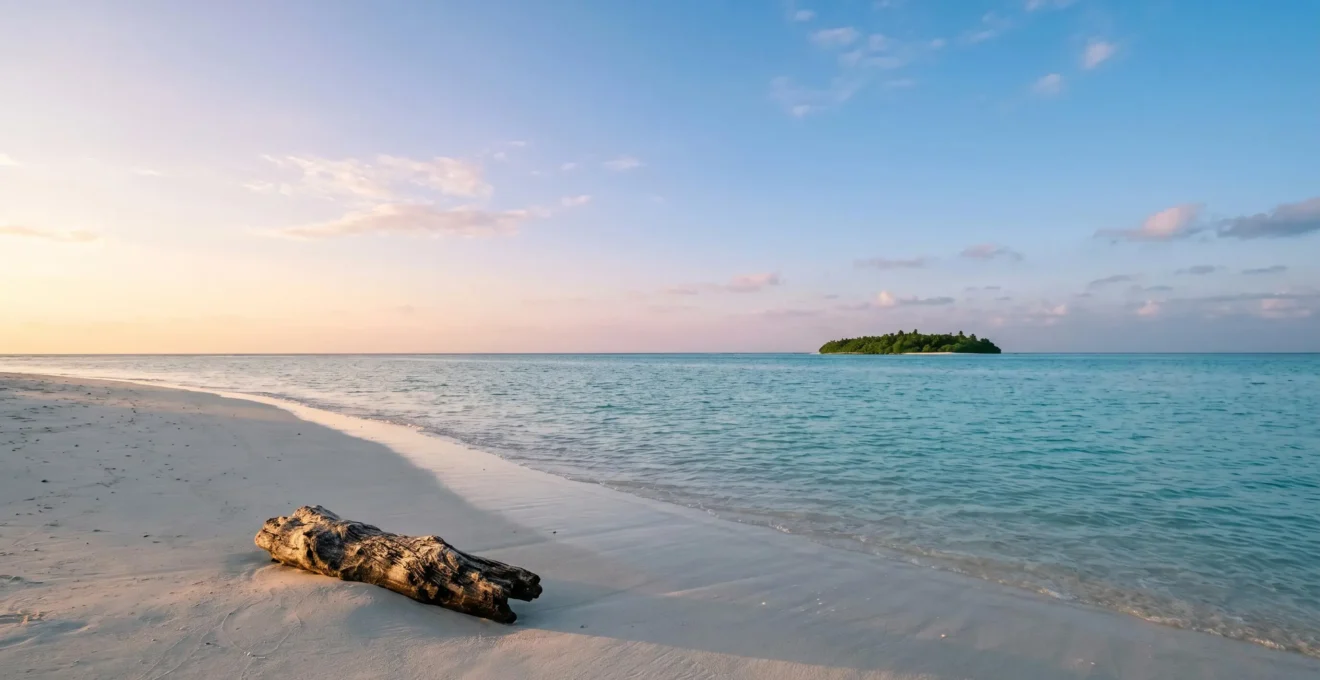
Finding a truly pristine beach is becoming impossible because most travelers follow the same outdated advice, leading them to the same crowded shores.
- The solution is to adopt a systematic approach, using landscape literacy to decode topographic maps and satellite imagery.
- Understanding the science of water clarity and the predictable dynamics of tourist crowds gives you a strategic advantage.
Recommendation: Stop searching like a tourist and start discovering like an explorer by learning to read the hidden language of the coast.
There’s a shared story among modern adventurers: you research for weeks, dreaming of a secluded island paradise. You envision a stretch of white sand, kissed by turquoise water, with no sound but the gentle lap of waves. But when you arrive, the reality is a theme park. The shore is a tapestry of towels, the air thick with the scent of sunscreen and the buzz of a hundred conversations. The quest for untouched beauty often ends in disappointment, a feeling that you’re always one step behind the guidebooks and Instagram geotags.
The common advice—go off-season, talk to locals, walk further down the beach—has become a platitude. While sometimes effective, it’s a strategy of chance, not skill. It fails to address the core problem: everyone is looking in the same way. To find what others miss, you must see what others don’t. The real secret isn’t a location; it’s a methodology. It’s about transforming from a passive tourist into an active scout, one who can read the land, the water, and the subtle patterns of human behavior.
This guide isn’t another list of « secret » spots that will be overrun by next season. Instead, it’s a manual for developing your own system of discovery. We’ll move beyond luck and into the realm of strategy. You will learn the science behind why some waters are impossibly clear while others are murky. You’ll master the art of landscape literacy, turning topographic maps and satellite images into treasure maps. We will explore the critical, yet often ignored, ethics of visiting these fragile spaces. This is your training to become the person who doesn’t just find pristine beaches, but understands and respects them.
To equip you for this journey, this guide is structured as a scout’s manual. Each section builds a specific skill, from mastering time to decoding the environment, helping you find—and preserve—the world’s last untouched shorelines.
Summary: A Scout’s Manual to Undiscovered Shores
- Why Does Visiting Pristine Island Beaches Before 8am Mean Avoiding 90% of Crowds?
- How to Use Topographic Maps to Locate Unmarked Pristine Beaches?
- Pristine Beach With Basic Facilities or Completely Wild Shoreline: Which for a Day Trip?
- The Ecosystem Damage Caused by Taking « Just One » Shell From Pristine Beaches
- When Are Pristine Island Beaches Safe for Swimming: Seasonal Current and Jellyfish Patterns?
- Why Are Some Island Lagoons Crystal Turquoise Whilst Others Are Murky Brown?
- Why Are Caribbean Waters Clearer Than the Mediterranean Despite Similar Warm Climates?
- Which Islands Have Turquoise Lagoons Calm Enough for Young Children to Swim Safely?
Why Does Visiting Pristine Island Beaches Before 8am Mean Avoiding 90% of Crowds?
The most powerful tool for finding solitude is not a map, but a watch. The vast majority of beachgoers operate on a predictable schedule, dictated by hotel breakfast times, tour bus departures, and the collective mindset of a « leisurely » vacation. This creates a massive, under-exploited window of opportunity for the aspiring scout. The hours between sunrise and 8 a.m. are a different world, a hushed, tranquil version of the same coastline that will become a bustling hub by noon. It’s when the soft, golden light is perfect for photography, the air is cool, and the only sounds are the waves and seabirds.
Understanding crowd dynamics is key. Most beach visits are concentrated in the afternoon and on specific days. Research on beach attendance patterns confirms that almost half (48%) of all visits occur on weekends, with peak hours bunching up after lunch. By simply inverting this schedule, you sidestep the human traffic jam. The early morning hours are not just less crowded; they offer a qualitatively better experience. You can jog or walk along paths unimpeded, find the perfect spot without competition, and truly connect with the natural environment before the daily commotion begins.
This strategy also has a secondary, equally valuable window. After 4 p.m., the crowd begins to thin as people depart for dinner preparations and evening plans. This late-afternoon period offers another chance for solitude, often with the added bonus of a spectacular sunset. On peak days, this two-pronged approach of arriving very early and staying late is far more effective than wasting hours in traffic trying to hit the beach at the same time as everyone else. The simple act of timing your visit is the first and most effective step in reclaiming paradise.
How to Use Topographic Maps to Locate Unmarked Pristine Beaches?
While Google Maps shows you the known world, topographic maps reveal its secrets. For the beach scout, these maps are the primary tool for developing landscape literacy—the ability to read the terrain and predict what you’ll find on the ground. A standard road map shows you how to get to a named beach; a topographic map shows you the potential for an unnamed one. The key is learning to interpret the language of contour lines, which represent elevation. These lines tell a story about the coast’s accessibility and form.
The basic principle is simple: widely spaced contour lines indicate gentle, walkable slopes, while tightly packed lines signal steep, often impassable cliffs. A scout looking for a hidden cove will scan the coastline for U-shaped or V-shaped indentations where the contours are spread apart, suggesting a gradual descent to the sea. You also learn to cross-reference this data. By pairing a topographic map with high-resolution satellite imagery, you can spot faint « social trails » or changes in vegetation that hint at an unofficial access point not marked on any map. This combination of elevation data and visual ground-truthing is the core of systematic discovery.
This technique helped explorers on the Oregon coast identify hidden inlets by looking for unassuming markers like « natural area » or « viewpoint » on maps, which often signaled a nearby, unadvertised trail to the shore. Becoming proficient at this requires practice, but it fundamentally changes your relationship with travel. You are no longer a passive recipient of information but an active investigator of the landscape, unlocking coastal access that remains invisible to the average tourist.
Your Action Plan: Reading Topo Maps for Beach Discovery
- Identify Steep Terrain: Look for closely spaced contour lines. These signal cliffs and dangerous, inaccessible areas where you should exercise extreme caution.
- Find Gentle Slopes: Search for widely spaced contour lines. This is your primary indicator of a gentle, walkable slope that could lead down to the water.
- Locate Coves: Scan for U-shaped or V-shaped indentations in the coastline’s contour pattern. These often reveal sheltered coves and hidden beaches.
- Cross-Reference with Imagery: Overlay your map findings with high-resolution satellite imagery. Look for faint footpaths, vegetation changes, or stretches of sand without obvious road access.
- Prepare for Offline Navigation: Download offline topographic maps (like the USGS 7.5-minute series for the US) to your GPS device or phone before heading into remote areas with no cell signal.
Pristine Beach With Basic Facilities or Completely Wild Shoreline: Which for a Day Trip?
Once your map-reading skills have unveiled a potential location, the next strategic decision is one of logistics and mindset: are you seeking a pristine beach with a touch of convenience, or a completely wild, untamed shoreline? The choice between these two types of « pristine » dictates your entire day’s plan, from the gear you pack to the risks you’re willing to accept. It’s a crucial distinction that separates a comfortable adventure from a serious wilderness expedition.
A pristine beach with basic facilities—think a single restroom, a simple outdoor shower, or a small, family-run food stall nearby—offers a balance. Accessibility is generally straightforward, requiring minimal hiking, and the presence of some infrastructure provides a safety net. This option is ideal for « balanced adventurers » or families who want to escape the main tourist beaches without sacrificing all creature comforts. The crowd level is typically low to moderate, but you won’t be completely alone.
On the other hand, a completely wild shoreline is a commitment. Access may require extensive hiking, navigating unmarked trails, or even boat access. You are entirely self-sufficient, meaning you must carry everything in and out, including water, food, and comprehensive first-aid supplies. There are no lifeguards and likely no cell service. This is the domain of the wilderness purist, the experienced outdoorsperson who finds reward in radical self-reliance and the profound solitude it brings. Planning for this type of trip is extensive, involving checks of tide schedules, weather monitoring, and a clearly defined emergency exit strategy. The following table breaks down the decision-making process.
| Feature | Beach with Basic Facilities | Completely Wild Shoreline |
|---|---|---|
| Accessibility | Easy vehicle access, marked parking | Requires hiking, unmarked trails, boat access |
| Amenities | Restrooms, simple showers, nearby food | No facilities – bring everything |
| Safety | Lifeguards sometimes present | No lifeguards, limited cell service |
| Crowd Level | Low to moderate | Minimal to none |
| Equipment Needed | Basic beach gear sufficient | PLB/satellite messenger, water filter, comprehensive first-aid, high-energy food, offline maps |
| Best For | Comfort Seekers, Balanced Adventurers | Wilderness Purists, experienced outdoors people |
| Planning Required | Minimal | Extensive: tide schedules, weather monitoring, emergency exit strategy, pre-determined rendezvous point |
The Ecosystem Damage Caused by Taking « Just One » Shell From Pristine Beaches
The instinct is almost universal: you’re walking on a perfect, untouched beach, and you spot a beautiful, empty shell. Taking it seems like a harmless way to capture a memory. But the scout’s ethos requires a deeper understanding. On a pristine beach, every element is part of a fragile, functioning system. That « just one » shell, when multiplied by thousands of visitors over time, causes a devastating cascade of ecological damage that is nearly invisible to the casual observer.
Shells are not mere decorations; they are critical coastal infrastructure. They provide essential homes for hermit crabs, attachment surfaces for algae and sponges, and hiding spots for small fish avoiding predators. As they break down, shells release calcium carbonate back into the environment, which is vital for buffering the pH of the sand and providing nutrients for sand-dwelling organisms. The removal of shells, especially large ones, also accelerates shoreline erosion by weakening the beach’s natural armor. The link between tourism and this degradation is not theoretical; a landmark 30-year study found shell numbers decreased by 60% on a Spanish beach while tourism soared. The science is clear: we are loving these beaches to death, one souvenir at a time.
This is one of the most understudied but significant impacts of tourism. The cumulative effect of millions of individual actions creates a profound problem for the organisms that depend on these shells for their very survival. Adopting a strict « leave no trace » policy, which includes leaving all shells, sand, and pebbles in their place, is not just a nice idea—it’s an ecological imperative. The best souvenir is a photograph, and the greatest act of respect is to leave the beach as pristine as you found it, allowing its delicate systems to continue functioning for generations to come.
As the image above powerfully illustrates, a simple shell is often a home. For a hermit crab, a suitable shell is a matter of life and death. By taking one, a visitor may be inadvertently signing a death warrant for one of the beach’s most iconic residents. The most rewarding mindset for an explorer is not that of a collector, but of a guardian.
When Are Pristine Island Beaches Safe for Swimming: Seasonal Current and Jellyfish Patterns?
Discovering a deserted beach is a triumph, but it comes with a critical responsibility: you are your own lifeguard. Wild shorelines lack the flags, safety patrols, and warning signs of developed beaches. This means a scout must possess a basic knowledge of ocean safety, particularly in identifying dangerous currents and understanding seasonal hazards. The most beautiful water can conceal the most significant dangers, and rip currents are the most common and treacherous.
A rip current is a powerful, narrow channel of water moving away from the shore. It doesn’t pull you under, but it can pull you out to sea at a frightening speed. Panicking and trying to swim against it is a fatal mistake. Fortunately, rip currents have distinct visual cues that a trained eye can spot from the shore. The National Weather Service notes that while they can occur any time, rip currents are most common during summer months, especially when offshore storms generate larger waves. Before ever entering the water on an unpatrolled beach, take several minutes to stand back and observe the wave patterns. Look for the tell-tale signs: a break in the incoming wave pattern, a channel of churning, choppy water, or a line of foam and debris moving steadily seaward.
Beyond currents, seasonal patterns are also crucial. In many tropical regions, certain months bring an influx of jellyfish or other stinging marine life. A quick online search for your specific island’s « marine stingers calendar » or consulting local dive shops before you go is a vital planning step. If you are ever in doubt about the conditions, the safest choice is to stay out of the water. The ultimate goal of the scout is not just to find the pristine beach, but to return safely from it. Here are the key visual cues for identifying a rip current:
- Look for darker, choppier water compared to surrounding areas.
- Watch for noticeable gaps or breaks in the wave pattern.
- Observe channels where foam, seaweed, and debris move steadily away from shore.
- Notice areas where waves are breaking consistently on either side but not in the center.
- If caught: stay calm, swim parallel to the shore until the current stops, then angle back diagonally.
- Float on your back if tired—never fight the current directly.
Why Are Some Island Lagoons Crystal Turquoise Whilst Others Are Murky Brown?
The vision of a perfect island beach is almost always defined by its water: a luminous, impossible shade of turquoise. But not all tropical waters are created equal. Some lagoons are crystal clear, while others, sometimes just a few bays over, are murky and brown. This difference is not random; it’s the result of a precise scientific recipe—a hydrographic signature. Understanding this « Turquoise Trifecta » allows a scout to predict water clarity before even setting foot on an island.
The first and most critical ingredient is the sand. The iconic turquoise color is born from light reflecting off a bright, white bottom. In the world’s clearest lagoons, this sand is not made of rock, but of calcium carbonate from pulverized coral and, fascinatingly, the excrement of parrotfish who spend their days nibbling on the reef. This brilliant white base acts like a mirror, bouncing sunlight back up through the water column.
The second factor is shallow depth. The light needs to be able to penetrate all the way to the bottom and reflect back to your eye. In deep water, light is scattered and absorbed, resulting in the deep navy blue of the open ocean. Shallow lagoons, however, create a natural swimming pool effect, allowing the water to become saturated with reflected color. The third and final ingredient is the water’s chemistry. The most vibrant lagoons are oligotrophic, meaning they are nutrient-poor. This prevents the growth of phytoplankton and algae that would otherwise cloud the water, giving it a greenish or brownish tint. This perfect combination—white sand, shallow depth, and clear, nutrient-poor water—is what creates the dazzling turquoise of places like Aitutaki in the Cook Islands and the lagoons of the Maldives, turning them into natural wonders.
Why Are Caribbean Waters Clearer Than the Mediterranean Despite Similar Warm Climates?
The « Turquoise Trifecta » explains why a specific lagoon is clear, but geology and oceanography explain why entire regions, like the Caribbean, are renowned for clarity while others, like the Mediterranean, are not, despite similar warm climates. The difference lies deep in the geology of the seafloor and the macro-dynamics of ocean currents. It’s a tale of two very different seas.
The Caribbean basin is fundamentally built for clarity. It rests on an ancient limestone platform, which is essentially fossilized coral reef. This geological base doesn’t produce much loose, muddy sediment. When it erodes, it creates more of the white calcium carbonate sand that promotes clarity. Furthermore, the Caribbean is an open system, constantly flushed by powerful Atlantic currents that swiftly carry away any sediment that does enter the water. It’s like a self-cleaning pool on a massive scale.
The Mediterranean, by contrast, is geographically predisposed to murkiness. It is a semi-enclosed sea, surrounded by relatively young, steep mountain ranges. Numerous large rivers (the Nile, the Po, the Ebro) constantly discharge enormous amounts of silt and agricultural runoff into this contained basin. With a very slow water renewal rate—taking hundreds of years for a full exchange with the Atlantic—this sediment and pollution has nowhere to go. It accumulates, feeding algae blooms and reducing visibility. While the Med has many stunningly beautiful coastlines, its baseline clarity can’t compete with the geologically and hydrologically blessed Caribbean. This large-scale understanding helps a scout set realistic expectations based on a region’s fundamental natural systems.
Key Takeaways
- Master Time & Crowd Dynamics: The easiest way to find solitude is to operate outside peak hours, especially by visiting beaches before 8 a.m.
- Develop Landscape Literacy: Learn to read topographic maps and satellite imagery to identify potential unmarked beaches by interpreting contour lines and terrain features.
- Understand and Respect the Ecosystem: Recognize that pristine beaches are fragile systems. Adopt a strict « leave no trace » ethic, especially by never taking shells, to prevent cumulative ecological damage.
Which Islands Have Turquoise Lagoons Calm Enough for Young Children to Swim Safely?
For the scout traveling with family, the quest for a pristine beach has an added dimension: safety. The ideal family beach combines the beauty of a turquoise lagoon with the calm, shallow waters necessary for young children to swim securely. Instead of relying on a list of « top 10 family beaches, » a scout uses a repeatable method to identify these safe havens anywhere in the world: the Barrier Reef Method.
The key is to look for islands with a prominent barrier reef—a coral reef that runs parallel to the coast but is separated from it by a wide, deep lagoon. This reef acts as a natural breakwater, absorbing the energy of open-ocean waves and creating a vast, protected area of exceptionally calm and shallow water between the reef and the main island. These lagoons are the planet’s ultimate natural swimming pools. Using satellite imagery, you can easily identify these locations by looking for the dark line of the outer reef and the expansive, light-blue area of the lagoon behind it. This method allows you to assess suitability from thousands of miles away.
Applying this criteria reveals ideal spots in both famous and unexpected destinations. The world-famous lagoons of Bora Bora and Aitutaki are classic examples. But the same method can identify the family-safe, shallow waters of Elafonissi in Crete, certain areas of El Nido in the Philippines, and Turquoise Bay in Western Australia. The high demand for such locations is clear, as European tourism data shows beach and leisure activities were most important for a majority of travelers from the UK (66%), Germany (64%), and the Netherlands (55%). By learning to spot the tell-tale signature of a barrier reef, you can satisfy this desire for a perfect beach experience while ensuring a safe environment for your entire crew.
Your next adventure doesn’t start with a flight booking; it starts with a map and a new way of seeing. Begin your journey from tourist to true scout by applying these principles of landscape literacy and conscious exploration to your next island destination. The world is full of hidden wonders, waiting for those who know how to look.