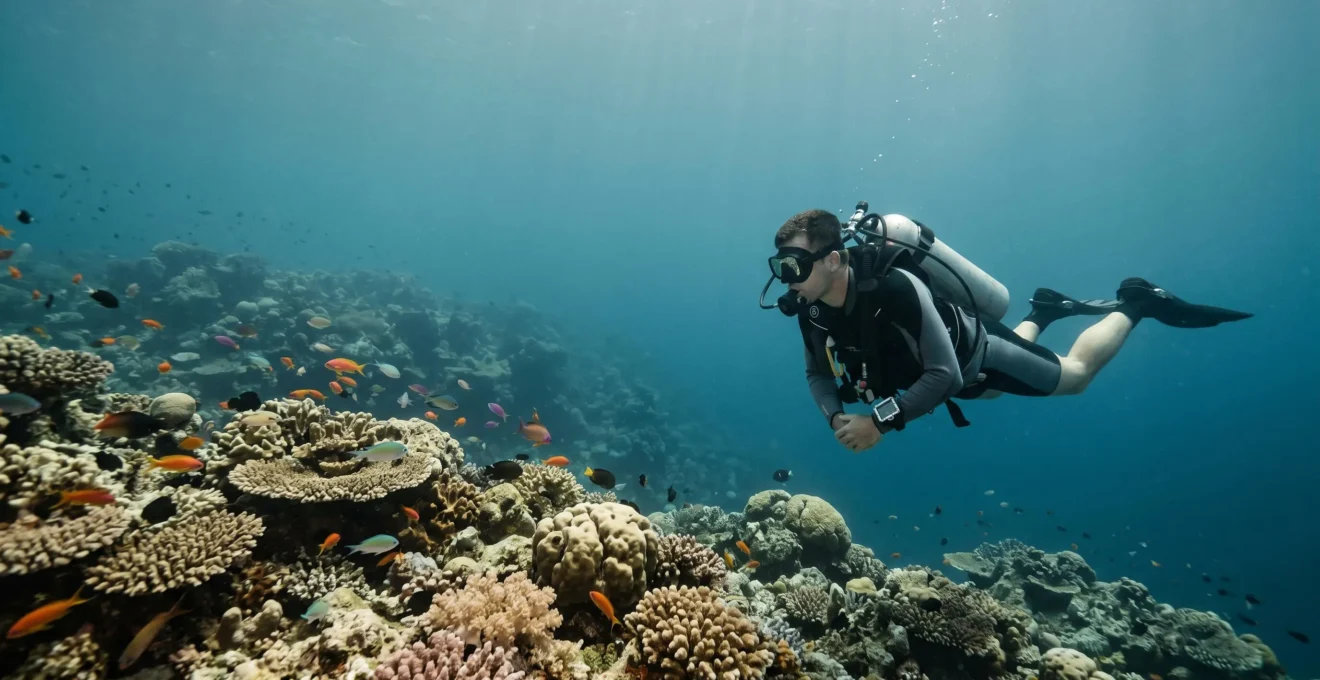
Choosing the right dive isn’t about the certification card in your wallet; it’s about a dynamic self-assessment of your real-world experience against the dive’s specific demands.
- Certification is a license to learn, not a guarantee of skill in all conditions. Logged experience in varied environments is a more reliable predictor of competence.
- Dive operators’ marketing terms often hide the true skill requirements. Understanding terms like « drift dive » or « pinnacle » is crucial for safety.
Recommendation: Before booking any island dive, use your logbook to honestly assess your skills in buoyancy, navigation, and recent activity, then critically question the dive operator about their safety procedures and guide-to-diver ratios.
For many divers, planning an island getaway revolves around one question: « What dives can I do? » The default answer is to pull out a certification card. An Open Water card means Open Water sites; an Advanced card unlocks deeper options. But this approach is a dangerous oversimplification. It treats a qualification earned, perhaps years ago in calm conditions, as a universal passport to any environment an operator is willing to take you to. This mindset overlooks the vast difference between being certified and being competent for a specific challenge.
The common advice— »log your dives » and « talk to the dive shop »—is well-intentioned but incomplete. It fails to provide a framework for translating that logbook into a meaningful decision or for asking the right, probing questions. The true key to selecting safe and enjoyable island dives lies in a paradigm shift: from passively relying on a piece of plastic to actively conducting a dynamic self-assessment. This involves honestly evaluating your recent experience, developing environmental literacy to « read » the conditions, and learning to decode the marketing language of dive centers.
This guide moves beyond the platitudes. It provides a strategic framework for every diver, from the newly certified to the seasoned veteran, to accurately match their true abilities with the unique demands of island diving. We will deconstruct the fundamental safety protocols, teach you how to vet an operator, and provide tools to translate dive site descriptions into real-world skill requirements. By the end, you will be empowered to make informed decisions that prioritize not just adventure, but your safety and the health of the marine ecosystems you explore.
To help you navigate these critical considerations, this article is structured to build your decision-making framework step-by-step, from understanding basic safety limits to making responsible conservation choices.
Summary: How to Choose Island Scuba Diving Experiences Matching Your Certification and Experience
- Why Do Discovery Scuba Dives Restrict You to 12 Metres and 40 Minutes?
- How to Check Island Dive Operators Meet International Safety Standards?
- Beginner Dive Sites or Advanced: Which Island Locations Match Your Experience Level?
- The Scuba Diving Mistake That Causes Decompression Sickness on Island Dive Trips
- When Are Island Scuba Diving Conditions Best: Seasonal Visibility and Marine Life Patterns?
- How to Snorkel Coral Reefs Without Damaging Them: Buoyancy and Reef-Safe Sunscreen?
- Barrier Reef Lagoon or Volcanic Crater Lagoon: Which Offers Better Snorkelling for Beginners?
- How to Find Healthy Coral Reefs That Welcome Responsible Snorkellers?
Why Do Discovery Scuba Dives Restrict You to 12 Metres and 40 Minutes?
The strict limits on introductory or « discovery » dives are not arbitrary; they are a fundamental safety protocol designed to create a significant physiological safety buffer for untrained participants. The core principle is to manage nitrogen absorption. As you descend, the increased pressure causes your body tissues to absorb more nitrogen from the air you breathe. If you ascend too quickly or have too much nitrogen in your system, it can form bubbles in your tissues and bloodstream, causing Decompression Sickness (DCS), a serious and potentially life-threatening condition.
By restricting the dive to a maximum depth of 12 meters (40 feet) and a duration of around 40 minutes, dive agencies like PADI ensure that nitrogen absorption remains minimal. This shallow depth and short time create a profile where the risk of DCS is virtually eliminated, even if a novice diver makes mistakes during ascent. This strategy is critical because discovery participants have not been trained in ascent rates, safety stops, or how to use a dive computer. The depth limit is a cornerstone of programs like the PADI Scuba Diver certification, which is specifically designed for those with limited time who will always dive under professional supervision.
While the risk of DCS in recreational diving is statistically low, with professional medical data showing an incidence of only 2 to 4 cases per 10,000 dives, this rate applies to certified divers following protocols. For untrained individuals, the risk would be significantly higher without these conservative restrictions. These limits are the first and most important lesson in matching experience to environment: when skill is absent, the environment must be strictly controlled.
How to Check Island Dive Operators Meet International Safety Standards?
Your certification is only half of the safety equation; the other half is the professionalism and preparedness of the dive operator you choose. On a remote island, you are placing your trust in their equipment, their knowledge of local conditions, and their emergency procedures. A glossy brochure or a cheap price is no substitute for a rigorous safety culture. Vetting an operator before you even arrive on the island is a non-negotiable step for any responsible diver.
A professional operator will welcome questions about safety and transparency. Their answers—or lack thereof—will reveal their commitment to your well-being. Don’t be shy about asking direct questions regarding their procedures, equipment, and staff credentials. Reputable centers with up-to-date credentials and well-maintained gear will be proud to show them off. As the SDI/TDI training standards organization notes, a diver’s education goes beyond in-water skills. As they state in their guide to diving in dynamic environments:
Quality training teaches divers an equally important lesson: understanding personal limits and making informed decisions.
– SDI/TDI Training Standards, Diving Safely in Dynamic Environments
Making an informed decision starts with asking the right questions. The following checklist provides a powerful tool to screen dive operators before you book, helping you distinguish between a professional outfit and one that cuts corners on safety.
Your Pre-Booking Safety Verification Checklist
- Ask about air management: « What is your procedure if a diver in the group gets low on air before others? » A professional response will detail buddy protocols or a clear plan for the guide to ascend with the diver.
- Inquire about group sizes: « What is your guide-to-diver ratio for a group with my experience level? » Look for lower ratios, ideally no more than 1:4 or 1:6 for less experienced groups.
- Verify emergency equipment: « Can I see your emergency oxygen kit and its last service date upon arrival? » A confident « yes » is a great sign. Hesitation is a red flag.
- Question emergency plans: « What are your emergency evacuation procedures, and where is the nearest hyperbaric chamber? » They should have a clear, practiced plan.
- Confirm credentials: « Are all your instructors and divemasters current with their certifications and insured? » Professionals maintain transparent and up-to-date documentation.
Beginner Dive Sites or Advanced: Which Island Locations Match Your Experience Level?
This is the central question where most divers make a critical error: they equate their certification level with their experience level. An Advanced Open Water card with only nine total dives does not make you an « advanced » diver, especially when faced with strong currents or challenging navigation. Your logbook is a far more honest measure of competence than your certification card. True self-assessment requires looking at the number, variety, and recency of your dives.
A diver with 100 logged dives in a calm quarry may be less prepared for a dynamic reef environment than a diver with 30 dives in varied ocean conditions. Before evaluating a dive site, evaluate yourself. Ask: When was my last dive? How is my buoyancy control right now, not six months ago? Have I ever deployed a surface marker buoy (SMB) in a current? This dynamic self-assessment is the foundation of safe dive planning.
With an honest assessment of your skills, you can then begin to decode the marketing language used by dive operators. Terms like « exciting drift dive » or « dramatic pinnacle » sound appealing, but they describe environmental conditions that demand specific, well-practiced skills. Failing to understand this translation from marketing to reality is how divers find themselves in situations that are, at best, uncomfortable and, at worst, dangerous. The following table decodes common dive site terminology to help you match them with your true skill level.
As this analysis from NOAA on diving conditions implicitly shows, the name of a dive site often hints at the skills required. The following table breaks down what these names really mean for you as a diver.
| Marketing Term | Actual Diving Conditions | Required Skills & Certification |
|---|---|---|
| Drift Dive | Currents exceeding 1 knot, rapid horizontal movement | SMB deployment proficiency, Advanced Open Water recommended, 20+ logged dives |
| Pinnacle / Seamount | Strong and unpredictable multi-directional currents, depth variation | Advanced buoyancy control, current navigation experience, minimum 30 logged dives |
| Swim-Through / Cavern | Overhead environment with restricted passages | Excellent buoyancy control, no-contact finning, Cavern/Cave specialty for complex systems |
| Deep Dive | Depths 18-40 meters with increased nitrogen narcosis risk | Advanced Open Water or Deep Diver specialty, understanding of decompression limits |
| Wreck Dive (Penetration) | Enclosed spaces, silt-out potential, entanglement hazards | Wreck Diver specialty certification, redundant equipment, advanced training required |
The Scuba Diving Mistake That Causes Decompression Sickness on Island Dive Trips
The single biggest mistake divers make on island vacations isn’t a dramatic error on one dive, but a slow, cumulative series of seemingly minor misjudgments over several days. This mistake is underestimating cumulative nitrogen loading. While a single dive may be well within your computer’s no-decompression limits (NDLs), doing multiple dives per day for consecutive days creates a compounding effect. Your body may not have enough time during surface intervals to fully off-gas the nitrogen from previous dives, leading to a progressively higher baseline saturation that standard dive computer algorithms can struggle to track accurately.
This risk is amplified by the typical holiday environment. Factors like dehydration from the tropical climate, fatigue from travel, and even moderate alcohol consumption the night before can all impair your body’s ability to eliminate nitrogen efficiently. According to the CDC, dehydration alone can significantly increase DCS risk. A yo-yo depth profile (frequently ascending and descending during a dive) or cutting surface intervals short to fit in another dive further compounds the problem.
The consequences of getting this wrong are severe. Decompression sickness primarily affects the nervous system. In fact, comprehensive research revealed that an alarming 88.5% of DCS cases presented with neurological symptoms, ranging from numbness and tingling to paralysis and cognitive impairment. The best way to avoid becoming a statistic is to be conservative. Build longer surface intervals into your plan, stay exceptionally well-hydrated, avoid alcohol before diving days, and plan your deepest dive first. Most importantly, listen to your body; if you feel fatigued, skip a dive. The reef will be there tomorrow.
When Are Island Scuba Diving Conditions Best: Seasonal Visibility and Marine Life Patterns?
Many divers chase one metric above all: perfect visibility. While crystal-clear water is beautiful, defining « best » conditions solely by visibility is a novice mistake. Experienced divers and underwater photographers know that the ‘best’ time to dive depends entirely on your objective. Seasonal changes dramatically affect not just visibility but also water temperature, currents, and, most importantly, marine life behavior. Strategic dive planning involves aligning your trip with these patterns, not just hunting for clear water.
For example, the dry season in many tropical locations often brings calm seas and stunning 20-30 meter visibility. This is ideal for wide-angle photography, capturing sweeping reefscapes, and spotting pelagic species like sharks that patrol the reef edges. However, this is also peak season, meaning more crowds and higher prices. Conversely, the rainy or transitional season might bring plankton blooms that reduce visibility to 10-15 meters.
While this « green water » might deter some, it’s a dinner bell for others. These nutrient-rich conditions are what attract massive aggregations of filter-feeding megafauna like manta rays and whale sharks. The lower visibility also forces a change in focus, creating perfect conditions for macro photography and « muck diving, » where the hunt is for small, rare critters like frogfish and ornate ghost pipefish hiding in the sediment. As a case study on strategic planning highlights, experienced divers don’t avoid low-visibility seasons; they use them to their advantage to see specific marine life that is absent during the clearer months. The key is to research the destination’s specific seasonal patterns and decide: am I here for the big picture or the tiny details?
How to Snorkel Coral Reefs Without Damaging Them: Buoyancy and Reef-Safe Sunscreen?
The beauty of a coral reef is fragile. A single misplaced fin kick or a cloud of the wrong sunscreen can cause irreparable damage to an ecosystem that has taken centuries to grow. For snorkelers, the prime directive is simple: look, but do not touch. This principle extends to everything—your hands, your feet, and your equipment. The most common damage from snorkelers comes from standing on coral (mistaking it for rock) or from kicking it with fins while trying to stay afloat.
The key skill to prevent this is buoyancy control, even at the surface. Instead of a vertical, « bicycle-kicking » posture that sends your fins straight down towards the coral, practice a calm, horizontal trim. Keep your body parallel to the surface, with your legs straight behind you, and use slow, deliberate kicks that stay just below the water. If you need to rest, find a sandy patch or float on your back away from the reef. Never use the coral to steady yourself. A buoyancy vest or even a simple pool noodle can be a great aid for beginners, helping you float effortlessly without the temptation to stand.
The second critical aspect of responsible snorkeling is chemical. Many common sunscreens contain chemicals like oxybenzone and octinoxate, which are highly toxic to coral, causing bleaching and DNA damage even in minute concentrations. Always choose a « reef-safe » sunscreen that uses mineral-based blockers like zinc oxide or titanium dioxide. Better yet, minimize sunscreen use altogether by wearing a long-sleeved rash guard and leggings. This provides superior sun protection without releasing any harmful substances into the water, protecting both your skin and the delicate marine life you’ve come to admire.
Barrier Reef Lagoon or Volcanic Crater Lagoon: Which Offers Better Snorkelling for Beginners?
For a beginner snorkeler or a diver doing their first training dives, the choice of environment is critical for building confidence and ensuring safety. While both barrier reef lagoons and volcanic crater lagoons offer protected waters, they present distinct characteristics. For the true novice, a volcanic crater lagoon is almost always the superior choice. These environments, often formed in collapsed calderas like the « Molokini Crater » in Hawaii, are typically small, almost fully enclosed, and exceptionally sheltered from open-ocean swell and currents.
The result is an environment that is as calm and predictable as a natural swimming pool. The depth is often shallow and slopes gently, allowing beginners to stay in comfortable depths. The near-absence of currents means minimal energy is expended, allowing new snorkelers to focus on their breathing and technique rather than fighting the water. While water clarity can sometimes be affected by fine volcanic sediment, these craters often serve as vital nurseries for juvenile fish, offering delightful and easy-to-observe marine life.
A barrier reef lagoon, while also protected, is a much larger and more dynamic system. The sheer size means there is more potential for wind-generated chop. More importantly, these lagoons are connected to the open ocean via channels. As tides change, moderate currents can flow through these passages, which can be challenging for an inexperienced swimmer. While the water clarity is often better and the biodiversity more extensive, it may require a longer swim to reach the best parts of the reef. For a beginner, the predictability and tranquility of a volcanic crater provide an unmatched learning environment.
This comparative analysis of lagoon types, drawing from observations of dive sites worldwide, highlights key differences for beginners. The data below shows why a crater is often the best starting point.
| Characteristic | Volcanic Crater Lagoon | Barrier Reef Lagoon |
|---|---|---|
| Typical Depth Range | 3-8 meters, gradual slope | 2-15 meters, variable with channels |
| Current Conditions | Minimal to none, highly protected | Moderate tidal currents, stronger near channels |
| Water Clarity | Variable, can be affected by volcanic sediment | Generally excellent, 15-25 meter visibility |
| Marine Life Type | Juvenile fish nursery, macro subjects, reef fish | Larger pelagic species near drop-off, diverse reef ecosystem |
| Beginner Friendliness | Excellent – calm, predictable, sheltered | Good – but requires current awareness near passages |
| Energy Expenditure | Low – minimal swimming against current | Moderate – may require longer surface swim to reef edge |
| Dive Site Indicator | Suggests calm, easy scuba conditions for training | Hints at potential drift diving and deeper wall opportunities |
Key Takeaways
- Your certification card is a starting point, not a complete measure of your ability. Your logbook and recent experience are more important.
- Island diving holidays introduce unique risks like cumulative nitrogen loading and dehydration. Dive conservatively.
- The « best » conditions are subjective. Match your dive objective (e.g., macro photography vs. pelagic encounters) to the season, not just the visibility.
How to Find Healthy Coral Reefs That Welcome Responsible Snorkellers?
Finding a vibrant, thriving coral reef is the ultimate goal, but it’s also a responsibility. The healthiest reefs are often those under active protection. Therefore, the most effective strategy for finding a quality site is to seek out locations designated as Marine Protected Areas (MPAs). An MPA is a legally defined section of the ocean where human activities are more strictly regulated than in surrounding waters to protect natural and cultural resources. Choosing to visit and pay fees in an MPA directly supports the conservation efforts that keep reefs healthy.
However, a designation on a map is not enough. The key is to look for signs of active management and enforcement. Do you see ranger patrols on the water? Are there mooring buoys for boats to use instead of dropping anchors on the coral? The presence of these buoys, as noted by the NOAA National Marine Sanctuary System, is often a clear indicator of a well-managed and popular site. Operators who hold official permits to work within the MPA are also a positive sign, as they are beholden to its rules.
Beyond official designations, look for operators with third-party eco-certifications. Programs like « Blue Star » in the US or the international « Green Fins » initiative assess dive and snorkel operators on their environmental standards. Choosing a certified operator ensures you’re giving your business to a company committed to best practices, from waste management to detailed environmental briefings. This proactive research not only leads you to healthier, more vibrant reefs but also ensures your tourism dollars contribute to their long-term survival.
Action Plan: How to Verify a Healthy Reef Destination
- Research MPA Status: Before you travel, use government or NOAA databases to confirm if your destination has legally established Marine Protected Areas.
- Assess Enforcement: Look for evidence of active management, such as visible ranger patrols, mooring buoy systems, and clear zoning rules for activities.
- Check Operator Compliance: Ask if your chosen tour operator holds the required permits to operate within the MPA and if they contribute to conservation fees.
- Seek Eco-Certifications: Prioritize operators certified by reputable programs like Green Fins or Blue Star, which audit for sustainable practices.
- Use Citizen Science: Check platforms like iNaturalist or Reef Check for recent user-submitted photos and observations of reef health in the area.
Ultimately, a successful island dive trip is the result of this thoughtful planning. By moving beyond your certification card and embracing a holistic assessment of your skills, the operator’s professionalism, and the environment’s demands, you can ensure every descent is not only thrilling but fundamentally safe. Start applying this framework today by vetting operators for your next trip with the critical questions provided in this guide.