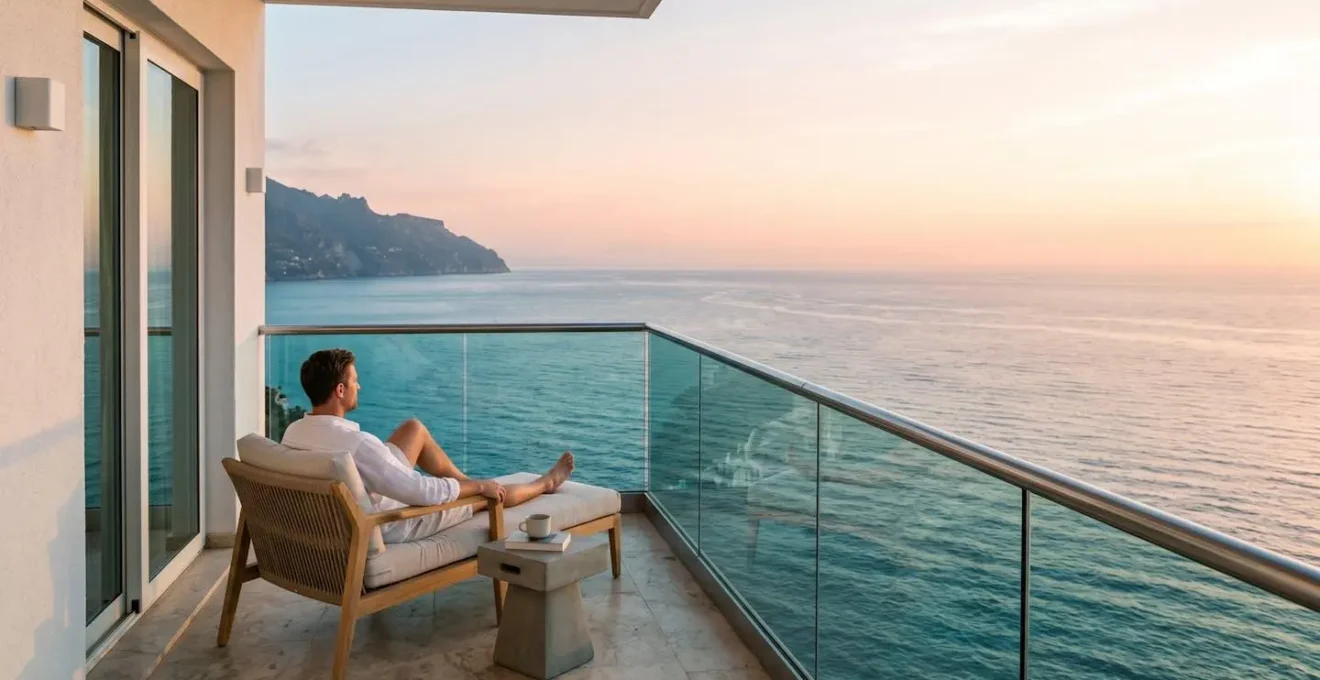
The marketing term « Ocean View » is no guarantee of quality; securing a spectacular vista depends on understanding a hotel’s architecture and operational weak points.
- Architectural reality, like corner room placement and floor height, dictates a view’s quality far more than its official category name.
- Booking photos are often manipulated with specific lenses and angles; learning to spot these tricks is key to managing expectations.
Recommendation: Use a combination of direct booking, loyalty status, and precise communication with the Front Office Manager—not the general reservation line—to request specific, pre-verified room numbers.
You’ve been there before. After hours of research, you pay a premium for that coveted « Ocean View » room, dreaming of panoramic sunsets from your balcony. You arrive, open the curtains, and your heart sinks. The promised vista is a disappointing sliver of blue visible only if you lean precariously over the railing, framed by a parking lot and the resort’s noisy air conditioning units. This frustrating gap between expectation and reality is a common pain point for even the most seasoned travelers.
Many will advise you to simply « read the fine print » or « look at traveler photos, » but this advice is superficial. It fails to address the underlying systems that create the problem. Hotels use a specific vocabulary— »oceanfront, » « ocean view, » « partial view »—that is intentionally flexible. Their photography is a masterclass in perspective that can make a distant sea appear to be at your doorstep. To truly secure the view you’re paying for, you need to stop being a passive customer and start thinking like a hotel strategist.
But what if the key wasn’t just in deciphering these terms, but in understanding the hotel’s physical and operational structure to your advantage? This guide moves beyond the basics. We won’t just define the terms; we’ll deconstruct the architectural and photographic tactics hotels use. We will provide a clear, actionable strategy to bypass the marketing fluff and leverage insider knowledge to ensure the view from your window is the one you actually dreamed of.
This article provides a complete roadmap for the discerning traveler. We will explore the tangible value of specific room types, how to make requests that get results, the critical trade-offs to consider, and the visual tricks you need to recognize on booking sites. Follow these steps, and you’ll never be disappointed by a « partial view » again.
Summary: A Traveler’s Guide to Guaranteeing Your Hotel’s Ocean View
- Why Do Corner Hotel Rooms Offer 180-Degree Ocean Views Worth the 30% Upcharge?
- How to Request Specific Room Numbers With Verified Ocean Views Before Check-In?
- High-Floor Ocean Panorama or Ground-Floor Beach Access: Which Room Type for a 5-Day Stay?
- The Photo Angle Trick Hotels Use to Exaggerate Ocean Views on Booking Sites
- When Can You Book Ocean View Island Rooms for 50% Less Than Peak Season?
- Why Do Beachfront Island Hotels Cost 40% More Than Properties 500m Inland?
- How to Photograph Island Sunsets With Properly Exposed Foregrounds and Vibrant Skies?
- Which Islands Offer the Most Diverse Coastal Landscapes in a Single Destination?
Why Do Corner Hotel Rooms Offer 180-Degree Ocean Views Worth the 30% Upcharge?
The premium price for a corner room isn’t just a marketing gimmick; it’s rooted in a fundamental architectural advantage that standard rooms cannot replicate. While a typical room offers a single, forward-facing view, a corner room is positioned at the intersection of two exterior walls. This unique placement often allows for windows on two perpendicular sides, creating a true 180-degree panorama that captures not just the ocean straight ahead, but the coastline and surrounding landscape as well. This dual-aspect view provides a more immersive and expansive experience, justifying the higher cost.
Furthermore, this design often translates to more valuable outdoor space. The balcony on a corner unit can be significantly larger, sometimes wrapping around the building’s edge. This provides distinct zones for lounging and dining, along with multiple angles for appreciating the view. As travel agent Victoria Fricke notes in an interview with Islands magazine, this configuration is a key selling point:
Often the balcony can wrap around the side of the room versus just being on the front, allowing for more outdoor space!
– Victoria Fricke, Travel agent and owner of Vic’s Vacations, interview with Islands
This extra space and the superior, multi-angle view equity are tangible benefits. You aren’t just paying for a label; you’re paying for a geometrically superior position within the building’s footprint, offering a viewing experience that is quantifiably better than that of its neighbors.
How to Request Specific Room Numbers With Verified Ocean Views Before Check-In?
Securing the perfect room is less about luck and more about a systematic, polite, and well-timed communication strategy. Simply adding a note to a third-party booking is the least effective method. To truly influence your room assignment, you must engage directly with the hotel and demonstrate that you are a prepared and valuable guest. The most successful guests don’t just ask for a « nice view »; they know how to navigate the hotel’s internal systems to get their specific, well-researched requests prioritized.
As the editorial team at TripMemos, a travel advice publication, points out, there’s a clear methodology to this process. It’s not about being demanding; it’s about being strategic.
The guests who consistently land the best rooms are not just lucky. They know exactly what to ask for, when to ask, and how to phrase their requests so hotel staff actually want to help.
– TripMemos editorial team, 17 Room Request Tricks That Get You the Best Hotel Room
This proactive approach, which involves using specific channels and timing, dramatically increases the odds of the front desk staff making a special effort for you. The key is to make their job easier by providing clear, concise information and using the hotel’s preferred communication pathways. Your goal is to transform your request from one of thousands into a specific, actionable task for a specific person.
Your Action Plan: The Room Request Escalation Path
- Book directly: Book through the hotel’s website, not third-party sites. This gives you access to special request fields and increases your leverage, as hotels save on the 15-25% commissions paid to online travel agencies.
- Join the loyalty program: Immediately join the hotel’s free loyalty program. Even basic-tier members are prioritized for room assignments over non-members.
- Email the manager: Send a polite, concise email to the Front Office Manager (not general reservations) about two weeks before arrival. Include your confirmation number and specific, researched preferences (e.g., « requesting a room on a high floor on the north side, like room 714 »).
- Use the mobile app: Check in digitally via the hotel’s app hours before your physical arrival. If the assigned room is unsatisfactory, message the front desk through the app to request a change before you even get there.
- Make a final call: Make a polite follow-up call 48 hours before check-in to confirm your request has been noted in their system. This gentle reminder puts your name top-of-mind during final room assignments.
High-Floor Ocean Panorama or Ground-Floor Beach Access: Which Room Type for a 5-Day Stay?
The choice between a high-floor room with panoramic views and a ground-floor room with direct beach access is a classic island travel dilemma. There is no single « best » option; the right choice depends entirely on your travel style, priorities, and who you’re traveling with. This decision is a trade-off between sweeping vistas and ultimate convenience. A romantic couple seeking privacy will have vastly different needs from a family with young children wanting to run straight out to the sand.
High-floor rooms excel at delivering the « wow » factor. They offer unobstructed, elevated perspectives that are perfect for watching sunsets and feeling a sense of seclusion from the activity below. The sounds are often muted to a gentle, distant wash of waves. Conversely, ground-floor rooms, often called « walk-out » or « beachfront, » offer an unparalleled sense of immediacy. The ocean isn’t just a view; it’s an extension of your living space. This is ideal for those who want to be in and out of the water all day without the hassle of elevators or long walks through the resort.
To make an informed decision for your stay, you must weigh these competing benefits. Consider not just the view, but also the soundscape, privacy levels, and the simple logistics of getting to and from the beach and pool. The following table breaks down the key differences to help you align your choice with your vacation goals.
| Criteria | High-Floor Ocean Panorama | Ground-Floor Beach Access |
|---|---|---|
| Best for Traveler Type | Romantic couples, solo travelers seeking privacy | Families with toddlers, action-seekers, water sports enthusiasts |
| View Quality | Unobstructed panoramic vistas, dramatic sunsets, horizon perspective | Intimate beach-level perspective, sand and surf proximity |
| Sound Experience | Reduced noise from pool/beach activities, gentle distant wave sounds | Immersive wave sounds, potential pool music, higher ambient noise |
| Privacy Level | High – no foot traffic, elevated seclusion | Lower – beach passersby may see into room unless curtains closed |
| Convenience Factor | Requires elevator wait, further from beach/pool | Instant beach access, no elevator needed (ideal for families) |
| Sensory Trade-offs | Less salt air intensity, cooler balcony breezes | Maximum salt air, possible proximity to restaurant vents |
The Photo Angle Trick Hotels Use to Exaggerate Ocean Views on Booking Sites
Hotel photography is a powerful marketing tool designed to sell an idealized experience, not to provide a perfectly accurate representation of reality. When it comes to ocean views, photographers employ a specific set of techniques to make vistas appear larger, closer, and more dramatic than they might be in person. Being able to recognize these visual tricks is a critical skill for any traveler trying to perform vista verification before booking. By deconstructing the photo, you can manage your expectations and avoid the disappointment of a view that doesn’t live up to its digital depiction.
One of the most common tactics is the use of extreme wide-angle lenses. While necessary for capturing the small space of a hotel room, these lenses distort perspective, making rooms feel larger and, crucially, pulling the distant background (the ocean) deceptively closer. As the Furoore Photography Guide warns, there is a fine line between professional and dishonest photography.
Once you shoot regularly below 20mm, you’ll notice walls starting to bow outward and beds starting to look like they’re sliding toward the camera. That’s fisheye distortion, and it looks dishonest.
– Furoore Photography Guide, The Ultimate Guide to Hotel, Resort, and Airbnb Photography
This distortion is often combined with other subtle manipulations. Learning to spot them will empower you to look at booking site photos with a more critical, analytical eye. Rather than being seduced by the image, you can start asking practical questions about what the photo *isn’t* showing.
- Extreme wide-angle lenses: Look for slightly curved or bowed lines at the edges of the photo. This effect can make rooms appear 30-50% larger and compress perspective, making the ocean seem nearer.
- Strategic cropping: Be wary of photos that are tightly framed on the view. Ask yourself: what is just outside the frame? Often, obstructions like buildings, roofs, or parking lots are carefully excluded.
- Telephoto lens compression: If a photo taken from a balcony makes the waves look like you can almost touch them, it may have been shot with a telephoto lens, which compresses the distance between the room and the water.
- Ultra-low camera angle: If the photo is taken from near the floor, it’s a trick to create an artificial sense of spaciousness. The view you experience from a normal standing height will be different.
- Unrealistic HDR (High Dynamic Range): If both the dark room interior and the bright ocean outside the window are perfectly exposed with vibrant colors, the image has been heavily manipulated. The human eye cannot perceive this range, and the real-life view will have much more contrast.
When Can You Book Ocean View Island Rooms for 50% Less Than Peak Season?
The secret to booking premium ocean view rooms at a significant discount lies in targeting the « shoulder seasons. » These are the periods just before and after the peak season—think late April/May or September/October for many Caribbean and Mediterranean destinations. During these times, the weather is often still excellent, the crowds have thinned, and hotels are facing lower occupancy rates. This creates a powerful incentive for them to lower prices and offer deals to attract travelers.
When occupancy drops, hotels shift their pricing strategy from maximizing rates to maximizing occupancy. They become more flexible and are often willing to offer not just lower prices but also complimentary upgrades to fill their best rooms, which would otherwise sit empty. This is your window of opportunity. Booking a standard room during a low-occupancy week gives you significant operational leverage for a free upgrade to a coveted ocean view suite. The hotel would rather have you in a premium room paying *something* than have it remain unsold.
This isn’t just theory; it’s a core part of modern hotel revenue management. By understanding this dynamic, you can time your booking to coincide with the hotel’s moment of greatest need, turning their operational challenge into your travel triumph.
Case Study: Strategic Booking for Complimentary Upgrades
During off-peak seasons when hotel occupancy drops, properties frequently employ dynamic pricing to stimulate demand. As detailed in hospitality industry analyses, a high-end resort that normally relies on high-budget guests may slash rates during the low season to attract a different demographic that couldn’t typically afford the stay. This strategy helps keep occupancy steady and revenue flowing. This creates an optimal window for savvy travelers to book a standard room with a high probability of receiving a complimentary upgrade to a premium ocean view room, as the hotel’s priority shifts from rate integrity to filling empty rooms.
To capitalize on this, research the historical peak and off-peak seasons for your chosen island. Look for periods with favorable weather but outside of major holidays or school breaks. Booking during these shoulder periods is the single most effective strategy for cutting the cost of an ocean view room by up to 50% or more.
Why Do Beachfront Island Hotels Cost 40% More Than Properties 500m Inland?
The significant price difference between a true beachfront hotel and one located just a short walk away is a clear example of the « proximity premium. » In real estate and hospitality, direct access and unobstructed views are the most valuable commodities. A hotel sitting directly on the sand can command a higher price because it offers an experience that a property across the street simply cannot replicate: the ability to walk directly from your room onto the beach, the immersive sound of the waves, and guaranteed, unblocked views.
This premium is not arbitrary; it is a calculated reflection of supply and demand. There is a finite amount of beachfront land available for development, making it inherently more valuable. Hotels pay more for this land and pass that cost on to guests who are willing to pay for the ultimate convenience and sensory experience. According to travel industry analysis, this isn’t a small markup. A 2024 analysis of booking data revealed that genuine beachfront hotels charge 15-30% more than similar ‘near-beach’ properties, with the premium easily reaching 40-50% for rooms with full ocean views in prime tourist locations.
This principle is not unique to beach destinations. It is a universal rule in hospitality pricing, where location is paramount. For example, an analysis of hotel pricing in Las Vegas showed a similar dynamic, where proximity to the main attraction dictates the rate.
Properties in Las Vegas within 0.72 miles of the Strip have a premium of 70 percent compared to hotels located beyond 2.25 miles.
– AltexSoft Hotel Pricing Analysis, Rack Rates, BAR, Discounts, and More: A Guide to Hotel Price
Whether it’s a beach or a famous boulevard, the closer you are to the action, the more you pay. When you book a beachfront hotel, you are not just paying for a room; you are paying for a prime location and the convenience that comes with it. For many travelers, that 40% premium is a worthwhile investment for the seamless beach experience it provides.
How to Photograph Island Sunsets With Properly Exposed Foregrounds and Vibrant Skies?
Capturing the magic of an island sunset with your smartphone can be frustrating. Often, you’re forced to choose between a beautifully colored sky with a completely black, silhouetted foreground, or a properly lit foreground with a « blown-out, » washed-out white sky. The secret to a great sunset photo that mirrors what your eyes see is learning to control your phone’s camera exposure manually and then making a few quick edits. This allows you to balance the extreme brightness of the sky with the darkness of the landscape.
The most powerful tool on your phone for this task is the AE/AF (Auto Exposure/Auto Focus) Lock. By locking the exposure on the brightest part of the scene (the sky) and then manually dialing it down, you can preserve the rich, vibrant colors of the sunset that the automatic mode would otherwise overexpose. This technique, combined with a strong foreground element, is the key to moving beyond simple snapshots to creating evocative, well-balanced photographs.
The goal is to create an image with depth and context. A photo of just the sky can be pretty, but a photo of the sky framed by a palm tree or with a person watching the sunset in the foreground tells a story. Here is a simple, step-by-step process you can use on any modern smartphone to dramatically improve your sunset photography from your hotel balcony.
- Use AE/AF Lock: On your iPhone or Android, open the camera app. Long-press your finger on the bright sky area until you see a confirmation that AE/AF Lock is enabled. This locks the focus and exposure to that zone.
- Adjust Exposure Manually: After locking, a sun icon or slider will appear. Slide your finger down the screen to decrease the exposure. The goal is to make the sky’s colors look rich and vibrant, not washed out.
- Anchor with a Foreground Element: Compose your shot using the rule of thirds. Place an interesting silhouette—like a palm tree, a cocktail on the railing, or a person looking out at the view—in the foreground to give the image scale and an emotional anchor.
- Shoot During the « Golden Hour »: The best light occurs in the 30 minutes just before and after the sun officially sets. Avoid shooting in the harsh midday sun, which creates too much contrast.
- Quick Post-Processing: Open your photo in a free app like Snapseed or Lightroom Mobile. Don’t change the whole image; just find the « Shadows » slider and lift it. This will brighten the dark foreground without affecting the perfectly exposed sky, creating a balanced and professional-looking final image.
Key Takeaways
- The term « Ocean View » is a flexible marketing label; a room’s physical location (corner, floor height) is a more reliable predictor of view quality.
- Hotels use specific photographic tricks like wide-angle lenses and strategic cropping to enhance views on booking sites. Learn to spot them.
- The most effective way to secure a good room is through direct, polite, and well-timed communication with the hotel’s Front Office Manager, not a generic booking note.
Which Islands Offer the Most Diverse Coastal Landscapes in a Single Destination?
For the traveler who craves variety, some islands are geological treasures, offering a spectacular range of coastal landscapes within a single, manageable destination. Instead of a monotonous stretch of identical beaches, these unique locations provide a journey through different natural worlds, from sheer volcanic cliffs to serene coral coves, all within a short drive. Choosing such an island means every day can offer a new type of coastal experience, satisfying the explorer’s spirit.
These destinations are defined by their dramatic geological and meteorological diversity. For instance, many volcanic islands have a « windward » side, battered by wind and waves into dramatic, rugged coastlines, and a « leeward » side, sheltered and calm with placid beaches perfect for swimming. Others, like the Big Island of Hawaii, offer the startling contrast of jet-black volcanic sand beaches on one coast and pristine white coral sand beaches on another. This diversity elevates a simple beach vacation into a true journey of discovery.
However, this variety comes with a logistical reality. Experiencing these different landscapes often requires renting a car and planning your days around travel times that can range from 30 minutes to two hours. The reward, however, is a far richer and more memorable travel experience than one spent on a single stretch of sand. The following table categorizes islands based on the types of coastal pairings they offer, providing a starting point for planning your next multifaceted island adventure.
| Landscape Pairing Category | Example Islands | Key Coastal Features | Logistical Reality Check |
|---|---|---|---|
| Cliffs & Coves | Kauai (USA), Mallorca (Spain) | Dramatic vertical cliffs, sheltered coves, rugged coastal trails | Requires 45-90 min drives between zones; rent a car essential |
| Volcanic Black & Coral White Sands | Big Island Hawaii (USA), Santorini (Greece) | Black lava rock beaches, pristine white/coral sand, extreme color contrast | Different coasts 60-120 min apart; plan multi-day exploration |
| Lush Jungle-to-Reef | St. Lucia, Palawan (Philippines) | Rainforest descending to beach, coral reefs, waterfalls meeting ocean | Some beaches boat-access only; 4WD may be required |
| Calm West vs Dramatic North | Maui (USA), Oahu (USA) | Sunset-calm leeward beaches, wind/wave-active windward shores | 30-60 min between coasts; easily accessible in single day |
Armed with this insider knowledge, you are now equipped to approach your next island booking not as a hopeful tourist, but as a savvy strategist. By understanding architectural advantages, seeing through photographic tricks, and communicating effectively, you can confidently book the room that delivers the breathtaking ocean vista you deserve. Start putting these strategies into practice today to transform your travel experiences.