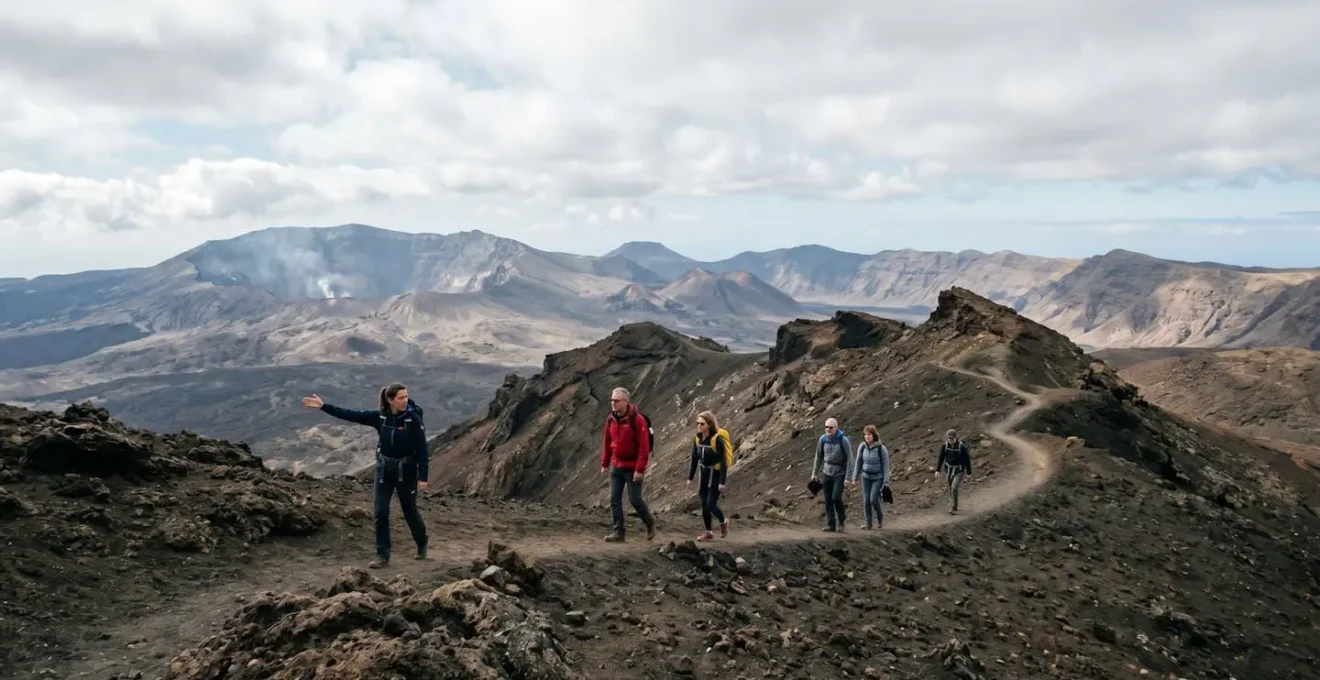
The true cost of an island adventure is not its price tag but its unmanaged risk; a professional guide is a calculated investment in safety, not a mere expense for convenience.
- Operator legitimacy and hidden environmental variables—not just the activity’s name—are the critical factors in your decision.
- Verifying certifications and understanding equipment standards are non-negotiable steps for any high-risk technical activity.
Recommendation: Shift your mindset from asking « Is a guide required? » to « Is my risk being professionally managed? »
Imagine the scenario: you’re on a beautiful volcanic island, and a local vendor on the beach offers a volcano trek for a fraction of the official tour price. The trail looks clear, the weather is perfect. It feels like a savvy bargain, but is it a calculated saving or a life-altering gamble? This is the core dilemma for every activity planner. The common advice is often too simplistic, suggesting guides for technical activities like scuba diving while deeming seemingly straightforward hikes as safe for independent exploration.
This binary view is dangerously flawed. It overlooks the complex matrix of factors that truly define an activity’s risk profile. The decision to hire a guide should not be based on the activity’s name alone, but on a rational assessment of hidden environmental variables, operator legitimacy, and your own specific capabilities. But what if the key to a safe adventure wasn’t just choosing the right activity, but applying the right risk-mitigation framework before you even book?
This guide moves beyond generic lists to provide a safety-rational framework for your decision-making. We will deconstruct the non-obvious risks tied to popular island adventures, provide concrete methods for verifying a guide’s credentials, and outline the critical differences in safety protocols between budget operators and certified professionals. This is your toolkit for making informed, cost-benefit decisions where the primary return on investment is your well-being.
This article provides a structured approach to help you evaluate when professional guidance is a critical safety control and when independent adventure is a reasonable choice. The following sections break down the key areas of risk assessment, from verifying certifications to understanding equipment policies.
Contents: A Framework for Island Activity Risk Assessment
- Why Do Volcanic Crater Treks Require Professional Guides Despite Visible Trails?
- How to Check Whether Island Activity Guides Hold Valid Safety Certifications?
- Private Island Activity Guide or Group Tour: Which for Better Safety and Experience?
- The Activity Booking Mistake: Choosing the Cheapest Guide Who Lacks Proper Training
- When Do Guided Island Activities Include All Equipment in the Price?
- How to Verify Current Volcanic Activity Levels Before Booking Crater Trek Tours?
- How to Check Island Dive Operators Meet International Safety Standards?
- How to Prepare for Trekking Active Volcanic Craters Safely on Island Expeditions?
Why Do Volcanic Crater Treks Require Professional Guides Despite Visible Trails?
A visible trail on a volcano is a deceptive invitation. It suggests a simple path from A to B, but it fails to communicate the invisible and dynamic environmental variables that pose the most significant threats. The primary justification for mandatory guides in these environments is their expertise in managing risks that are not apparent to the untrained eye. These include unstable crater edges prone to collapse, treacherous slopes of loose volcanic scree, and the presence of fumaroles emitting toxic volcanic gases like sulfur dioxide.
Furthermore, weather conditions in volcanic regions can change with extreme rapidity. A clear morning can descend into dense fog, causing disorientation and dramatically increasing the risk of hypothermia as temperatures plummet at altitude. A professional guide is trained to read micro-weather patterns and make critical decisions to turn back before conditions become untenable. Their role is not just to lead the way, but to act as a real-time risk manager for the group.
Case Study: Mandatory Guidance at Mount Bisoke, Rwanda
The trek to the crater lake of Mount Bisoke in Rwanda’s Virunga Mountains perfectly illustrates this principle. Despite being a dormant volcano, guidance is mandatory. The park authorities understand the inherent dangers: unstable crater rims, slippery trails that become hazardous in the rain, and the potential for encountering wildlife. Trained rangers monitor conditions and guide all hikers, with armed personnel providing security. This policy acknowledges that the « visible trail » is only one component of a complex and potentially dangerous environment that requires professional oversight to navigate safely.
Ultimately, the guide’s fee is an investment in a sophisticated safety system. They carry communication devices for emergencies, are trained in first aid specific to high-altitude environments, and possess an intimate knowledge of the terrain’s hidden hazards. Opting out of this system based on the appearance of a trail is to fundamentally misunderstand the nature of volcanic risk.
How to Check Whether Island Activity Guides Hold Valid Safety Certifications?
Trusting an operator’s verbal assurances is insufficient when your safety is on the line. A core component of your risk assessment is the verification of professional certifications. Legitimate guides are proud of their qualifications and will readily provide evidence. The key is to know what to look for and how to check it. For many activities, international bodies set the gold standard, and their member databases are often publicly searchable online.
For example, in mountain activities, certifications from the IFMGA (International Federation of Mountain Guides Associations) or UIMLA (Union of International Mountain Leader Associations) represent the highest levels of training in technical skills, rescue, and client care. Reputable dive centers will prominently display their affiliation with organizations like PADI (Professional Association of Diving Instructors) or SSI (Scuba Schools International) and can have their status verified through the organizations’ websites. There are around 6,000 mountain guides worldwide who hold IFMGA certification, representing an elite standard you should seek for technical ascents.
When you inquire, ask for the guide’s full name and certification number. Be wary of vague answers. A professional operation views this request as a sign of a discerning and responsible client. This process of verification is a critical filter that separates qualified professionals from informal, unregulated operators who may lack the training and insurance to manage an emergency.
The following table outlines some of the primary international certifications to look for. Always cross-reference an operator’s claims with the certifying body’s official registry where possible.
| Activity Type | Primary Certification | Certifying Body | Online Verification |
|---|---|---|---|
| Mountain Trekking | UIMLA International Mountain Leader | Union of International Mountain Leader Associations | Through member associations |
| Technical Mountaineering | IFMGA Mountain Guide | International Federation of Mountain Guides Associations | IFMGA member association registries |
| Scuba Diving | PADI Divemaster / Instructor | Professional Association of Diving Instructors | PADI Pro Chek online database |
| Scuba Diving | SSI Dive Guide / Instructor | Scuba Schools International | SSI professional verification system |
| Kayaking | ACA Instructor | American Canoe Association | ACA instructor database |
Private Island Activity Guide or Group Tour: Which for Better Safety and Experience?
The choice between a private guide and a group tour is a cost-benefit analysis where the ‘benefit’ is often a significant increase in personalized safety and experience. While group tours are more economical, their safety protocols are inherently designed around the « weakest link » or average capability of the participants. A private guide, by contrast, tailors the entire experience—and its safety margins—directly to you.
This distinction becomes critical in several scenarios. For high-risk technical activities like multi-pitch climbing or advanced wreck diving, a private guide provides undivided attention, managing your specific safety systems and making decisions based solely on your performance and condition. If you have any physical limitations or health concerns, a private guide can adjust the pace, route, and rest times to your needs, rather than forcing you to keep up with a group, which could lead to exhaustion and accidents.
A significant skill mismatch also warrants a private guide. If you are far more experienced than a typical group, a private guide can take you on more challenging routes. Conversely, if you are a complete novice, one-on-one instruction ensures you receive the foundational skills and constant oversight necessary for a safe and confidence-building experience. In remote environments with unpredictable conditions, a private guide can make the conservative call to turn back based on your fatigue alone, a decision that is much more complex in a group with varying levels of motivation and endurance.
However, for low-risk activities like guided cultural walks or simple nature trails, group tours are perfectly safe and cost-effective. In these cases, the primary value of the guide is shared knowledge and interpretation, not personalized risk management. The decision framework is clear: when technical skill and individualized safety management are paramount, a private guide is a wise investment; when the goal is shared learning in a controlled environment, a group tour is a logical choice.
The Activity Booking Mistake: Choosing the Cheapest Guide Who Lacks Proper Training
The allure of a cheap deal for an adventure activity is strong, but it is often the most expensive mistake a traveler can make. A significantly lower price is a major red flag, as it almost always indicates a compromise in one of three critical areas: guide training and certification, equipment quality and maintenance, or liability insurance. A professional operator has fixed costs associated with these safety fundamentals, and an operator who bypasses them is transferring the risk directly to you.
Unlicensed street or beach touts often operate without the overhead of proper registration, insurance, or equipment maintenance schedules. They may use personal vehicles instead of commercially licensed transport and rely on worn-out gear that would be retired by any reputable company. Their « training » may be informal experience rather than a formal, verifiable certification that includes rescue and emergency medical procedures. When you ask about their credentials or insurance, their answers are likely to be vague or evasive.
This is where your risk assessment framework becomes a crucial filter. Before committing, you must actively look for signs of legitimacy. A professional operation will have a clear booking process, provide official receipts, and conduct a thorough pre-activity safety briefing. A budget operator is more likely to pressure you for a cash-only transaction with no paper trail. By choosing the cheapest option, you are not getting a bargain; you are unknowingly accepting a higher level of personal risk and forgoing the legal and financial protections that come with a legitimate operator.
Action Plan: Red Flag Checklist for Unsafe Budget Operators
- Transactions: Is the operator insisting on cash-only payments with no official receipt or booking confirmation? This often indicates a lack of official registration.
- Evasive Answers: Do they become vague or defensive when asked directly about their insurance coverage or the specific certifications their guides hold?
- Transport: Are they using unmarked personal vehicles for transport instead of properly branded and licensed company vehicles?
- Equipment Condition: Is the safety equipment (helmets, harnesses, life jackets, etc.) visibly worn-out, dirty, or damaged? Professionals invest in maintaining their gear.
- Sales Tactics: Are you being approached with high-pressure sales tactics on the street or beach by unlicensed touts, rather than booking through an official office or website?
- Lack of Specialization: Does the operator offer a wide range of unrelated, high-risk activities (e.g., diving, climbing, and paragliding) without having dedicated specialist staff for each discipline?
- Safety Briefing: Is there no pre-activity safety briefing, or is it rushed and incomplete, failing to cover emergency procedures in detail?
- Proof of Legitimacy: Does the operator show reluctance to provide their company registration details or allow you to see their guides’ physical certification cards?
When Do Guided Island Activities Include All Equipment in the Price?
A common point of confusion for activity planners is understanding what equipment is included in the advertised tour price. The general rule is that operators will provide all essential technical safety equipment required to perform the activity, but personal comfort and specialized gear are often extra rental items. This distinction is based on both safety standards and practical logistics.
For example, in scuba diving, the price almost always includes the core life-support system: tanks, weights, regulators, and a buoyancy control device (BCD). These are items the operator is obligated to maintain to professional standards. However, items that require a precise personal fit for comfort and safety, like wetsuits and masks, may be rentals. Advanced gear like dive computers or underwater cameras are typically premium add-ons.
Case Study: PADI Equipment Standards and Operator Obligations
PADI (Professional Association of Diving Instructors) standards mandate that operators provide functional life-support equipment, including properly maintained regulators with alternate air sources and working BCDs. Failure to do so is a serious violation of safety obligations. However, the standards recognize that personal fit is crucial for items like wetsuits. An ill-fitting wetsuit can compromise thermal protection, so offering them as a rental allows divers to select the correct size. This highlights the split: operators are responsible for the core technical gear, while clients are responsible for ensuring their personal gear is adequate.
This principle applies across most activities. A canyoning trip will include ropes, harnesses, and helmets, but may charge extra for properly fitting climbing shoes. A kayaking tour provides the kayak, paddle, and buoyancy aid, but a wetsuit or dry bag will likely be an additional rental. Always clarify what is and isn’t included before booking to avoid surprise costs and, more importantly, to ensure you are not left without a critical piece of personal gear.
The following table provides a general guide, but you must always confirm the specifics with your chosen operator.
| Activity | Almost Always Included (Technical Safety Gear) | Often NOT Included (Personal Comfort Gear) | Typical Premium Add-Ons |
|---|---|---|---|
| Scuba Diving | Tanks, weights, regulators, BCDs, basic masks | Wetsuits (proper fit), dive computers, underwater cameras | Nitrox tanks, dive computer rental, GoPro rental |
| Rock Climbing / Canyoning | Ropes, harnesses, carabiners, helmets | Climbing shoes, personal gloves, specialized clothing | Premium shoe rental, private belay service |
| Kayaking / Rafting | Kayak/raft, paddles, buoyancy aids, helmets | Wetsuits, dry bags, waterproof phone cases | Wetsuit rental, professional photo package |
| Mountain Trekking | Group safety equipment (first aid, communication) | Hiking boots, trekking poles, personal backpacks | Trekking pole rental, porter service, sleeping bag rental |
| Volcano Trekking | Group guide equipment, basic safety briefings | Gas masks, specialized boots, layered clothing | Gas mask/respirator rental, headlamp rental |
How to Verify Current Volcanic Activity Levels Before Booking Crater Trek Tours?
Booking a volcanic crater trek requires a two-tiered verification process: you must confirm both the official geological safety level and the practical accessibility of the trails. These are two separate assessments, and getting a green light on one does not guarantee the other. The most reliable information comes from a clear hierarchy of sources.
Your primary source should always be the official geological observatory for that country or region. These scientific institutions, such as the USGS in the United States or Italy’s INGV, monitor seismic activity, gas emissions, and ground deformation in real-time. They issue official alert levels (e.g., Green, Yellow, Orange, Red) that are the definitive word on the volcano’s stability. As an example, it’s known that active volcanoes like Cotopaxi are closely monitored by national institutes tracking seismic activity, gas emissions, and temperature, and all climbers must follow park advisories based on this data.
Your secondary source is the relevant National Park Authority. Their official websites and visitor centers will post the current status of trails and access roads. A trail may be closed for reasons unrelated to volcanic activity, such as landslides, trail erosion, or extreme weather. A low geological alert level is meaningless if the path to the crater is impassable.
Tertiary sources include reputable, long-established tour operators and recent traveler reports on forums. Experienced operators often have the most up-to-date information on practical accessibility. Traveler reports can provide valuable on-the-ground context about actual conditions, but this anecdotal information must always be verified against official sources. Never rely solely on a forum post or a single operator’s claim without cross-referencing with the geological observatory and park authority.
The correct verification workflow is as follows:
- Primary Source – Official Geological Observatories: Check national institutes like USGS (United States), INGV (Italy), Ecuador’s Geophysical Institute, or local volcano observatories that track seismic activity, gas emissions, and temperature changes in real-time.
- Secondary Source – National Park Authorities: Verify current trail status and access restrictions through official park websites and visitor centers, as trails may be closed for non-volcanic reasons like weather or erosion.
- Tertiary Source – Reputable Tour Operators: Long-established operators with professional websites maintain current information about volcanic activity and trail accessibility, often updated more frequently than official sources.
- Supporting Context – Recent Traveler Reports: Use forums like TripAdvisor or mountain-specific communities for on-the-ground reports from recent visitors about actual conditions, but verify against official sources.
- Critical Distinction: Confirm both geological safety (official alert level is low) AND practical accessibility (trails are actually open and safe to trek), as these are separate determinations.
How to Check Island Dive Operators Meet International Safety Standards?
Verifying a dive operator’s commitment to safety goes far beyond checking their PADI or SSI rating. While a high rating like a PADI 5 Star IDC or SSI Diamond Center indicates a long-term investment in training, the true measure of their professionalism is revealed in their day-to-day operational procedures. The most effective way to assess this is by asking specific, targeted questions before you book.
The single most critical litmus test is the quality of their pre-dive safety briefing. A professional briefing is thorough and un-rushed, covering emergency procedures, hand signals, a map of the dive site, maximum depth and time limits, and a mandatory buddy check. A rushed or skipped briefing is a massive red flag, regardless of the certifications hanging on the wall. Another non-negotiable is the presence of emergency oxygen. Ask directly: « Do you have medical-grade oxygen on every dive boat? » The answer must be an unequivocal « yes. »
Other essential questions probe their equipment maintenance and risk management protocols. Inquire about their guide-to-diver ratio for the specific site you’ll be visiting; a professional operator adjusts this based on conditions and dive complexity. Ask to see maintenance logs for their air compressor and regulators. Finally, ask about their emergency action plan: « What is your procedure for an emergency, and where is the nearest hyperbaric chamber? » A professional operator has this plan documented and can answer without hesitation. Their affiliation with the Divers Alert Network (DAN) is also a strong positive indicator.
These questions are not confrontational; they are the mark of a responsible diver. A professional operator will welcome them as a sign of your competence and commitment to safety. An evasive or dismissive response should be considered a definitive reason to take your business elsewhere.
Case Study: PADI’s Emphasis on Pre-Dive Briefings
PADI’s Standard Safe Diving Practices explicitly require thorough pre-dive briefings. This process reinforces critical safety rules, such as maintaining a safe ascent rate (no faster than 18 meters/60 feet per minute) and always diving with a buddy. The organization considers the briefing the cornerstone of a safe dive. The quality of this briefing serves as the best immediate indicator of an operator’s professionalism and adherence to international safety standards, often being more revealing than their official rating alone.
Key Takeaways
- Prioritize Risk Assessment Over Activity Name: The decision to hire a guide should be based on a rational analysis of hidden environmental risks and operator legitimacy, not just the activity’s label.
- Verification is Non-Negotiable: Never take an operator’s claims at face value. Actively verify certifications, check equipment maintenance, and confirm insurance coverage as part of your booking process.
- Price is a Safety Indicator: A significantly lower price is almost always a red flag that indicates compromises on guide training, equipment quality, or insurance. The « bargain » transfers risk directly to you.
How to Prepare for Trekking Active Volcanic Craters Safely on Island Expeditions?
Safe trekking on active or dormant volcanoes depends as much on your personal preparation as it does on your guide. Even with professional oversight, you are responsible for your own fitness, clothing, and equipment. The volcanic environment is unforgiving, and proper preparation is your first line of defense against its inherent hazards, including rapid weather changes, difficult terrain, and altitude.
Your clothing strategy is paramount. The cardinal rule is: never wear cotton. Cotton absorbs moisture and loses all insulating properties when wet, making it a direct path to hypothermia. Instead, use a layering system of synthetic or wool fabrics: a moisture-wicking base layer, an insulating mid-layer (like fleece), and a waterproof and windproof outer shell. This system allows you to manage sweat and protect yourself from sudden drops in temperature.
Stability is a major concern on volcanic terrain. The ground is often composed of loose scree and ash, where slips and falls are common. As one report notes, steep volcanic ash slopes and loose scree significantly increase slip and fall risks, making sturdy hiking boots with good ankle support an absolute necessity. Trekking poles are highly recommended to provide additional points of contact and improve balance. Furthermore, even on dormant volcanoes, respiratory protection like an FFP2 or N95 mask is a wise precaution against fine ash and dust that can irritate the lungs. Finally, proper acclimatization is crucial. Arrive at least a day or two early, hydrate excessively, and avoid alcohol before your trek to allow your body to adjust to the altitude.
Your essential gear checklist should include:
- Clothing Strategy – No Cotton Rule: Use synthetic or wool base layers, insulating mid-layers, and waterproof shell layers to manage sweat and protect against sudden temperature drops and high winds at altitude.
- Respiratory Protection: Pack FFP2, FFP3, or N95 masks for protection against volcanic ash, dust, and fumes.
- Navigation and Emergency: Carry a headlamp with extra batteries even for day hikes, and bring portable power banks as cold drains phone batteries quickly.
- Nutrition and Hydration: Pack high-energy snacks and hydrate excessively starting the day before the trek—more than you think you need.
- Stability Equipment: Use trekking poles to aid stability on loose volcanic scree and unstable terrain.
- Acclimatization Plan: Arrive at least 1-2 days early, avoid alcohol, and allow your body to adjust to altitude before the trek.
Your next island adventure begins not with a booking, but with a deliberate safety assessment. Use this framework to ensure your experiences are as safe as they are memorable.