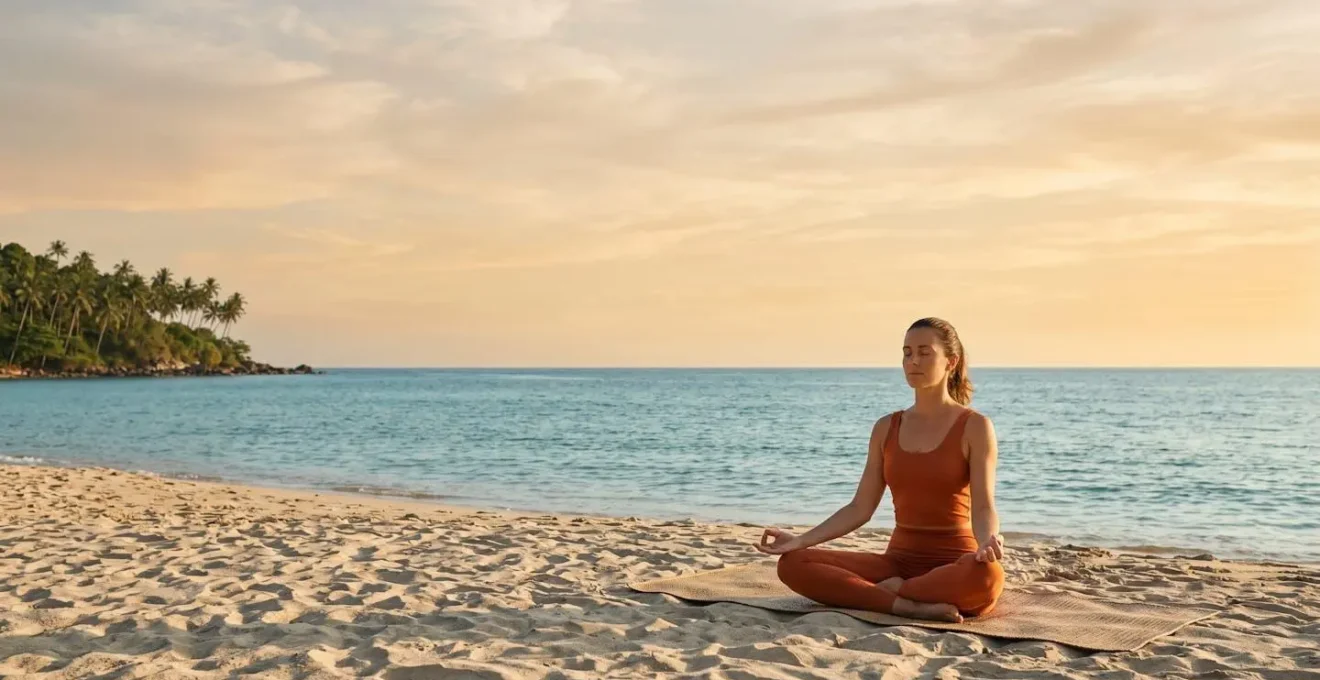
The frustration with superficial « beach yoga » is valid. The solution isn’t to abandon the idea, but to build a deliberate practice architecture. This guide moves beyond photo-ops to focus on instructional discernment, physiological acclimatization in tropical climates, and using yoga as a lens for deeper cultural presence. It’s about transforming your practice from a holiday activity into the very core of a more meaningful travel experience.
The image is iconic: a lone figure in a perfect warrior pose against a Caribbean sunrise, the epitome of wellness travel. Yet for the serious yoga practitioner, this picture often rings hollow. The promise of a deep, grounding practice can quickly dissolve into a crowded, 20-minute resort class led by an enthusiastic but untrained activities coordinator. You’re left craving the authenticity of your home studio, feeling that your practice has been reduced to a tourist gimmick, a mere backdrop for a holiday snapshot rather than a tool for genuine presence and self-inquiry.
The common advice— »find a class at your hotel » or « just do some stretches on the beach »—misses the point entirely. It overlooks the integrity of the practice and the practitioner’s need for qualified guidance and a conducive environment. The wellness tourism market is booming, with one report from the Global Wellness Institute projecting it to grow from $651 billion annually with 16.6% average annual expenditure growth to 2027, but this commercial explosion makes discernment more critical than ever. But what if the key wasn’t just finding a yoga class, but consciously designing a ‘practice architecture’ for your trip?
This guide provides a strategic framework for integrating a meaningful yoga practice into your island travels. We will deconstruct the process, moving from the philosophical ‘why’ to the practical ‘how’. We’ll explore how to identify truly qualified teachers, structure your sessions for maximum benefit, understand the unique physiological demands of a tropical climate, and use your practice as a bridge to deeper cultural and personal discovery. This is your path to ensuring your yoga enhances your travel, rather than becoming a diluted imitation of the real thing.
This article provides a complete framework for shifting from superficial holiday yoga to a deeply integrated practice. The following sections will guide you through each critical component, from finding the right teacher to making the wellness benefits last.
Summary: A Practitioner’s Guide to Authentic Island Yoga
- Why Does Daily Yoga Practice Deepen Island Travel Experiences and Presence?
- How to Identify Qualified Yoga Teachers on Islands Rather Than Untrained Resort Staff?
- Group Yoga Sessions or Private Instruction: Which for Your Island Retreat Experience?
- The Island Yoga Mistake: Practising Too Intensely in Hot Humid Tropical Conditions
- When Should You Practise Yoga on Islands: Morning Energy or Sunset Calm?
- Detox Spa Retreat or Stress-Relief Programme: Which Island Wellness Approach for You?
- When Should You Visit Island Temples: During Active Ceremonies or Quiet Contemplation Hours?
- How to Choose Island Spa Retreats That Create Lasting Wellness Changes?
Why Does Daily Yoga Practice Deepen Island Travel Experiences and Presence?
A daily yoga practice during travel is not about maintaining a fitness routine; it is about cultivating a state of heightened presence that transforms how you experience your destination. Travel, by its nature, bombards the senses with novelty. Without a grounding anchor, this can lead to a feeling of being overwhelmed or disconnected, skimming the surface of a place without truly absorbing it. A consistent morning asana or evening meditation session acts as a stable baseline, a quiet moment of inner consistency amidst outer change. This daily ritual recalibrates your nervous system, allowing you to engage with the new environment from a place of centeredness rather than reaction.
This is more than a feeling; it’s a documented psychological process. Research into the effects of yoga retreats confirms this. A comprehensive 2025 study examining 409 retreat participants found that the structured, daily practice was a key mechanism for enhancing well-being. The findings revealed that this regularity creates a stable baseline that enhances receptivity to new experiences and fosters a deeper connection to the environment. When your internal world is ordered, your capacity to appreciate the external world expands exponentially. The vibrant colours of a local market, the subtle shifts in the ocean’s hue, the taste of unfamiliar fruit—all become more vivid.
Ultimately, the practice becomes a lens, not just an activity. It trains your attention to notice the subtle details, both within your own body and in the world around you. Instead of simply ‘seeing’ a tropical flower, you might notice the intricate geometry of its petals. Instead of just ‘hearing’ the ocean, you might discern the complex rhythm of the waves. This is the essence of deep travel: an experience defined not by the number of sights seen, but by the depth of presence brought to each moment. Your yoga mat becomes a microcosm of your travel journey—a space to explore, to be challenged, and to connect.
How to Identify Qualified Yoga Teachers on Islands Rather Than Untrained Resort Staff?
The difference between a transformative yoga session and a glorified stretching class often comes down to one factor: the teacher. On islands, where tourism is a major industry, the term « yoga teacher » can be applied loosely. Distinguishing a deeply knowledgeable guide from an employee with a weekend certification requires instructional discernment. Your first step is to look beyond the convenience of the all-inclusive resort class and investigate the teacher’s credentials with a critical, yet respectful, line of inquiry. An authentic teacher will welcome questions about their background as an opportunity to connect.
The baseline for modern yoga instruction is a 200-hour certification from a Registered Yoga School (RYS). However, this is merely the starting point. As the Asheville Yoga Center notes, this training is about building a foundation for safe and authentic teaching. To go deeper, ask about their parampara (lineage)—the stream of knowledge they come from. Inquire about their continuing education and personal practice. A great teacher is always a student first. Crucially, ask about their specific experience teaching in hot and humid climates; a teacher unfamiliar with heat-related contraindications can put students at risk.
The true markers of a qualified teacher, however, are revealed in their approach. Do they begin class by asking about injuries or experience levels? Do they offer modifications and use props to support different bodies? A teacher who provides pose variations demonstrates a sophisticated understanding of anatomy and a commitment to individual student safety over a one-size-fits-all aesthetic. They should also weave in philosophical elements, connecting the physical practice (asana) to the wider context of yoga. This shows they are teaching yoga, not just shapes.
Your Action Plan: Verifying Teacher Qualifications
- Verify Foundation: Check for a minimum 200-hour RYS certification, but understand this is just the entry ticket, not a guarantee of expertise.
- Inquire About Lineage: Ask about their teachers, their ‘parampara’, and their commitment to ongoing study beyond the initial certificate.
- Assess Environmental Knowledge: Specifically ask about their experience teaching in tropical conditions and their knowledge of heat-related safety and contraindications.
- Observe Their Method: Notice if the teacher asks about your injuries, offers variations for different levels, and discusses yoga philosophy beyond just the physical postures.
- Check Online Presence: Look for an online presence focused on community and inner experience, not just aesthetic-focused content. The language they use is a powerful indicator of their focus.
Group Yoga Sessions or Private Instruction: Which for Your Island Retreat Experience?
Once you’ve identified a qualified teacher, the next decision in your practice architecture is the format: the collective energy of a group class or the tailored focus of private instruction. There is no single right answer; the optimal choice depends entirely on your intention for the practice and your trip. Group sessions offer a unique sense of community and shared energy (satsang). Practicing alongside others, breathing in unison, can create a powerful, uplifting experience that reminds you that you are part of something larger than yourself.
This shared journey is often a highlight for many travelers. As one participant on a yoga-focused trip with The Travel Yogi shared, the experience was life-changing due to the « balance of history, travel, and yoga. » They felt their « mind was being expanded in multiple venues all at the same time but at a reasonable pace. » This highlights how a well-curated group retreat can weave together practice, culture, and connection, creating a rich tapestry of experiences where the group’s energy amplifies individual discovery.
On the other hand, private instruction offers precision and personalization that a group class cannot. If you are working with a specific injury, looking to master a challenging pose (like an inversion or arm balance), or seeking to deepen your understanding of yoga philosophy and its application to your life, a one-on-one session is invaluable. The teacher’s undivided attention allows for hands-on adjustments, detailed alignment cues, and a dialogue tailored to your unique body and goals. This is where subtle but profound shifts in understanding and physical practice can occur.
As seen in the focused interaction above, a private session is a conversation. It’s an opportunity to refine the nuances of your practice in a way that is both safe and deeply effective. For a serious practitioner, a hybrid approach can be ideal: use group classes for energy and community, and book one or two private sessions during your trip to work on specific personal goals. This balances the communal spirit with focused, individual growth, creating a truly comprehensive practice.
The Island Yoga Mistake: Practising Too Intensely in Hot Humid Tropical Conditions
One of the most significant and often underestimated challenges of practicing yoga on an island is the environment itself. The dream of a vigorous vinyasa flow on a sun-drenched deck can quickly become a lesson in the dangers of overexertion if you fail to respect the principles of physiological acclimatization. Tropical heat and humidity place a substantial additional load on the body’s cooling systems. Your heart works harder, you sweat more (and less efficiently in high humidity), and the risk of dehydration and heat-related illness skyrockets. Treating a 90°F (32°C) outdoor class the same as one in an air-conditioned studio is a serious mistake.
The danger is not theoretical. Safety guidelines for hot yoga are clear and based on a metric called the heat index, which combines temperature and humidity. According to expert advice published in Yoga Journal, a heat index above 95°F (35°C) is dangerous for prolonged exposure or strenuous exercise. It’s crucial to understand that an 88°F day with 70% humidity—a common scenario in many island destinations—produces a heat index of 100°F. As Yoga Journal clarifies, many dedicated hot yoga studios, with humidity between 40-60%, can easily surpass this safety threshold, and an outdoor practice in a tropical environment can do so even more easily.
Ignoring these realities can lead to dizziness, nausea, heat exhaustion, or even heat stroke. The key is to modify your practice. Swap a dynamic, heat-building power flow for a slower, more deliberate hatha or gentle vinyasa practice. Focus on stability over speed and deep, calming breaths (pranayama) over rapid, heat-generating ones. Increase your hydration significantly, adding electrolytes to your water, and listen intently to your body’s signals. Dizziness or a sudden cessation of sweating are red flags that demand you stop immediately, rest, and cool down. True yoga practice is about honoring your body’s limits, not pushing them recklessly in the name of a workout.
When Should You Practise Yoga on Islands: Morning Energy or Sunset Calm?
The timing of your practice is another crucial element of your island yoga architecture, influencing both your energy levels and the philosophical quality of your session. The two classic windows—sunrise and sunset—offer distinct benefits that go far beyond the aesthetic. A morning practice is traditionally aligned with building energy (prana) for the day ahead. Practicing as the sun rises, during the cooler, quieter hours, is an opportunity for a more dynamic, invigorating flow. This could include sun salutations (Surya Namaskar) and standing poses to awaken the body and focus the mind, setting a clear, intentional tone for the day’s explorations.
A morning practice prepares you to receive the day with openness and vitality. It’s a proactive step, a way of grounding yourself before the activities and interactions of the day begin. The air is often clearer, the sounds of the island are just beginning to stir, and the mind is less cluttered with the day’s events. This is the ideal time for setting an intention (sankalpa) that you can carry with you, whether you’re planning to hike a volcano, explore a local village, or simply read by the ocean.
Conversely, a sunset practice serves a different purpose. It’s a time for reflection, gratitude, and release. As the day’s heat subsides and the sky softens, the practice can shift towards a more restorative and introspective quality. This is the perfect window for a gentle, floor-based practice, including long-held yin poses, calming forward bends, and gentle twists to unwind the body and process the day’s experiences. A sunset practice is less about building energy and more about assimilating it. It’s a transition from doing to being, a moment to let go of any tension accumulated during the day.
The sensory experience of a sunset practice is profound. The feeling of your feet grounded in the cooling sand, the sound of the gentle evening waves, and the sight of the fading light all contribute to a deep sense of peace and connection to the natural world. This practice is an act of closure, preparing the body and mind for restful sleep. The choice isn’t about which is « better, » but about which aligns with your needs: do you want to energize for the day, or wind down from it? An ideal island practice might even include both: a short, dynamic flow in the morning and a longer, meditative session at dusk.
Detox Spa Retreat or Stress-Relief Programme: Which Island Wellness Approach for You?
The wellness landscape is vast, with global spa facilities growing significantly. Data shows there were over 201,861 spas globally in 2024, up from 175,482 in 2019, offering a dizzying array of programmes. When choosing an island wellness experience, a critical distinction must be made: are you seeking a short-term ‘detox’ or a long-term ‘stress-relief’ toolkit? A detox-focused spa retreat often emphasizes restrictive diets, intense cleansing protocols, and passive treatments. While it can offer a temporary feeling of purity, the results are often fleeting and disconnected from everyday life.
A stress-relief programme rooted in yoga, however, takes a fundamentally different approach. It is not about eliminating ‘toxins’ but about building resilience. It operates on the principle that stress is an inevitable part of modern life, and the goal is to change our relationship with it. This is achieved through the cultivation of self-awareness and the learning of practical tools—such as mindfulness, specific breathing techniques (pranayama), and a deeper understanding of the mind-body connection—that can be integrated into your life long after you’ve left the island.
This approach addresses the root cause rather than the symptoms. As researchers from Arizona State University point out, yoga retreats are actively sought for healing because they are viewed as a « panacea for the ailments of modern society—tech overload, disconnection and alienation, insomnia, stress and anxiety. » A programme focused on stress-relief equips you with sustainable skills. It teaches you how to recognize your stress triggers, how to self-regulate your nervous system through breath, and how to cultivate a mindset of compassionate self-awareness. This is a far more profound and lasting investment in your well-being than a three-day juice cleanse.
When evaluating options, look at the programme’s core philosophy. Is the language about ‘purging’ and ‘fixing’, or is it about ‘integrating’ and ‘understanding’? Does it promise a quick fix, or does it offer educational workshops and tools for ongoing self-practice? A true wellness experience empowers you; it doesn’t just treat you. It provides the foundation for lasting change by giving you the architecture to manage life’s challenges, not just escape them for a week.
When Should You Visit Island Temples: During Active Ceremonies or Quiet Contemplation Hours?
Integrating your yoga practice with cultural exploration often leads to visiting sacred sites like temples, monasteries, or ancient ruins. Here again, intentionality is key. The question of when to visit—during a vibrant, active ceremony or during the quiet hours of contemplation—depends on your goal. Attending an active ceremony can be a powerful, immersive sensory experience. The sounds of chanting, the smell of incense, the sight of communal rituals—all of this can offer a profound glimpse into the living heart of a culture. It is an experience of collective energy and shared devotion.
However, this approach requires a high degree of mindfulness and respect. You are a guest in a sacred space during an active ritual. This is not a performance for tourists. The yogic principles of Ahimsa (non-harming) and Asteya (non-stealing) are paramount here. This means dressing modestly, moving quietly, refraining from flash photography, and never intruding on worshippers’ personal space. It is an opportunity to practice observation without interference, to be present without being the center of attention.
Visiting during designated quiet hours, on the other hand, offers a different kind of depth. This is an opportunity for personal contemplation and a more intimate connection with the space itself. The silence or quiet ambient sounds allow you to feel the history and energy of the place. This is the ideal time to engage in your own quiet practice—not a physical asana practice, which would be inappropriate, but a seated meditation or a walking mindfulness exercise. You can find a quiet corner to sit, close your eyes, and simply be present with your breath, absorbing the palpable peace that often permeates such locations.
Case Study: Mindful Cultural Integration in Practice
The approach of some international yoga retreats exemplifies how to engage with local culture respectfully. For instance, Mikki Trowbridge Yoga’s model focuses on partnering with local organizations and emphasizing socially responsible tourism. Their retreat participants engage by supporting local artisans and learning from community groups. This demonstrates a philosophy of being « mindful of how tourism dollars are spent, and the impact we are leaving on the places we visit. » This shifts the dynamic from one of passive observation to one of respectful participation and economic support, turning cultural engagement into a yogic practice of conscious action.
Key Takeaways
- Authentic island yoga requires a ‘practice architecture’, not just random classes.
- Vetting a teacher’s qualifications, especially their experience with tropical climates, is non-negotiable.
- Lasting wellness comes from retreats that provide tools for integration and self-care, not just temporary respite.
How to Choose Island Spa Retreats That Create Lasting Wellness Changes?
The ultimate goal of a wellness-focused trip is not merely to return rested, but to return transformed, armed with tools and perspectives that create lasting positive change. Many island spa retreats offer a wonderful sense of temporary escape, but the ‘glow’ fades within days of returning to daily life. The difference between a fleeting holiday and a transformative experience lies in the retreat’s design. A truly effective programme is built not on passive pampering, but on active, experiential learning and integration.
Look for retreats that explicitly include educational components. Do they offer workshops on nutrition, mindfulness techniques, stress management, or yoga philosophy? A retreat that teaches you *how* to cook a healthy meal is infinitely more valuable than one that simply serves you one. A programme that guides you through different meditation techniques you can practice at home provides a skill for life, not just a moment of peace. The emphasis should be on empowerment—giving you the knowledge and skills to become your own agent of well-being.
This principle is supported by scientific research. A 2022 study on a 5-day yoga-based retreat called RISE (Resilience, Integration, Self-awareness, Engagement) examined its long-term impact on professionals in high-stress jobs. In-depth interviews conducted three months later revealed that lasting benefits were tied to two key factors: the experiential learning that occurred *during* the retreat, and a new-found « sense of permission to prioritize self-care » *after* the retreat. As Dr. Sat Bir S. Khalsa of Harvard Medical School noted in relation to the study, these findings provide « evidence for mechanisms influencing outcomes in a yoga-based retreat setting. » The retreat worked because it changed the participants’ internal framework and gave them actionable tools.
The RISE Programme: A Model for Lasting Change
The RISE yoga-based retreat study, published in the International Journal of Qualitative Studies on Health and Well-being, provides a clear model for what creates lasting impact. By focusing on Resilience, Integration, Self-awareness, and Engagement, the 5-day programme provided 17 professionals with more than just a break. The study showed that the combination of learning practical tools in an immersive environment and the explicit ‘permission’ to use them afterward was the key to sustained well-being, demonstrating that effective retreats must be designed for integration, not just escape.
Ultimately, transforming your island travel into a deeply resonant wellness journey begins with intention. By moving beyond the superficial and applying this framework of discernment—in choosing your teachers, your practice style, and your wellness programmes—you build an experience that nourishes you long after you’ve returned home. Start planning your next journey not just as a vacation, but as an opportunity to deepen your practice and enrich your life.