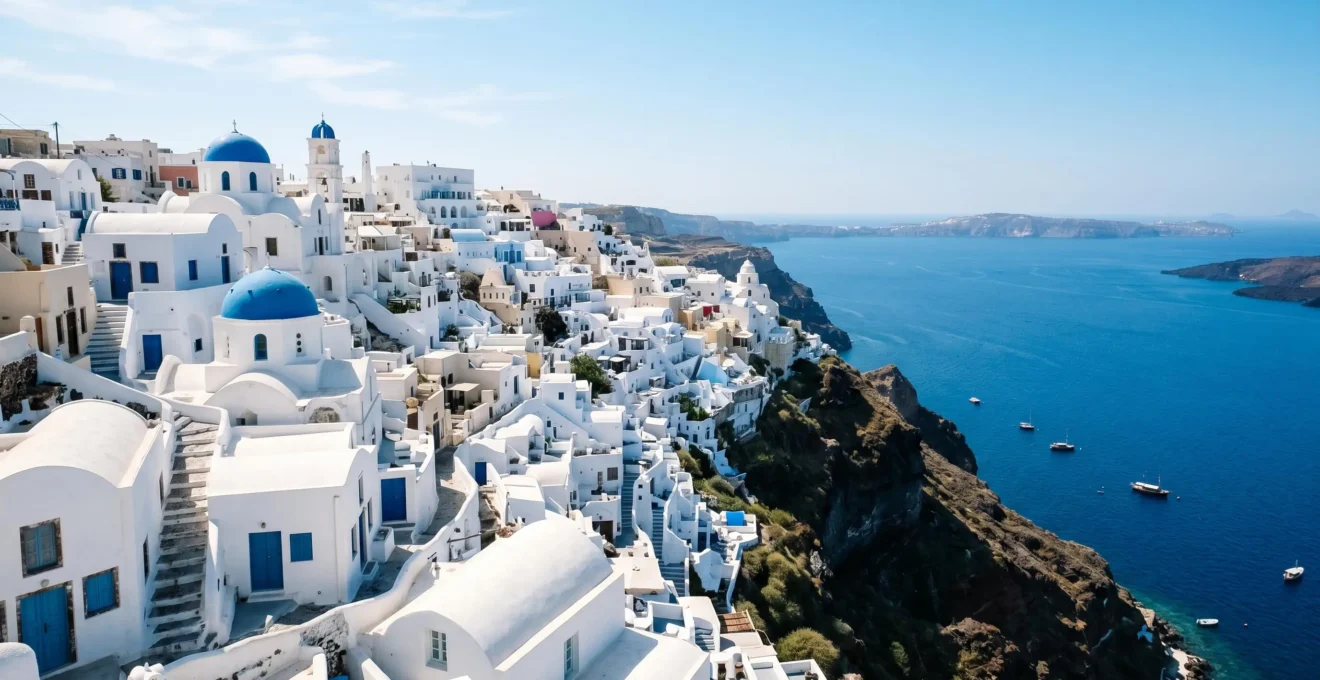
Photographing island architecture isn’t about finding famous spots; it’s about understanding the story written in stone, plaster, and light.
- The iconic whitewashed walls of the Cyclades are a direct result of early 20th-century public health mandates, a functional history now preserved as a cultural aesthetic.
- Your photographic choices—from timing to tripod placement—can either celebrate and preserve these fragile sites or inadvertently accelerate their decay.
Recommendation: The most compelling images come not from chasing icons, but from mastering light, seeking architectural honesty, and engaging with the cultural narrative behind the facade.
For the discerning cultural traveller, the allure of an island is often intertwined with its architecture. We see the images—sun-drenched whitewashed villages clinging to cliffs, vibrant colonial facades lining cobblestone streets—and we feel a pull to capture that beauty. Yet, many return with photographs that feel strangely familiar, echoes of a million other pictures, failing to capture the soul of the place. The common advice is to visit iconic locations like Santorini or to simply « wake up early for the good light, » but this approach barely scratches the surface.
This superficial engagement often misses the deeper narrative. The true art of architectural photography on these islands lies not in mere documentation, but in a dialogue with the past. It’s about understanding why a building looks the way it does, the materials it’s made from, and the culture it represents. What if the most profound architectural photographs aren’t just captured, but earned? Earned through an understanding of history, a mastery of light, and a deep respect for the structure itself. This is the perspective of an architectural historian, where the camera becomes a tool for interpretation, not just appropriation.
This guide moves beyond simple lists of « photogenic » spots. We will explore the symbiotic relationship between architectural heritage and the photographic eye. We will delve into the historical reasons behind iconic styles, dissect the technical challenges of capturing them, and consider the ethical responsibility that comes with pointing a lens at living history. By the end, you will not only know which islands offer elegant architectural subjects, but you will also possess the framework to photograph them with intention, depth, and originality.
To navigate this exploration of history, technique, and ethics, this guide is structured to build your understanding layer by layer. Discover the stories behind the facades, the methods to capture them authentically, and the locations where this practice is most rewarding.
Summary: A Photographer’s Guide to Elegant Island Architecture
- Why Do Greek Cycladic Islands Maintain Whitewashed Architecture Despite Modern Paint Options?
- How to Photograph Iconic Island Buildings Without Crowds in Every Frame?
- Islands With Colonial Architecture or Indigenous Design: Which Offers More Authentic Cultural Insight?
- The Photography Behaviour That Accelerates Decay of Historic Island Architecture
- When Does Natural Light Best Showcase Island Architecture: Seasonal and Daily Timing?
- Which Greek and Spanish Islands Have the Most Photogenic Whitewashed Villages?
- How to Tell the Difference Between Handmade Island Crafts and Factory Imitations?
- How to Photograph Whitewashed Villages Without Harsh Shadows and Blown Highlights?
Why Do Greek Cycladic Islands Maintain Whitewashed Architecture Despite Modern Paint Options?
The dazzling white and blue of the Cyclades has become a global symbol of idyllic island life, so ingrained in our consciousness that we assume it was always an aesthetic choice. However, the origin of this architectural uniformity is rooted not in design, but in public health and politics. While the practice of using lime-wash for its antiseptic and cooling properties is ancient, the widespread, mandated application is a relatively modern phenomenon. The most significant catalyst was a national decree issued by Ioannis Metaxas in 1938. As a measure to combat a cholera epidemic, the order required citizens to whitewash their homes, harnessing the antibacterial properties of lime to sanitize the islands.
What began as a pragmatic health directive was later codified into building regulations, especially after the rise of tourism. The government recognized the powerful brand identity this unified aesthetic created and encouraged its preservation. Today, many island municipalities have strict building codes that mandate the use of white and specific shades of blue, effectively fossilizing a historical moment into a contemporary style. This is a fascinating case of functional necessity evolving into cultural identity, which is then reinforced by economic incentive (tourism).
So, while modern, more durable paints exist, the adherence to traditional lime-wash is a conscious act of cultural preservation and economic branding. For the architectural photographer, knowing this history transforms the subject. You are no longer just capturing a « pretty white wall, » but a layered story of public health, political decree, and the birth of a tourism icon. This understanding allows for a more profound photographic interpretation, focusing on the texture of the lime-wash and the way it interacts with the intense Aegean light as a testament to this history.
How to Photograph Iconic Island Buildings Without Crowds in Every Frame?
One of the greatest frustrations for the architectural photographer in popular island destinations is the constant presence of crowds, turning potential masterpieces into chaotic snapshots. While arriving at sunrise is standard advice, a more sophisticated approach is required to truly isolate the architecture. It involves shifting your perspective from capturing the whole scene to curating a specific, intentional frame. This means employing techniques that either digitally remove people, use the time of day strategically, or change the compositional focus entirely.
Instead of battling for a clear shot of an entire building, a more artful solution is architectural abstraction. By focusing your lens on details—the curve of a stairway, the texture of a door, the interplay of light and shadow on a single wall—you create a composition that is inherently crowd-proof. This not only solves a practical problem but also often results in more powerful and unique images that speak to the essence of the building’s design.
As the image above demonstrates, focusing on the sensual curve and texture of hand-plastered steps creates a compelling image that tells a story of material and light, completely independent of the surrounding tourist activity. For more comprehensive strategies, consider these advanced methods:
- Temporal Compositing: Mount your camera on a tripod and capture 10-15 shots of the same scene over several minutes. Later, using a « median stack » mode in software like Photoshop will automatically erase moving tourists while preserving the static architecture.
- Golden Hour Advantage: The true advantage isn’t just the light. At sunrise, you often have a 1-2 hour window before the first tourist buses arrive, providing a truly crowd-free environment.
- Off-Axis Scouting: Avoid the main viewpoints. Explore side alleys, find ethical higher vantage points, or shoot from low angles to use the architecture itself as a natural shield, blocking crowds from your frame.
Islands With Colonial Architecture or Indigenous Design: Which Offers More Authentic Cultural Insight?
Pitting colonial architecture against indigenous design in a quest for « authenticity » presents a false dichotomy. The most culturally insightful island architecture is often not one or the other, but a complex, living dialogue between the two. As one piece of architectural analysis research notes, « Buildings, often termed ‘frozen art,’ reflect the aspirations and values of the people of the respective era. » In many island contexts, this « frozen art » reveals a history of collision, adaptation, and fusion.
Buildings, often termed ‘frozen art,’ reflect the aspirations and values of the people of the respective era.
– Architectural analysis research, The Impact of Travel on Architectural destination – RTF
Colonial architecture, imposed by a foreign power, tells a story of control, trade, and the importation of European ideals of space and order. Its grand plazas, formal facades, and fortifications speak volumes about the colonizer’s worldview. Conversely, indigenous design, often using local materials and traditional building methods, reflects a deep connection to the environment, climate, and ancestral beliefs. It speaks to a pre-colonial way of life and a culture’s resilience.
However, the most fascinating insights often emerge from syncretic architecture—where these two traditions meet. This is where you see a colonial-style building constructed with local coral stone, a European layout adapted with a veranda for tropical heat, or indigenous decorative motifs carved into a church facade. This architectural fusion tells a more nuanced and arguably more « authentic » story of cultural exchange, resistance, and survival.
Therefore, the question for the photographer isn’t which is « more authentic, » but « what story does this building tell? » Look for the points of tension and harmony. A purely colonial structure tells one story; a purely indigenous one tells another. But a building that carries the DNA of both offers a profound glimpse into the complex soul of the island itself.
The Photography Behaviour That Accelerates Decay of Historic Island Architecture
While most photographers approach historic sites with respect, many are unaware of the subtle ways their actions contribute to the cumulative decay of fragile structures. The most damaging behavior is not overt vandalism, but the « death by a thousand cuts » caused by physical interaction driven by the desire for the perfect shot. This includes leaning against ancient walls, setting up tripods on delicate mosaic floors, or—most commonly—touching or resting on features for a portrait. Each touch, however light, deposits oils and dirt, and each point of pressure, however small, can dislodge fragile plaster or worn stone.
This cumulative, low-level damage is far more insidious than catastrophic events. While we hear about major incidents, the slow erosion caused by millions of visitors is the greater threat. For instance, heritage conservation records note incidents like a sacred stone at Machu Picchu being damaged during a commercial film shoot, a stark reminder of the risks involved. But the more pervasive issue is the constant, widespread physical contact. The oils from human hands can permanently stain porous materials like limestone or traditional lime-wash, requiring harsh cleaning methods that further abrade the surface.
The core of the problem lies in viewing a historic building as a static, indestructible backdrop rather than a living, fragile artifact. The most damaging photography behavior is, therefore, treating the architecture as a prop. This mindset leads to photographers climbing on ruins for a better angle, bracing equipment against decorative carvings, or encouraging models to interact physically with historic elements. A responsible photographer cultivates a « responsible gaze, » one that understands the need for a respectful distance. This means using a longer lens instead of getting closer, finding compositions that don’t require physical interaction, and educating others about the importance of a hands-off approach. The best photograph is never worth compromising the integrity of the subject for future generations.
When Does Natural Light Best Showcase Island Architecture: Seasonal and Daily Timing?
The mantra of « shoot during the golden hour » is a useful starting point, but for island architecture, it’s an oversimplification. The best light is not a fixed time but a variable that depends on the architecture’s material, orientation, and the desired mood. Understanding how to use the entire 24-hour light cycle is what separates a good photographer from a great one. The harsh midday sun, often dismissed by photographers, can be a powerful tool for capturing the stark, geometric essence of whitewashed Cycladic architecture, creating deep, dramatic shadows that emphasize form and texture. Conversely, the soft, diffused light of an overcast day is perfect for capturing the rich colors of colonial facades in places like the Caribbean, preventing garish reflections and oversaturation.
Seasonally, the « shoulder seasons » (spring and autumn) are often superior to summer. The sun’s lower angle in the sky creates longer, more dramatic shadows and a warmer quality of light that lasts for a greater portion of the day. This is especially true for east-west running streets, which may be in perpetual shadow during the high-sun of midsummer but are beautifully side-lit during the equinoxes. Furthermore, these seasons offer the practical benefits of fewer crowds and more temperate weather.
Beyond the golden hour, the most magical and often-overlooked period is the « blue hour. » As photographer Me Ra Koh notes, this is a time of unique atmospheric quality. The deep, saturated blue of the sky creates a stunning contrast with the warm artificial lights of a village just beginning to glow, offering a completely different mood than sunset.
The thirty to forty minutes following sunset is when you often have the most amazing color in the sky. Blue hour is the finale, giving you the bluest sky.
– Me Ra Koh, The Photo Mom, How To Beat The Crowds In Popular Photography Destinations
Ultimately, the best approach is to treat light as a material itself. Scout a location at different times of the day. Observe how the light interacts with the surfaces. Does it reveal texture? Does it create graphic lines? Does it evoke a sense of peace or drama? The right time to shoot is when the light best tells the story you want to convey about that specific piece of architecture.
Which Greek and Spanish Islands Have the Most Photogenic Whitewashed Villages?
While Santorini and Mykonos are the undisputed stars of Greek island photography, their immense popularity comes at a cost: extreme crowds, commercialized storefronts, and a sense of « authenticity » that can feel heavily curated for tourism. For the photographer seeking a deeper, more personal connection with traditional whitewashed architecture, the real gems lie on quieter, less-trafficked islands. Places like Folegandros and Amorgos in Greece offer a more preserved vision of Cycladic life. Here, the narrow alleys feel less like shopping malls and more like genuine village pathways, and the architectural integrity is often higher.
In Spain, the concept extends beyond the islands to the mainland’s « Pueblos Blancos » (White Villages) of Andalusia. These hilltop towns, with their strong Moorish heritage, offer a different but equally compelling photographic experience, often set against a dramatic mountain backdrop. On the Spanish islands, Lanzarote in the Canaries presents a unique variation, where the stark white architecture of towns like Teguise, influenced by local artist César Manrique, creates a breathtaking contrast against the black volcanic soil—a completely different aesthetic from the Aegean blue.
Choosing the « best » island depends on your photographic priorities: are you seeking iconic, world-famous vistas, or the quiet discovery of untouched authenticity? The following table, based on an analysis of Cycladic minimalism and beyond, offers a comparison to guide your decision, weighing factors like crowd levels and the potential for unique shots.
| Island/Region | Crowd Levels | Architectural Authenticity | Shot Diversity | Vantage Point Accessibility | Photographer Advantage |
|---|---|---|---|---|---|
| Santorini (Greece) | Extremely High | Moderate (tourism-modified) | High (iconic vistas) | Difficult (crowded viewpoints) | Best at blue hour when tourists leave |
| Mykonos (Greece) | Very High | Moderate (commercialized) | Moderate | Moderate | Early morning or late evening only |
| Folegandros (Greece) | Low | Very High (preserved) | High (narrow alleys + vistas) | Excellent | Authentic discovery, fewer crowds, preserved authenticity |
| Amorgos (Greece) | Low | Very High (traditional) | Very High (dramatic cliffs) | Excellent | Stronger sense of quiet discovery |
| Pueblos Blancos, Andalusia (Spain) | Moderate | High (Moorish heritage) | High (mountain context) | Good | Road trip potential, different cultural context |
| Teguise, Lanzarote (Canary Islands) | Moderate | High (volcanic landscape influence) | Unique (stark volcanic contrast) | Good | North African aesthetic, volcanic backdrop |
How to Tell the Difference Between Handmade Island Crafts and Factory Imitations?
The search for authentic souvenirs is a natural extension of appreciating a location’s architectural heritage. Often, the same materials, motifs, and craftsmanship that define a region’s buildings are echoed in its traditional crafts. However, in popular tourist destinations, the market is flooded with mass-produced imitations that mimic the local style without any of the cultural substance. Distinguishing genuine handmade items from factory knock-offs requires a trained eye and a hands-on approach, moving beyond surface appearances to assess material honesty and craftsmanship.
A truly handmade item is rarely perfect. Look for what can be called the « perfect imperfection » test. Genuine handcrafted goods will display subtle irregularities that are signs of human touch: slight asymmetry in a woven basket, minor variations in the glaze of hand-painted tiles, the unique grain of wood in a carving. Factory products, by contrast, are defined by their soulless uniformity—every item is an identical clone. Your senses are your best guide. Trust your tactile instincts over a sales pitch. Does that « hand-carved » statue feel suspiciously light and hollow? It’s likely resin, not wood. Does the « hand-painted » ceramic plate have a pixelated quality under close inspection? It was probably printed.
To ensure you’re supporting local artisans and acquiring a piece with a genuine story, consider these authentication techniques:
- Material Connection Test: Look for crafts made from the same materials as the island’s vernacular buildings. Pottery from local clay, carvings from native wood, or jewelry with volcanic stone all show a genuine connection to place.
- Honesty of Materials: Handle the item. Feel its weight, its texture. A genuine article will feel like what it purports to be.
- Find the Source: The most reliable method is to buy directly from the artisan’s workshop. These are often located away from the main tourist thoroughfares. This not only guarantees the item’s origin but also transforms a simple purchase into a memorable cultural exchange.
Key Takeaways
- Understand the History: The most compelling island architecture, such as the whitewashed walls of the Cyclades, often has roots in practical, historical mandates rather than pure aesthetics. Knowing this story adds depth to your photography.
- Master the Light and the Crowd: Go beyond the golden hour. Learn to use all types of light—even harsh midday sun—and employ advanced techniques like temporal compositing and architectural abstraction to create clean, powerful images, even in busy locations.
- Practice the Responsible Gaze: The most damaging behavior is treating historic architecture as a prop. Maintain a respectful distance, avoid physical contact, and understand that preserving the site is more important than getting the shot.
How to Photograph Whitewashed Villages Without Harsh Shadows and Blown Highlights?
Photographing whitewashed villages under the bright Mediterranean sun presents one of photography’s classic technical challenges: extreme dynamic range. Your camera’s sensor struggles to capture detail in both the brilliant, sunlit white walls (blown highlights) and the deep, dark alleyway shadows (crushed blacks) simultaneously. While modern cameras are improving, the key to a successful image lies in technique, both in-camera and in your approach to the scene. Simply pointing and shooting will almost always lead to disappointment, with the camera exposing for one extreme and sacrificing the other.
The fundamental principle is to stop seeing the scene as your eyes do and start seeing it as your camera does. You must make a conscious choice about what part of the scene is most important. Instead of letting the camera average the whole chaotic scene, take control and meter your exposure on a mid-tone element. This could be a grey stone path, a traditional blue shutter, or a terracotta pot. By telling your camera to correctly expose this middle grey, you give it the best possible chance of retaining usable information in both the highlight and shadow areas, which can be further refined in post-production.
To gain full control over this high-contrast environment, you need a toolkit of specific strategies. This isn’t about « fixing it in post, » but about capturing the best possible file in the field, one that preserves the feeling of bright sunlight without sacrificing crucial detail.
Your action plan for managing extreme contrast
- Reflected Light Technique: Position your subject (e.g., a person or colorful door) in a shaded alley and use the opposing sunlit whitewashed wall as a massive, natural softbox. This provides beautiful, directional light without any harshness.
- Expose for Mid-Tones: Ignore the brightest whites and darkest blacks. Meter your camera on a mid-tone element like a blue shutter or grey stone path to anchor your exposure and retain detail across the dynamic range.
- Circular Polarizer (CPL) Filter: Use a CPL filter not just to darken skies, but to cut the specular glare reflecting directly off the whitewashed walls themselves. This reveals more plaster texture and boosts saturation in surrounding colors.
- Exposure Bracketing and Manual Blending: For static scenes, shoot two or three exposures from a tripod—one for the highlights, one for the shadows—and then manually blend them in post-production for a natural-looking High Dynamic Range (HDR) result.
By employing these techniques, you move from being a victim of the harsh light to using its properties to your advantage, creating images that are both technically sound and artistically compelling.