In summary:
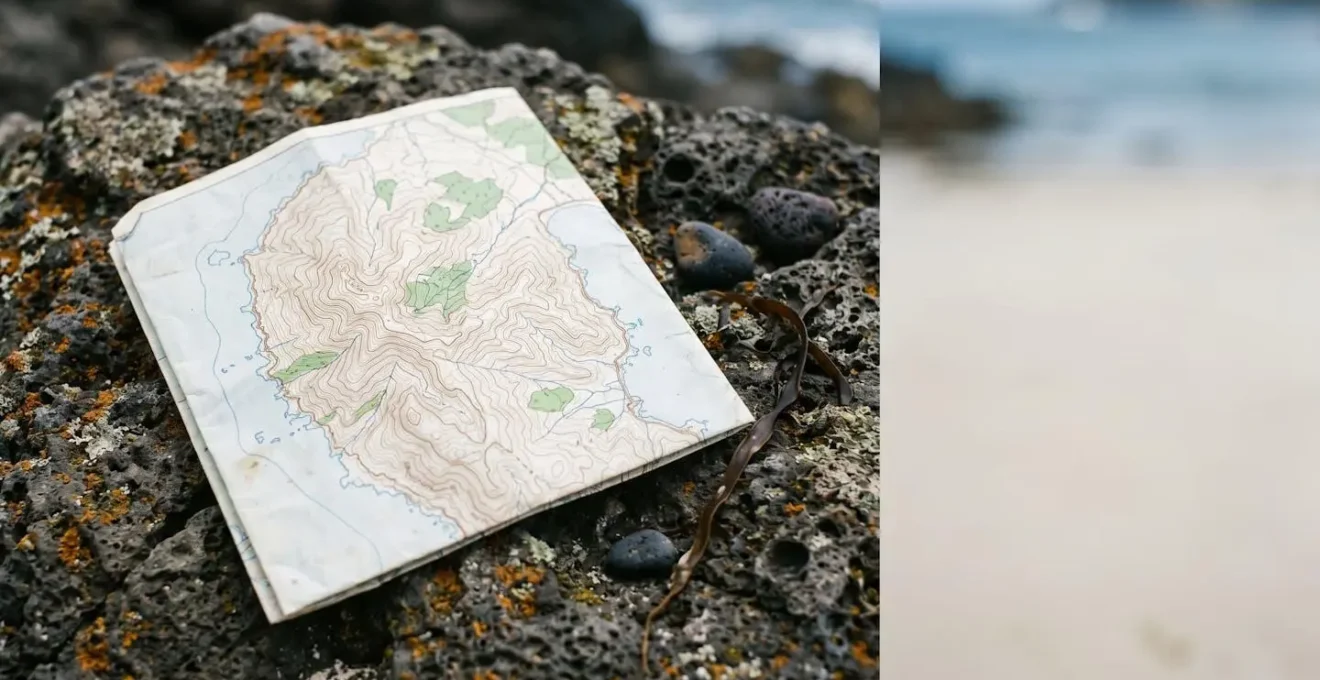
- Prioritize official paper topographic maps for their baseline accuracy and independence from technology.
- Use community-sourced digital maps (like GPX tracks) for recent trail intelligence, but critically vet their data provenance.
- Mastering contour line interpretation is non-negotiable for accurately predicting climb difficulty and estimating hike times.
- Always cross-reference multiple sources—official, digital, and human—to verify trail currency and safety, especially in volcanic areas.
For the independent hiker, the thrill of an island trek lies in self-guided exploration, far from crowded tours. Yet, this autonomy hinges on a single, critical tool: a reliable map. The free leaflet from a tourist office, with its charming illustrations and lack of topographic detail, is woefully inadequate for serious hiking. It’s designed for casual sightseeing, not for navigating remote coastal paths or volcanic slopes where a wrong turn can have serious consequences. Many hikers turn to popular navigation apps, assuming technology holds the answer.
However, relying solely on a smartphone screen introduces its own set of high-stakes risks, from battery failure to signal loss in deep ravines. The fundamental challenge isn’t a lack of information, but a lack of a framework to judge its quality. The real key to safe independent hiking is not just finding more maps, but developing the expertise to critically evaluate the trustworthiness of any cartographic source you encounter.
This guide moves beyond a simple list of apps or websites. It provides a precision-focused methodology for vetting your navigational tools. We will dissect the foundational reliability of paper maps, show you how to read terrain like a cartographer, and provide a clear system for assessing the risks and rewards of both official and community-created resources. By understanding the provenance and limitations of your data, you can build a navigation strategy that ensures safety and confidence on any island trail.
This comprehensive article will provide you with a clear framework for selecting, interpreting, and verifying your hiking maps. Discover the specific strategies to ensure your navigation is as solid as the terrain you plan to conquer.
Summary: Finding and Vetting Detailed Island Hiking Maps
- Why Are Paper Topographic Maps More Reliable Than Phone Apps for Remote Island Hiking?
- How to Read Hiking Map Contour Lines to Predict Climb Difficulty Before Starting?
- Official Tourism Trail Maps or Community-Created Resources: Which for Accurate Island Hiking?
- The Map Reading Mistake That Leads Hikers Onto Private Island Property
- When Should You Verify Island Hiking Maps Are Current: Pre-Trip Checking Strategies?
- How to Hike Volcanic Cliff Paths Safely Without Hiring Professional Guides?
- The Volcanic Trek Mistake: Inadequate Gear for High-Altitude Temperature Extremes
- How to Prepare for Trekking Active Volcanic Craters Safely on Island Expeditions?
Why Are Paper Topographic Maps More Reliable Than Phone Apps for Remote Island Hiking?
In an age of digital convenience, advocating for a paper map can seem archaic. Yet, for remote island hiking, its reliability is unmatched. A paper topographic map has one profound advantage: it has no battery. Hikers frequently underestimate how quickly a phone’s battery drains when its GPS is constantly active, especially in cold weather or areas with a weak signal. A power bank is a common workaround, but it introduces another point of failure—cables can break, and the banks themselves can be forgotten or arrive uncharged. When the screen goes dark, your digital map becomes useless.
Beyond battery life, there’s the question of accuracy. The GPS in a consumer-grade smartphone is a marvel, but it’s not infallible. In steep canyons or under dense forest canopy—common on tropical islands—the signal can degrade or fail entirely. An important analysis of GPS accuracy highlights that recreational devices can be off by as much as 7.8 meters. This margin of error might seem small, but on a narrow ridge or when searching for a trail junction, it can be the difference between safety and danger.
A paper map, produced by a national survey agency, represents a stable source of ground truth. It is not subject to battery loss, signal degradation, or software glitches. It provides a complete and unalterable overview of the entire area, allowing for better strategic planning than a small, scrolling screen. It is the foundation of a resilient navigation system, a failsafe that works under all conditions. While digital tools are excellent supplements for real-time data, they should never be the sole solution.
How to Read Hiking Map Contour Lines to Predict Climb Difficulty Before Starting?
The true power of a topographic map lies in its ability to represent a three-dimensional landscape on a two-dimensional surface. The key to unlocking this information is understanding contour lines. Each line connects points of equal elevation. The closer these lines are to each other, the steeper the terrain. When they are widely spaced, the ground is relatively flat. This visual grammar allows a hiker to « see » the shape of a mountain, the steepness of a valley, and the location of ridges and passes before ever setting foot on the trail.
By analyzing these patterns, you can make critical judgments about a route’s difficulty. Tightly packed lines indicate a significant, strenuous climb that will demand high energy output. Lines forming a « V » shape point uphill, indicating a gully or stream bed, while « U » shapes often denote a ridge. Recognizing these patterns helps you anticipate the physical challenge ahead and plan your pace and energy reserves accordingly. The contour interval—the change in elevation between two adjacent lines, stated in the map’s legend—is the numerical key to this analysis.
Practical Application: Estimating Hike Time with Naismith’s Rule
To turn this visual data into a practical plan, hikers can use Naismith’s Rule. Devised in 1892, this time-tested formula provides a solid estimate for hiking duration. As a well-documented method for estimating hiking time, the modern rule allows one hour for every 3 miles (or 5 km) of horizontal distance, plus an additional hour for every 2,000 feet (or 600 m) of ascent. To use it, simply count the number of contour lines your route crosses, multiply by the contour interval to find the total elevation gain, and plug the numbers into the formula. This simple calculation, done before you start, transforms an abstract route into a tangible schedule.
This skill is not merely academic; it’s a fundamental safety practice. It prevents you from underestimating a trail and finding yourself caught out by a grueling, unexpectedly long ascent, especially when daylight is limited on an island expedition.
Official Tourism Trail Maps or Community-Created Resources: Which for Accurate Island Hiking?
The modern hiker’s toolkit is flooded with options, from official government-issued maps to crowdsourced trail apps like AllTrails and Wikiloc. Choosing the right source requires understanding the crucial difference between them: their data provenance. Official maps from cartographic agencies are built on rigorous surveying standards. They are legal documents showing sanctioned trails and permanent topography. Their strength is unparalleled topographic accuracy.
Community resources, on the other hand, are built from user-submitted GPX tracks. Their strength is currency; a track can be hours or days old, reflecting recent changes like a new landslide or a fallen tree. However, their accuracy is highly variable and depends entirely on the user’s expertise and equipment. They show what is currently popular or possible, not necessarily what is permissible or safe. The choice is not about one being « better, » but about using them for their intended purposes: official maps for baseline truth and community resources for recent intelligence.
This table breaks down the fundamental differences, highlighting why a blended approach is the most robust strategy. As an analysis of hiking apps explains, each source has distinct strengths and weaknesses.
| Criteria | Official Maps (USGS/Government) | Community Resources (AllTrails/Wikiloc) |
|---|---|---|
| Data Source | Government cartographic agencies with rigorous surveying standards | Crowdsourced, user-submitted tracks of variable quality |
| Legal Status | Certified documents showing legally sanctioned trails | Unverified suggestions with no liability |
| Update Frequency | Updated infrequently (every few years) | Can be hours or days old |
| Information Type | Shows what is permissible and permanent topography | Shows what is currently popular or possible |
| Accuracy | High topographic accuracy, professionally surveyed | Variable accuracy, depends on user expertise |
| Current Conditions | Does not reflect recent trail changes | May include recent updates on trail conditions |
Your Vetting Checklist: Trust Scorecard for Community GPX Tracks
- Cross-Reference: Always compare the user-submitted track against an official map to ensure it follows a sanctioned trail.
- Verify with Multiple Sources: Look for consensus across several platforms or user tracks to confirm trail details and conditions.
- Check User Credibility: Investigate the user’s profile. Do they have a history of contributing high-quality, detailed tracks, or is this their only upload?
- Review Recent Activity: Prioritize tracks with recent, positive comments and geotagged photos that validate the route is currently passable and as described.
- Analyze the Elevation Profile: Scrutinize the elevation data for the track. Does it look logical, or are there sudden, impossible spikes or drops that indicate GPS data errors?
The Map Reading Mistake That Leads Hikers Onto Private Island Property
One of the most common and easily avoidable navigation errors on islands is unintentional trespassing. Hikers, engrossed in following a trail, can inadvertently wander onto private land, leading to uncomfortable confrontations or, in some areas, legal issues. This mistake almost always stems from a failure to understand or consult a map that shows property boundaries. Many islands feature a complex patchwork of public parks, private estates, and agricultural land.
Official topographic maps are the primary tool for avoiding this error. These maps use specific symbols to denote different types of land ownership. While conventions vary slightly by country, private property is often indicated by:
- Faint, thin dashed or dotted lines that are distinct from the bold lines used for trails or roads.
- Color tints or shading, where private parcels might be left white while public lands (like national parks) are shaded green or another color.
- Specific labels or abbreviations indicating a private reserve or estate.
The mistake happens when hikers either use a map that omits this information (like a simplified tourist map) or rely exclusively on a community-sourced GPX track. A GPX file is just a line on a screen; it contains no information about the legal status of the land it crosses. If a previous hiker cut across private property, their track will lead you to do the same. It has no built-in awareness of boundaries. Before trusting a digital track, you must overlay it on a proper base map that shows these property lines to ensure your intended route remains on public land.
When Should You Verify Island Hiking Maps Are Current: Pre-Trip Checking Strategies?
A map is a snapshot in time, and on dynamic island landscapes, that snapshot can become outdated quickly. Volcanic activity, landslides after heavy rains, or seasonal trail closures can render a perfectly good map dangerously inaccurate. Verifying a map’s currency is not a one-time check but an ongoing process of gathering dynamic intelligence right up until you start your hike. Assuming the trail you researched months ago is still the same today is a risky gamble.
Your verification should start with official sources. Check the website of the local national park service or the island’s official hiking authority for alerts, closures, or reroutes. However, official updates can sometimes lag behind reality. This is where active intelligence gathering becomes crucial. Use modern tools to get a near real-time picture of the ground truth. Your goal is to find information from people who have been on the trail within the last few days or weeks.
A multi-source verification protocol is the most effective strategy. Combine official channels with on-the-ground reports to build a comprehensive and current understanding of your route.
- Set Up Digital Alerts: Create Google Alerts for the island’s name plus keywords like « trail closure, » « landslide, » or « rockfall » to catch recent news.
- Use Social Media as an Intel Tool: Search Instagram, Facebook, or other platforms for the trail name or location as a hashtag. Filter by « Recent » to see the latest posts.
- Contact Recent Hikers: If you find people who posted from the trail recently, send a polite direct message asking about current conditions. Most hikers are happy to share timely information.
- Consult Local Experts: A quick phone call or email to a reputable local guiding company or the island’s hiking club can provide invaluable, up-to-the-minute ground truth.
- Check Satellite Imagery: For major changes, use the historical imagery feature in Google Earth Pro. Comparing satellite photos from different years can reveal major landscape alterations not yet reflected on maps.
How to Hike Volcanic Cliff Paths Safely Without Hiring Professional Guides?
Hiking along volcanic cliff paths offers some of the most dramatic coastal views imaginable, but it also presents a unique set of hazards. These trails are often narrow, exposed, and subject to high winds and erosion. Safe, independent navigation requires a heightened sense of environmental awareness and specific techniques beyond standard trail walking. Your safety depends on your ability to read the terrain and the weather in real-time.
Wind is one of the greatest dangers. An exposed cliff edge is not the place to discover that a strong gust can knock you off balance. Before starting an exposed section, assess the wind by observing the sea surface below; whitecaps and spray are clear warning signs of dangerous speeds. Be particularly cautious in gullies or between rock formations, where the venturi effect can cause wind to accelerate dramatically. In windy sections, adopt a low center of gravity by crouching and be prepared to use your hands for additional stability.
The stability of the trail itself is another critical factor. Volcanic rock can be brittle and prone to erosion. Always look for red flags indicating compromised stability:
- Signs of recent, small landslides or rockfall on or below the trail.
- Fresh cracks or signs of undercutting at the trail’s outer edge.
- Areas where water is actively seeping out of the cliff face, which can weaken the ground.
In any section identified as a « no-fall zone »—where a simple slip would have catastrophic consequences—shift to a deliberate, slow-paced movement, ensuring you always have three points of contact with the ground (two feet and one hand, or two hands and one foot).
Key Takeaways
- Baseline Reliability: Official paper topographic maps are the non-negotiable foundation for any serious trek due to their accuracy and independence from technology.
- Dynamic Intelligence: Digital and community sources are valuable for their currency, but their data must be critically vetted against official maps and recent reports.
- Terrain is the True Map: Your ability to read contour lines, assess wind, and spot signs of erosion is a more critical safety skill than any single piece of gear.
The Volcanic Trek Mistake: Inadequate Gear for High-Altitude Temperature Extremes
A frequent and dangerous mistake hikers make on island volcanoes is packing for the beach, not the summit. The warm, humid air at sea level can lull you into a false sense of security. As you ascend, the temperature can plummet dramatically. A 2,000-meter (6,500-foot) climb can easily correspond to a 12-15°C (22-27°F) drop in temperature, and that’s before factoring in wind chill on an exposed summit. Being caught in cold, wet conditions without proper gear is a fast track to hypothermia.
The gear required for a volcanic summit is fundamentally different from a standard day pack. Your clothing system must be built on the principle of layering and prepared for the worst-case scenario. This means leaving the cotton t-shirt behind and opting for a synthetic or wool base layer that wicks moisture. Most importantly, you need proper insulation and weather protection. A simple rain poncho won’t cut it against the driving wind and abrasive volcanic rock.
The following comparison starkly illustrates the difference in preparation required. A volcanic summit pack prioritizes protection from cold, wind, and unstable terrain, acknowledging that conditions at the top are a world away from the coast.
| Item Category | Beach Day Pack | Volcanic Summit Pack |
|---|---|---|
| Insulation | Light windbreaker only | Synthetic insulation jacket (e.g., PrimaLoft) that retains warmth when damp |
| Weather Protection | Basic rain poncho | Hardshell jacket for wind, abrasive rock, and potential acidic gas protection |
| Footwear | Trail runners or hiking sandals | High-top boots for ankle support on unstable scree, plus gaiters for volcanic pebbles |
| Navigation | Phone with downloaded map | Paper map, compass, GPS device, and a headlamp with extra batteries |
| Emergency Gear | Basic first aid | Emergency bivvy, full waterproofs, extra high-energy food, and a whistle |
| Electronics Protection | None | Waterproof dry bags or Ziploc bags for protection from volcanic ash and moisture |
How to Prepare for Trekking Active Volcanic Craters Safely on Island Expeditions?
Trekking to the rim of an active volcanic crater is the pinnacle of many island expeditions. It’s also an environment where objective hazards are high and the margin for error is slim. Safe preparation goes beyond packing the right gear; it requires a proactive safety protocol that begins long before you reach the trailhead. Your primary task is to research the volcano’s current state and understand its invisible dangers, namely volcanic gases.
Local volcano observatories are your most critical resource. Before your hike, find and interpret their data on gas emissions, particularly sulfur dioxide (SO2) levels. Elevated levels can cause serious respiratory irritation. Learn to recognize the physical symptoms of gas exposure, which include coughing, shortness of breath, and dizziness. When gas concentrations are elevated or if the wind might push plumes toward your trail, carrying an N95 or P100 respirator is a wise precaution. On the trail, look for warning signs of hot ground, such as steam vents (fumaroles), discolored yellow sulfur deposits, or shimmering air. Never sit or leave your pack directly on these active thermal features.
A rigid, disciplined approach to time and route management is also essential. A volcanic environment is not the place for summit fever.
- Plan Escape Routes: Using your map, identify at least two viable escape routes from the summit or crater rim before you even start the ascent.
- Set a Hard Turn-Around Time: Before you leave, decide on a non-negotiable turn-around time (e.g., 1 p.m.). Commit to turning back at that time, regardless of how close you are to the summit. This ensures you descend with ample daylight and energy reserves.
- Heed All Warnings: Pay attention to all official signage and respect any closed areas. They are closed for a reason.
This disciplined mindset, combining diligent research with conservative decision-making on the trail, is the cornerstone of safe, independent volcanic trekking.
By integrating these principles of map vetting, terrain analysis, and hazard-specific preparation, you elevate your practice from simple hiking to true independent expedition planning. This methodical approach is the key to unlocking the most spectacular and remote corners of any island, safely and confidently.