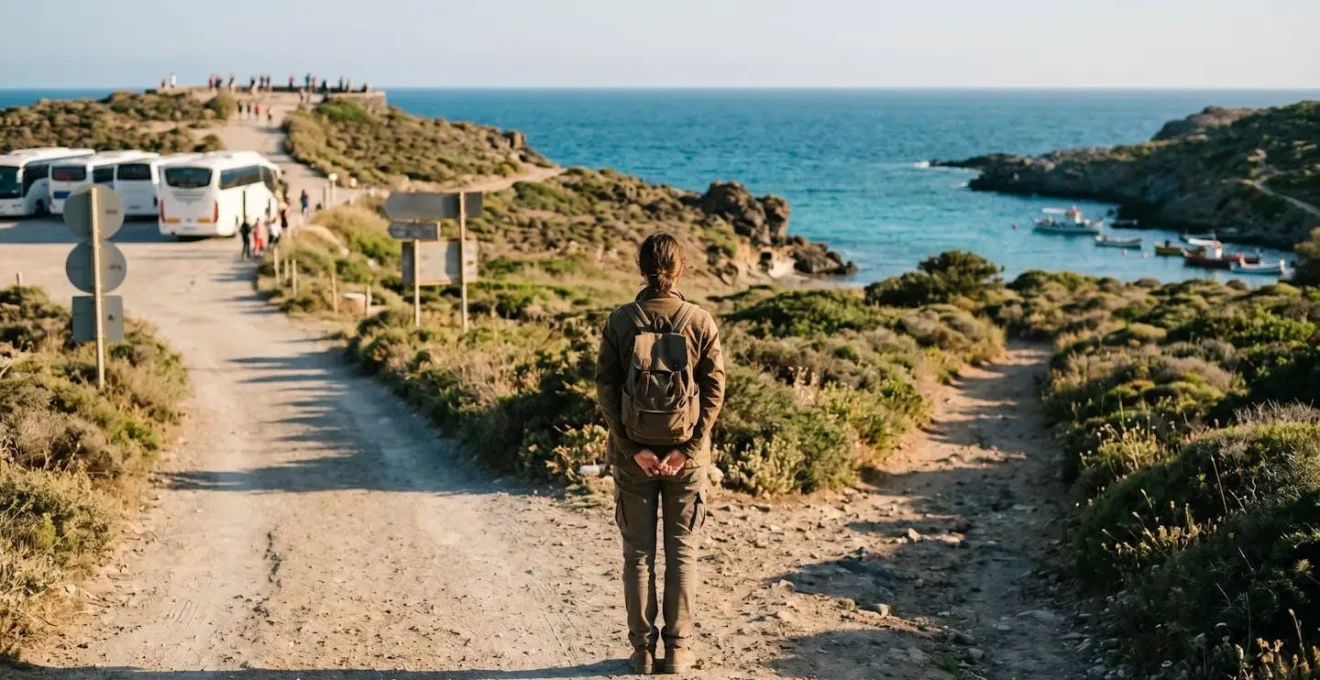
The most meaningful island trips don’t come from finding better Top 10 lists, but from building a better personal filter to sift through all available options.
- Generic lists lead to overtourism, concentrating 80% of travellers into just 10% of destinations, diminishing the quality of the experience for everyone.
- A flexible framework—researching options but making decisions in the moment—delivers up to 40% higher travel satisfaction than a rigid, pre-planned script.
Recommendation: Shift your focus from « what are the best sights? » to « which sights are best for me? » by creating a system to evaluate potential points of interest against your specific hobbies, passions, and travel style.
For the independent traveller, there’s a familiar disappointment that often sets in after a trip. You review your photos and realise they look uncannily similar to every other image of the island on social media. You followed the « Top 10 Points of Interest » lists, you visited the must-see landmarks, and yet, the experience felt strangely impersonal, like you were just checking boxes off a universal list. The reality is that most travel advice is designed for mass consumption, funnelling everyone toward the same handful of over-hyped locations and contributing to a homogenised tourist experience.
The usual solutions—sifting through endless online reviews or simply wandering aimlessly—are inefficient and often lead to more frustration. You want authenticity, but you’re given algorithms. You crave personal discovery, but you’re handed a script written for someone else. This cycle is a hallmark of modern travel, where the pressure to optimise a trip often leads to an experience that feels anything but your own. True independence requires a more strategic approach.
But what if the solution wasn’t to find a better, more obscure list? What if the key was to stop looking for external validation and instead build an internal compass? This guide is not another list of « hidden gems. » It is a methodology, a system for you, the discerning traveller, to become your own best itinerary designer. It’s about shifting your mindset from being a passive consumer of recommendations to an active curator of your own unique island adventure. We will deconstruct the process, providing you with the tools to filter the noise and build a trip that is a true reflection of your interests.
This article provides a structured methodology for the independent traveller to move beyond generic recommendations. Below, you will find a breakdown of the key strategies, from identifying the core problem of homogenised travel to developing the confidence to explore on your own terms.
Summary: A Methodological Guide to Crafting a Personal Island Itinerary
- Why Do Top 10 Points of Interest Lists Lead to Homogenised Tourist Experiences?
- How to Find Island Points of Interest Matching Your Specific Hobbies and Passions?
- Local Resident Recommendations or Online Reviews: Which Reveal Better Island Points of Interest?
- The Itinerary Mistake: Cramming 12 Points of Interest Into a 6-Day Island Trip
- When Should You Visit Island Points of Interest: Timing to Avoid Peak Crowds?
- Why Do Local Island Blogger Resources Beat International Travel Sites for Accuracy?
- The Independence Paradox: Over-Planning Island Trips Until They Resemble Organised Tours
- How to Develop Independent Exploration Confidence Beyond Organised Tour Packages?
Why Do Top 10 Points of Interest Lists Lead to Homogenised Tourist Experiences?
The fundamental flaw of « Top 10 » lists and algorithm-driven recommendations is their tendency to create a feedback loop. A point of interest gets initial popularity, it’s featured on a list, which drives more traffic, which in turn boosts its ranking on search engines and review sites, leading to even more features. This cycle results in a dramatic over-concentration of tourism. It’s a well-documented phenomenon; research confirms that an astonishing 80% of travellers visit just 10% of the world’s tourist destinations. This means the vast majority of people are vying for the same experience in the same few places, turning what should be a moment of discovery into a battle for a clear photo.
The consequences of this homogenisation are profound. For the destination, it leads to overtourism, straining local infrastructure and environmental resources. The island of Santorini provides a stark example. In recent years, it has seen up to 18,000 cruise passengers overwhelm the island daily, a number that surpasses its entire resident population of 15,000. This influx, funnelled by its « must-see » status, erodes the very authenticity that travellers were seeking in the first place.
This image captures the essence of the problem: a crowd of visitors, all standing shoulder-to-shoulder, trying to capture the exact same photograph. It’s tourism as a checklist, not an experience.
For the traveller, the result is a diluted, often stressful experience. Instead of serene contemplation of a beautiful vista, you get the jostle of crowds. Instead of a unique memory, you get a carbon copy of an Instagram post. Breaking free from this cycle requires a deliberate rejection of the idea that a « Top 10 » list defines what is valuable and a conscious effort to define value for yourself.
How to Find Island Points of Interest Matching Your Specific Hobbies and Passions?
The most effective strategy to break free from generic itineraries is to stop looking outward for lists and start looking inward at your own interests. Instead of asking « What are the top things to do on this island? », ask « How can I practice my hobbies and passions on this island? » This simple shift in perspective is the foundation of a truly personalised travel experience. The goal is to create a personal Interest Matrix, where you evaluate every potential activity not by its popularity, but by its alignment with what genuinely excites you.
Begin by deconstructing your interests. Are you a passionate gardener? Then your research should focus on botanical gardens, local nurseries, or endemic plant habitats, not just the most famous beach. Are you an amateur historian? Seek out small, local historical societies, forgotten ruins marked on old maps, or neighbourhoods known for their unique architecture. Are you a foodie? Go beyond restaurant reviews and look for local cooking classes, farmer’s markets, or food producers you can visit. By using your hobbies as a filter, not a list, you automatically venture beyond the standard tourist trail.
This approach isn’t just about having a more authentic experience; it’s also about efficiency. By focusing your time on activities that have a high personal value, you increase your experience density. Instead of rushing between five generic sights that leave you feeling unfulfilled, you might spend an entire afternoon deeply engaged in one activity that becomes a highlight of your trip. In fact, data shows that travellers with personalized itineraries fit 30-40% more meaningful experiences into the same timeframe. They achieve this by eliminating the « filler » activities that don’t align with their core interests.
Local Resident Recommendations or Online Reviews: Which Reveal Better Island Points of Interest?
Independent travellers are often caught between two primary sources of information: the crowd-sourced data of online review platforms and the anecdotal advice of local residents. There’s a common assumption that local advice is inherently superior, yet the data shows a more complex reality. Surprisingly, 84% of respondents say they trust online reviews as much as personal recommendations, indicating that travellers see value in both. The consultant’s approach is not to pick one over the other, but to use each for its specific strength—a « Source-for-Purpose » framework.
Online review platforms like Google Maps and TripAdvisor are unparalleled for logistical information. They provide a massive, constantly updated database on practicalities: opening hours, pricing, accessibility, and whether a location is temporarily closed. The most recent reviews are your best source for real-time operational data. However, they are less reliable for assessing cultural context or « vibe. »
Local recommendations, on the other hand, excel at providing the « why. » A local can tell you *why* a particular spot is special, the best time to go to feel the local atmosphere, its cultural significance, or the story behind it. The key is to ask qualifying questions like, « What makes it special to you? » to unlock this deeper context. This framework below helps clarify when to use which source.
This comparative analysis provides a clear guide for when to rely on crowd-sourced data versus seeking out local, insider knowledge. As this recent travel advice analysis shows, the smartest travellers triangulate information from multiple source types.
| Information Need | Best Source | Why It Works | Follow-Up Action |
|---|---|---|---|
| Opening hours, pricing, accessibility | Online Reviews (Google Maps, TripAdvisor) | Crowd-sourced logistics data updated frequently | Check most recent reviews (last 30 days) for current accuracy |
| Cultural context, best timing, local significance | Local Recommendations | Insider knowledge of vibe, authenticity, seasonal variations | Ask qualifying questions: ‘Is this more for locals or tourists?’ ‘What makes it special to you?’ |
| Identifying what to avoid | 1-Star Reviews of Popular Spots | Complaints reveal opposites: ‘too crowded’ → search ‘quiet beach’; ‘tour buses’ → find local gems | Use negative keywords as positive search filters |
| Legitimizing recommendations | Local Tourism Board + Editorial Content | Vested interest in quality without incentive for bad experiences | Cross-reference with magazine reviews and social media authenticity checks |
The Itinerary Mistake: Cramming 12 Points of Interest Into a 6-Day Island Trip
One of the biggest mistakes independent travellers make is overcompensating for the lack of a tour guide by creating a rigid, jam-packed schedule. This desire to « see it all » paradoxically leads to experiencing very little. An itinerary with 12 points of interest in six days is not a plan for a vacation; it’s a logistical challenge that leaves no room for spontaneity, relaxation, or the serendipitous discoveries that make travel meaningful. This approach prioritises quantity of sights over quality of experience, turning your trip into a frantic race against the clock.
A more effective and satisfying approach is to implement a system of planned constraint. The « Rule of Three » is a simple yet powerful framework for structuring your days to ensure both focus and flexibility. By limiting your planned activities, you deliberately create « white space » in your calendar, which is where true exploration happens. This isn’t about being lazy; it’s about being strategic. It’s a shift toward slow travel, a philosophy that values connection and immersion over a hurried checklist.
This method forces you to be ruthless in prioritising what truly matters to you, ensuring that your energy is spent on high-value experiences rather than being spread thin across a dozen mediocre ones. It also builds in the resilience needed to handle the unexpected—a sudden rainstorm or a fascinating conversation—without derailing your entire day. Adopting this mindset transforms your itinerary from a rigid script into a flexible framework for discovery.
Action Plan: Implementing « The Rule of Three » for Daily Island Exploration
- Plan exactly 1 ‘must-see’ anchor POI per day that aligns with your core interests (not someone else’s top 10).
- Schedule 1 planned food experience per day (a specific restaurant, market visit, or cooking class) to create rhythm.
- Reserve 1 flexible slot for spontaneous discovery by literally blocking out « unscheduled exploration » time in your calendar.
- Apply the 50/50 Calendar Rule: For every planned hour, leave one hour of white space. A morning walking tour means the afternoon is for serendipity.
- Use POI Clustering: Choose a neighbourhood or village as your daily ‘hub’ and explore within walking distance, avoiding repeated cross-island travel.
When Should You Visit Island Points of Interest: Timing to Avoid Peak Crowds?
Beyond choosing *what* to see, the savvy traveller must consider *when* to see it. On a small island, timing is everything. Most tourists operate on a predictable schedule, creating distinct peaks and lulls in crowd density at popular locations. By understanding these rhythms, you can often experience the most famous points of interest in relative peace. The issue is compounded by the intense spatial concentration of island tourism. A 2023 study found that a staggering 77% of all tourist overnight stays in island destinations occur on just 5% of their land area. This means avoiding the crowd is not just about off-season travel, but about micro-level, daily timing.
The first step is to think counter-cyclically. When are the tour buses scheduled to arrive? When do cruise ship passengers disembark for shore excursions? This information is often publicly available. Official port authority websites, for instance, frequently publish their cruise ship schedules. Planning your visit to a popular port town on a day with no ships docked can completely transform the experience. Your goal is to be where the crowds are not.
Beyond these macro strategies, there are several « micro-timing » tactics based on local daily life. These small adjustments can yield significant rewards in terms of experience quality. Embracing a slightly overcast day for a popular hike, for example, can mean you have the trail and the viewpoint almost to yourself. These strategies require a bit of research and a flexible mindset, but they are essential tools for anyone serious about avoiding the herd.
- The Lunch Hour Gambit: Visit popular beaches and attractions between 1-3 PM. This is often when local families and many tourists retreat for lunch and a siesta, creating a temporary window of quiet.
- Market End-Hour Strategy: Arrive at food markets in the final hour before closing. Vendors are often less busy, more willing to chat, and may offer samples or discounts.
- The Weather Opportunity Window: Don’t let a little rain deter you. Overcast or slightly drizzly days are perfect for visiting normally overcrowded outdoor sites like waterfalls or scenic viewpoints for a more atmospheric, solitary experience.
Why Do Local Island Blogger Resources Beat International Travel Sites for Accuracy?
While large international travel sites provide broad overviews, they often lack the granular, up-to-the-minute detail that makes a trip truly seamless. This is where local island bloggers and small, independent content creators offer a distinct advantage. Because they are embedded in the community, their knowledge is not static; it is constantly updated by their daily lives. They know which road is suddenly closed for a local festival, which new cafe has the best coffee, and that the « must-visit » waterfall is down to a trickle in the dry season. This is ephemeral knowledge, and it’s something a quarterly-updated international guide can never capture.
Local bloggers provide context and nuance that is lost in mass-market content. They write about the island as a living, breathing place, not just a collection of attractions. Their content often includes the mundane aspects of life—grocery shopping, community events, local politics—which gives you a much richer understanding of the destination. However, the challenge is distinguishing a genuinely local, passionate blogger from a content farm disguised as one. Vetting your sources is a critical skill.
This is not just about finding a « hidden gem » restaurant; it’s about tapping into a source of information that is both current and culturally attuned. A good local blogger acts as a virtual friend on the ground, offering advice that is both practical and authentic. The following checklist provides a framework for auditing potential blogger resources to ensure they are the real deal.
Action plan for vetting local sources
- Points of contact: Check if they write about mundane local life beyond tourism (e.g., community events, seasonal changes) to verify their connection to the place.
- Collecte: Examine comment sections and social media interactions. Do they feature conversations with other locals using specific references, or just generic praise from tourists?
- Cohérence: Verify their « About Us » photo. Is it taken at a recognizable but non-touristy spot that only a resident would know, confirming their claimed identity is consistent with their knowledge?
- Mémorabilité/émotion: Assess their capture of ephemeral knowledge. Do they post updates on new pop-ups, temporary closures, or real-time neighbourhood changes that a generic guide would miss?
- Plan d’intégration: Assess their affiliate disclosure transparency. A genuine local clearly discloses partnerships, allowing you to decide whether to integrate their advice into your plan.
The Independence Paradox: Over-Planning Island Trips Until They Resemble Organised Tours
A significant pitfall for newly independent travellers is the « Independence Paradox. » In an effort to avoid the constraints of an organised tour, they construct an itinerary so detailed and rigid that it becomes a self-imposed tour. Every hour is accounted for, every meal is pre-booked, and every route is mapped. While born from a desire for control and efficiency, this approach ultimately kills the very thing that makes independent travel so rewarding: the freedom to choose and the joy of serendipity.
The solution lies in understanding the crucial difference between a rigid script and a flexible framework. A script dictates every action: « 9:00 AM: Hike Trail X. 12:00 PM: Lunch at Restaurant Y. » A framework, however, provides structured optionality: « Morning: Northern region. Options include Hike A (challenging, 3hrs) or Beach B (relaxing). Decide at breakfast based on energy and weather. » This approach, which involves creating a ‘Personalised Digital Guidebook’ of researched options rather than a minute-by-minute schedule, is the key to balancing structure with spontaneity.
Case Study: The Flexible Framework Approach
Research into itinerary design reveals a key insight: custom travel plans that focus on being a ‘framework’ rather than a ‘script’ deliver up to 40% higher satisfaction than package tours. The effective method involves pre-trip research to identify a cluster of potential activities within a geographical area for each day. For example: ‘Tuesday: Explore the southern coast. Researched options: Hike A (2hrs, moderate), Beach B (good for overcast days), or Village C (market day). The final decision is made in the morning based on real-time factors like weather and energy levels.’ This strategy provides what itinerary consultants call ‘logistical scaffolding.’ It reduces in-the-moment decision fatigue by providing pre-vetted choices, but preserves the traveller’s autonomy and ability to adapt, which is the core of independent exploration.
By adopting a framework approach, you give yourself the gift of choice. You’ve done the homework to ensure your options are good ones, but you retain the power to make the final call in the moment. This is the essence of confident, independent travel—having a plan, but holding it loosely.
Key takeaways
- The goal is not to find a better list of attractions, but to build a better personal filtering system based on your own interests.
- Distinguish between using online reviews for logistics (hours, prices) and local recommendations for cultural context and authenticity.
- Adopt a « Rule of Three » for daily planning (1 anchor POI, 1 food experience, 1 flexible slot) to balance structure with spontaneity and avoid burnout.
How to Develop Independent Exploration Confidence Beyond Organised Tour Packages?
Transitioning from the safety net of organised tours to the freedom of independent exploration can be daunting. The key is to build confidence gradually using a « scaffolding » method, where you incrementally take on more responsibility for your own logistics and decision-making. This structured approach allows you to expand your comfort zone without feeling overwhelmed.
Start with a hybrid model. On your next trip, book an organised tour for the first day only. Use this as an orientation session: get your bearings, observe how things work, and ask your local guide practical questions about public transport, local customs, or safety. Then, for the rest of the trip, you are on your own, but armed with foundational knowledge. This small step can make a huge difference in your initial confidence level.
The next step is to master low-stakes micro-challenges. These are small, deliberate tasks designed to build your skills. Successfully navigate the local bus system for just a couple of stops. Order a meal at a restaurant with no English menu using a translation app or gestures. Ask a local for directions to a nearby pharmacy and find it. Each small success builds a foundation of self-reliance, proving to yourself that you are capable of handling the logistics of travel. Instead of booking full-day tours, book specific guided activities (like a diving lesson or cooking class) but handle all the surrounding logistics—transport, meals, and accommodation—yourself. This practices independence in a controlled context.
Slow travel centers on savoring the journey and immersing oneself deeply into local cultures while eschewing itineraries that seek superficial experiences over meaningful engagement with a destination.
– The Travel Team, Personalized Travel Itinerary Guide
By applying this methodological approach—from defining your interests to building your confidence—you transform yourself from a tourist into a true independent explorer. The next step is to put this framework into practice on your next island getaway.