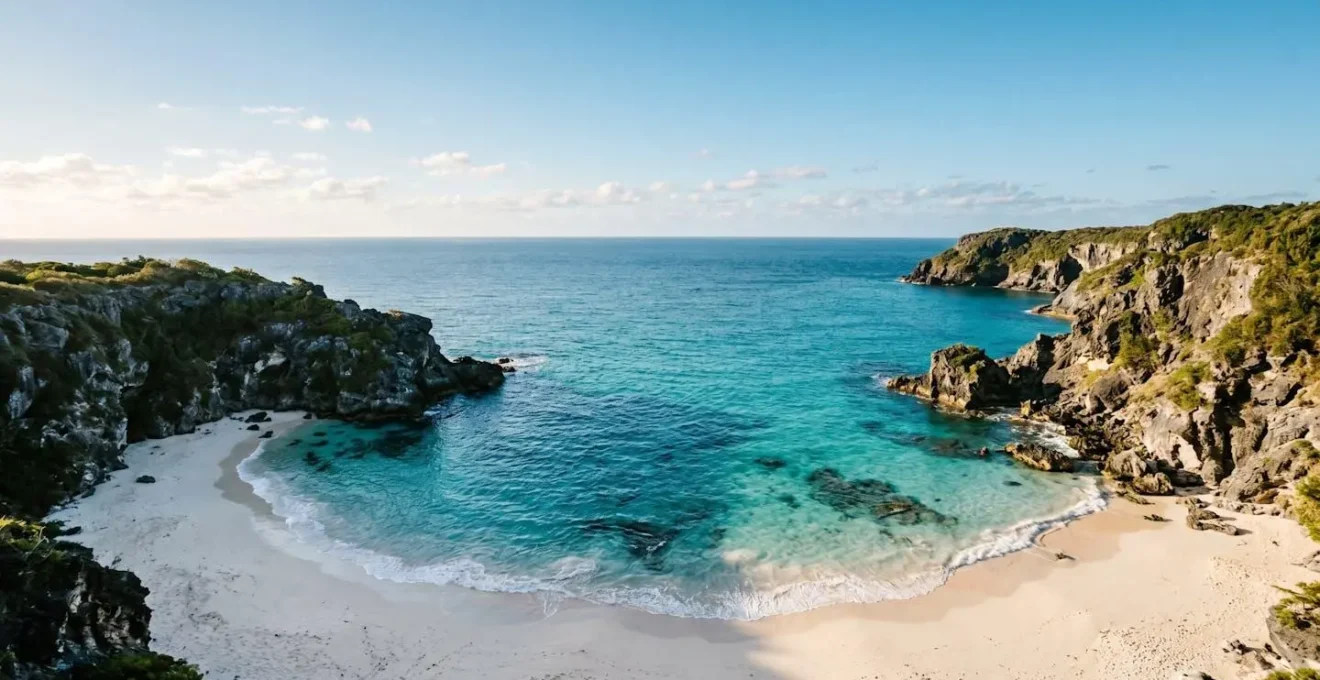
Sharing a hidden beach photo is no longer just a post; it’s a vote that determines the future of a fragile ecosystem.
- The « discovery-to-post » pipeline, fueled by geotagging, can overwhelm and degrade a pristine location within 6-12 months.
- True influence lies in ‘digital stewardship’—sharing the beauty and emotion of a place without revealing its exact coordinates, thus protecting it.
Recommendation: Shift your mindset from being a ‘discoverer’ who exposes locations to a ‘protector’ who uses your platform to advocate for conservation and mindful travel.
You’ve found it: a perfect, secluded stretch of sand, untouched by crowds, the kind of place that feels like a secret whispered by the ocean itself. The camera comes out, you capture the magic, and the impulse is immediate—share this beauty with the world. But in that moment, an ethical dilemma arises, one that every modern travel content creator and social media user faces. The tools designed to connect us and share experiences, like Instagram geotags, are also powerful enough to destroy the very places we cherish.
The common advice is a simple « leave no trace » and « don’t geotag. » While well-intentioned, this barely scratches the surface of the issue. It ignores the complex psychology of social media, the economic pressures on local communities, and the real-world mechanics of how a single post can trigger an irreversible cascade of environmental damage. The debate is not merely about secrecy versus openness; it’s about our role and responsibility within a digitally-connected world that has very physical consequences.
This article reframes the question. Instead of asking *if* you should share, we will explore *how* your online actions function as a form of digital stewardship. We will dissect the process by which a location goes from hidden gem to over-touristed hotspot and examine the ethical calculus involved. The true power of a content creator isn’t just in revealing a beautiful place, but in choosing how to tell its story in a way that ensures its survival for generations to come. This is about understanding that every post is a vote for or against an ecosystem’s future.
This guide will navigate the complex considerations behind sharing sensitive locations online, offering a framework for making more conscious and impactful decisions. The following sections break down the problem, the ethics, and the practical solutions for every traveler with a smartphone.
Summary: The Ethics of Sharing Hidden Locations Online
- Why Does Instagram Geotagging Destroy Hidden Beaches Within 6-12 Months?
- How to Share Hidden Beach Photos Without Revealing Their Precise Locations?
- Local Beach Gatekeeping or Open Tourism Access: Which Ethic Is More Defensible?
- The Discovery Mistake: Finding a Hidden Beach Then Immediately Posting Its Location
- When Should Hidden Beach Locations Be Publicised to Enable Protection and Monitoring?
- Should You Share Secluded Island Coves on Social Media or Protect Their Anonymity?
- Why Does Individual Tourist Behaviour Cumulatively Determine Island Ecosystem Survival?
- How to Travel to Fragile Island Ecosystems Without Contributing to Their Degradation?
Why Does Instagram Geotagging Destroy Hidden Beaches Within 6-12 Months?
The destructive power of a geotag lies in its efficiency. It transforms a beautiful, abstract image into an actionable, navigable destination for a global audience. This creates a rapid feedback loop: a stunning photo gets high engagement, the algorithm promotes it, and thousands of users now have the precise coordinates to a place that was previously protected by its obscurity. The impact isn’t theoretical; research shows that geotagging has driven rapid visitor increases to natural sites, leading directly to trail erosion, increased litter, and other forms of environmental strain.
This phenomenon, often called the « discovery-to-post pipeline, » can overwhelm a location’s carrying capacity in a startlingly short time. A beach that could sustainably handle a dozen visitors a day is suddenly inundated with hundreds. There is often no infrastructure—like waste management, established trails, or toilet facilities—to cope with the surge. As environmental journalists have noted, the problem has become so severe that some destinations have publicly asked visitors to stop using the feature entirely. It’s not an issue of illegality but one of collective responsibility, where a single digital action, multiplied by thousands, leads to tangible degradation.
Case Study: Jackson Hole’s Plea to Stop Geotagging
In a direct response to this threat, the tourism board of Jackson Hole, Wyoming, took the significant step of asking visitors to stop geotagging their photos. This decision was made after Instagram-fueled overtourism began to threaten the ecological balance of the area’s fragile natural landscapes. The campaign, « Tag Responsibly, Keep Jackson Hole Wild, » is a prime example of a destination acknowledging the direct line between a digital action and physical-world consequences, prioritizing long-term preservation over short-term social media promotion.
The 6-to-12-month timeframe is not an exaggeration. It represents a single tourist season in many parts of the world. A beach « discovered » and widely geotagged in the spring can be overrun by summer, its delicate ecosystem already showing signs of stress by autumn. The speed of this degradation is a direct product of social media’s scale and immediacy, turning what was once word-of-mouth discovery into a global broadcast.
How to Share Hidden Beach Photos Without Revealing Their Precise Locations?
Protecting a location doesn’t mean you can’t share its beauty. The ethical challenge for a content creator is to capture the essence and emotion of a place without turning it into a target. It requires a shift in focus from « look where I am » to « look at what I saw. » This approach, a core tenet of digital stewardship, prioritizes the artistic and narrative value of an image over its geographical data. As award-winning nature photographer Saswat Panda states, « It’s not the camera that damages the landscape. It’s what happens after the shutter clicks. »
So, how do you do this in practice? Focus on the details that make a place special, not the landmarks that make it identifiable. Instead of a wide shot showing the entire cove and surrounding cliffs, capture the intricate patterns in the sand, the texture of a unique rock formation, or the way light filters through the leaves of coastal vegetation. These macro details and abstract compositions evoke the feeling of the beach without providing a map to it.
As this image demonstrates, immense beauty can be found in the small-scale textures of a beach. By focusing on these elements, you invite your audience to appreciate nature on a more intimate level. Beyond visual techniques, be vague in your descriptions. Use general regional information (« a quiet cove on the Mediterranean coast ») instead of specific names. Disabling the geotag feature on your post is the most crucial step, but also be mindful of identifiable features in the background of your photos or videos. The goal is to inspire, not to instruct.
Local Beach Gatekeeping or Open Tourism Access: Which Ethic Is More Defensible?
The debate over sharing hidden locations often gets framed as a simple conflict: the « gatekeeping » of protective locals versus the « right to explore » of tourists. However, the reality is far more nuanced. What might be perceived as gatekeeping is often an informal act of destination stewardship, a desperate attempt by a community to protect its natural and cultural heritage from being overwhelmed. The Global Sustainable Tourism Council provides a formal framework for this concept, highlighting a multi-stakeholder approach to maintaining a destination’s integrity.
Destination stewardship is a process by which local communities, governmental agencies, NGOs, and the tourism industry take a multi-stakeholder approach to maintaining the cultural, environmental, economic, and aesthetic integrity of their country, region, or town.
– Global Sustainable Tourism Council, GSTC definition of destination stewardship
The argument for open access often champions the idea that nature belongs to everyone and that tourism brings vital economic benefits. While true to an extent, this perspective can overlook the finite capacity of fragile ecosystems. Unrestricted access, amplified by social media, can lead to catastrophic failure. In extreme cases, destinations have taken drastic measures, with Boracay in the Philippines closing for six months to recover from the devastating effects of overtourism. This wasn’t an act of gatekeeping but a necessary emergency response to ecological collapse, demonstrating that « open access » without management is unsustainable.
The more defensible ethic, therefore, is not one of absolute secrecy or absolute openness, but one of managed and responsible access. This often means respecting the wisdom and wishes of the local community who live with the consequences long after tourists have gone home. Their « gatekeeping » is a frontline defense for a shared natural resource, and engaging with them to understand the rules—both written and unwritten—is a fundamental part of ethical travel.
The Discovery Mistake: Finding a Hidden Beach Then Immediately Posting Its Location
The « discovery mistake » is a modern phenomenon driven by the powerful psychological rewards of social media. It’s the near-instantaneous transition from the personal awe of finding a secret spot to the public act of broadcasting its location for validation. This impulse is not born of malice but is a predictable outcome of platforms designed to reward novelty and exclusivity. Travel researchers have confirmed this motivation, with reports from Lonely Planet showing that « people choosing locations based on potential likes. » The allure of being the « discoverer » and the subsequent flood of engagement can override long-term ecological considerations.
This rush to post bypasses a crucial period of reflection: What is this place? How fragile is it? What would happen if a thousand people showed up here next week? The mistake is in treating a physical, living ecosystem as mere digital content, a backdrop for a post. The consequences of this mindset can be permanent and devastating, extending far beyond beaches.
Case Study: The Ontario Sunflower Farm’s Permanent Closure
A poignant example of the discovery mistake’s fallout is the story of a sunflower farm in Ontario, Canada. A small, family-run operation became an overnight Instagram sensation. The owners were quickly overwhelmed by thousands of visitors, who trespassed, damaged crops, and created traffic chaos, all in pursuit of the perfect photo. The situation became so untenable that the family was forced to close the farm to the public indefinitely. This demonstrates how a single location’s viral fame can completely destroy its ability to function, making the damage irreversible.
The lesson for beach lovers and island explorers is clear: the thrill of discovery comes with a profound responsibility. The moment of finding a pristine cove should be a moment of quiet appreciation, not an immediate content opportunity. Allowing time and space between discovery and any potential sharing allows for a more considered, ethical approach. It provides an opportunity to decide if the best way to honor a place is to share its picture, or to simply keep its secret safe.
When Should Hidden Beach Locations Be Publicised to Enable Protection and Monitoring?
While the dominant narrative focuses on the dangers of publicity, the inverse can sometimes be true: secrecy can also lead to neglect and destruction. In certain contexts, drawing controlled attention to a hidden location can be a strategic move to enable its protection. This is particularly relevant when a site is threatened by unregulated development, pollution, or other hidden dangers. By publicizing its existence to the right people—conservation groups, scientific bodies, or responsible government agencies—a location can be brought under a protective umbrella.
This strategy, however, is a double-edged sword. The key is controlled and targeted publicity, not a broad social media blast. It’s about leveraging visibility as a tool for conservation, not for tourism. Research confirms the power of social media to shape behavior for better or worse. As tourism researchers note, « Social media holds potential as a tool to encourage responsible travel behaviour, suggesting a more complex strategy for managing overtourism through targeted digital engagement. » The goal is to activate a community of protectors, not a crowd of consumers.
A location might be a candidate for publicity if:
- It is home to an endangered species that requires monitoring.
- It is facing an immediate threat from illegal construction or resource extraction.
- It has significant cultural or archaeological value that is being looted or degraded.
- Public support is needed to campaign for its official designation as a protected area.
Indeed, academic research demonstrates that social media opinion attachment significantly impacts overtourism, confirming its role as a powerful lever. The ethical decision, then, is about who you are publicizing the location to, and for what purpose. It’s the difference between posting on Instagram with a geotag and sending a detailed report to the World Wildlife Fund.
Should You Share Secluded Island Coves on Social Media or Protect Their Anonymity?
Secluded island coves represent a particularly fragile subset of hidden locations. Their enclosed or semi-enclosed nature means they have limited water circulation and more delicate, contained ecosystems. They are, in essence, natural laboratories with a low tolerance for disruption. A sudden influx of visitors can have a disproportionately large impact, introducing pollutants like sunscreen, causing physical damage to coral or seagrass from anchors and trampling, and disrupting sensitive wildlife breeding grounds.
For these specific environments, the argument for protecting their location anonymity is significantly stronger. The risk of degradation is higher, and the capacity for recovery is lower. As the conservation team at Natural Habitat Adventures explains, « Geotagging on Instagram can expose more remote or lesser-known natural areas to a vast online audience. As these locations gain popularity and visibility, they often experience a surge in visitor numbers. » In a small cove, that surge is not just an inconvenience; it can be an ecological death sentence.
The visual of a pristine, enclosed cove underscores its vulnerability. It is a self-contained world. The decision to share its location on social media is akin to publishing the key to a private sanctuary. While the intention might be to share beauty, the foreseeable consequence is its degradation. For these especially sensitive spots, the most ethical action is often the most difficult for a content creator: to take the photo, cherish the memory, and leave the location tag blank. Protecting the anonymity of such places is a direct act of conservation.
Why Does Individual Tourist Behaviour Cumulatively Determine Island Ecosystem Survival?
It’s easy to think that one person’s actions don’t matter. One dropped bottle, one stray anchor, one extra layer of sunscreen in the water—how much harm can it really do? The answer lies in the power of multiplication. The survival of an island ecosystem is determined not by a single catastrophic event, but by the cumulative impact of thousands of seemingly small, individual behaviors. When a location becomes popular on social media, these individual actions are amplified to an industrial scale.
As researchers M. Solanky and S. Gupta state in their academic work, « Social media can be considered as the foremost reason for overtourism… Social media plays a tremendous part in transforming the behavior of tourist due to the craze of user-generated content. » This transformed behavior, repeated by every new visitor drawn in by a viral post, adds up. The physical evidence is stark and measurable. For instance, scientific surveys reveal that Mediterranean island beaches contain an average of 1,197 litter items per 100 meters, much of it tourism-related. Each of those items was left by an individual.
This concept of cumulative impact is the central link between a digital post and a degraded ecosystem. A geotag doesn’t directly erode a trail, but it brings the 10,000 pairs of feet that do. A photo doesn’t bleach coral, but it can attract the hundreds of swimmers whose sunscreen contributes to it. Your individual behavior matters because you are never just an individual; you are part of a crowd, and on social media, you are a potential catalyst for creating that crowd. Understanding this turns every choice, from what you pack to what you post, into an act with ecological weight.
Key Takeaways
- The primary danger of sharing hidden locations is the « cumulative impact » of many small, individual actions amplified by social media’s scale.
- Digital stewardship is the ethical alternative: sharing the beauty of a place through artful photography and storytelling without revealing its precise location.
- The most responsible travel involves a mindset shift from being a ‘consumer’ of a location to a ‘protector,’ actively contributing to its well-being.
How to Travel to Fragile Island Ecosystems Without Contributing to Their Degradation?
Moving beyond the debate of whether to post or not, the ultimate goal is to become a net-positive force in the places we visit. Traveling to fragile island ecosystems without contributing to their degradation requires a conscious and proactive approach that extends far beyond your social media habits. It involves adopting a mindset of regenerative travel, where the aim is not just to leave no trace, but to leave a place better than you found it. This is the highest form of digital stewardship, where online influence is used to promote positive action.
This philosophy starts before you even leave home. Research and choose tour operators, accommodations, and guides who have certified sustainability practices and who actively contribute to local conservation efforts. Once there, your actions on the ground are paramount. This means rigorously adhering to all local guidelines, using reef-safe sunscreen, packing out everything you pack in, and never touching or disturbing wildlife or coral. The ethical photographer Vernon Chalmers puts it best, urging creators to « consider whether geotagging or explicitly revealing locations serves the long-term well-being of the landscape. »
Ultimately, a regenerative approach may even involve direct, positive action. Participate in a local beach clean-up, donate to a local conservation NGO, or use your platform to raise awareness and funds for their work. This is how you close the loop, turning the privilege of visiting a beautiful place into a tangible benefit for its ecosystem. It is the most powerful answer to the ethical dilemma of travel in the digital age.
Your Action Plan for Regenerative Island Travel
- Pre-Trip Vetting: Research and select only accommodations and tour operators with strong, verifiable commitments to sustainability and the local community. Look for recognized certifications.
- Pack for Impact: Bring a reusable water bottle and shopping bag to minimize plastic waste. Pack reef-safe sunscreen and eco-friendly toiletries.
- On-Site Protocol: Strictly follow all local rules. Stay on marked trails, never touch coral or wildlife, and maintain a respectful distance. Pack out all trash—yours and any other you find.
- Conscious Content Creation: Practice ethical photography by focusing on non-identifiable details. Disable geotags and use your captions to advocate for conservation principles rather than just showcasing the location.
- Give Back: Dedicate a few hours to a local clean-up initiative, or make a donation to a local environmental organization. Use your platform to amplify their mission, not just your vacation photos.
Your next post can be more than just a beautiful picture. It’s an opportunity to lead by example, to educate your audience, and to embody the principles of digital stewardship. By choosing to protect the anonymity of fragile places and promoting a deeper ethic of care, you use your influence not just to gather likes, but to safeguard the very beauty that inspires us all.