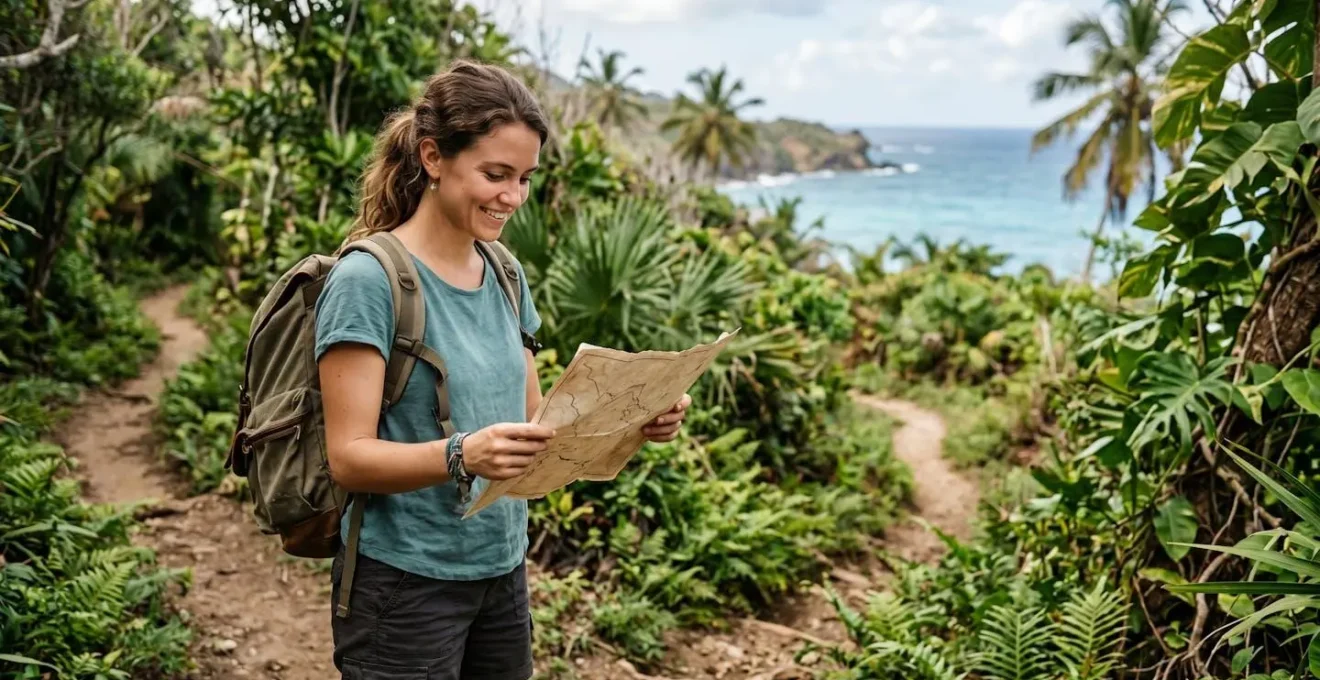
The secret to confident independent travel isn’t a perfect itinerary; it’s mastering the art of intentional discovery.
- Anxiety transforms from a barrier into a tool for building resilience when managed with simple, grounding techniques.
- True freedom comes from minimal planning—a ‘tripod’ of essentials—that leaves ample room for transformative, unplanned moments.
Recommendation: To begin your journey, plan only three things for your next trip: your first night’s accommodation, one primary transport option, and one non-negotiable personal experience. Leave the rest to serendipity.
For many, the allure of an island escape is a paradox. You crave the freedom of charting your own course, of discovering a hidden cove or a local café far from the tourist trail. Yet, the safety net of an organised tour package—with its pre-booked hotels, guided excursions, and guaranteed logistics—feels undeniably secure. This pull between autonomy and anxiety leaves many aspiring explorers stuck in a cycle of guided consumption, wondering if they have what it takes to truly go it alone. The common advice is to « just plan more, » but this often leads to rigid itineraries that merely replicate the structure of a tour, just without the guide.
What if the solution isn’t about logistics, but about mindset? The transition from passive tourist to active explorer is an internal one. It involves reframing your relationship with the unknown and learning to see small challenges not as threats, but as opportunities. It’s about cultivating a ‘discovery mindset’—a conscious practice that turns travel anxiety into a catalyst for building psychological resilience and creating memories with profound personal meaning. This isn’t about being fearless; it’s about becoming skilled at navigating uncertainty.
This guide is designed to be your coach in that transformation. We will deconstruct the psychological rewards of independent travel, provide concrete strategies for managing anxiety, and offer a practical framework for planning that prioritizes discovery over checklists. You’ll learn how to find information that truly matters, connect your passions to a place, and ultimately build the unshakeable confidence to explore any island on your own terms.
To navigate this journey from structured tourist to confident independent explorer, this article is structured to build your skills progressively. The following sections will guide you through the mindset, the methods, and the resources required for true travel autonomy.
Contents: Your Path to Travel Independence
- Why Does Independent Island Exploration Create Stronger Travel Memories Than Organised Tours?
- How to Manage Anxiety When Exploring Islands Independently Without Guide Support?
- Solo Independent Exploration or Small Group: Which for Island Discovery Freedom?
- The Independence Paradox: Over-Planning Island Trips Until They Resemble Organised Tours
- When Does Independent Island Exploration Cost Less Than Organised Tour Packages?
- Local Facebook Island Groups or Official Tourism Websites: Which for Real-Time Travel Conditions?
- How to Find Island Points of Interest Matching Your Specific Hobbies and Passions?
- Which Online Resources Provide the Most Accurate Island Travel Information Beyond TripAdvisor?
Why Does Independent Island Exploration Create Stronger Travel Memories Than Organised Tours?
The human brain is wired to remember events imbued with emotion and effort. An organised tour, while comfortable, often smooths out the very friction that makes an experience memorable. When you navigate a local bus system for the first time, successfully order a meal using a few new words, or find a spectacular viewpoint by following a hand-drawn map, you aren’t just seeing a sight; you are earning the experience. This process of overcoming minor obstacles creates a powerful narrative of competence and achievement.
These moments of self-reliance trigger a release of dopamine, the neurotransmitter associated with reward and motivation. Each small success—from finding your guesthouse in the dark to striking up a conversation with a shopkeeper—builds upon the last, creating a feedback loop of growing confidence. The memory isn’t just of the beautiful beach, but of the resourcefulness you discovered within yourself to get there. In contrast, the passive nature of being chauffeured from one photo-op to the next often results in a collection of beautiful but emotionally shallow snapshots.
This principle is rooted in the psychology of personal growth. As explained by researchers in the field of travel psychology, engaging with novel and moderately challenging situations is fundamental to building mental fortitude. Travel Psychology Research highlights this in their analysis for « The Hidden Psychology of Travel »:
Small, manageable challenges train your problem-solving faculties while developing psychological resilience.
– Travel Psychology Research, The Hidden Psychology of Travel: What Science Says About How It Changes Your Brain
Ultimately, independent travel transforms you from a spectator into the protagonist of your own story. The memories are stronger because they are chapters in a personal journey of discovery, not just items ticked off a pre-packaged list. It is the story of your own emerging competence, and that is a story the brain cherishes and retains with vivid clarity.
How to Manage Anxiety When Exploring Islands Independently Without Guide Support?
The fear of the unknown is the single greatest barrier to independent travel. What if I get lost? What if I can’t communicate? What if something goes wrong? The key is not to eliminate this anxiety, but to reframe it as energy and manage it with practical tools. Instead of seeing it as a stop sign, view it as the natural feeling of stepping outside your comfort zone—which is precisely where growth happens. The first step is to establish a sense of control, not over the entire trip, but over your immediate environment and your own physical response.
This begins by creating an ‘anchor point’ upon arrival. This is a safe, comfortable base—a friendly guesthouse, a welcoming café—that you can return to after your exploratory forays. Knowing you have a secure home base dramatically lowers the stakes of venturing out. Before you even leave, you can also practice simple breathing exercises; a slow, controlled pattern (inhaling for three counts, holding for three, exhaling fully) can activate the parasympathetic nervous system, your body’s natural relaxation response. This is a skill you can deploy anytime you feel a surge of panic.
When anxiety strikes in the moment, a powerful cognitive technique is the ‘5-4-3-2-1’ grounding method. This pulls you out of a spiral of future worries and into the present moment by forcing your brain to focus on your senses. To do this, you simply and calmly identify:
- 5 things you can see
- 4 things you can physically touch
- 3 things you can hear
- 2 things you can smell
- 1 thing you can taste
This simple sensory scan short-circuits the brain’s anxiety loop. It’s a reminder that you are physically safe, right here, right now. It is a powerful tool for reclaiming your sense of calm and control, allowing you to make a clear-headed decision about what to do next. Mastering this technique is like having a compass for your own mind.
Ultimately, managing anxiety is a practice. Start small. Create a ‘Fear Ladder,’ beginning with low-stakes actions like asking a shopkeeper for directions and gradually building to more complex tasks like navigating local transport. Each successful step provides the proof you need to quiet the anxious voice in your head, replacing it with the quiet confidence of proven capability.
Solo Independent Exploration or Small Group: Which for Island Discovery Freedom?
The dream of « total freedom » often conjures an image of the solo traveler, unburdened by compromise and completely in charge of their destiny. This path offers absolute autonomy: you eat where you want, go where you want, and change plans on a whim. This complete control is intoxicating and can lead to profound self-discovery. In fact, 43% of solo travelers felt travel brought adventure and excitement into their lives, compared to just 35% of those in groups. However, this absolute freedom comes at the cost of high decision fatigue. Every single choice, from which street to turn down to where to have dinner, rests solely on your shoulders.
A self-organized small group (2-4 people) offers a different kind of freedom. While you sacrifice absolute autonomy, you gain the benefit of shared decision-making, which reduces mental load. More importantly, you introduce what can be called ‘creative friction’. The different perspectives and interests within the group can lead to discoveries that no single individual would have made on their own. One person’s interest in architecture might lead you down a street you would have ignored, revealing a hidden courtyard that becomes the highlight of your day. This collaborative discovery is a powerful, often overlooked, benefit.
For those new to independent travel, a hybrid model can offer the best of both worlds. This involves traveling primarily solo but strategically planning social touchpoints. You might book a 3-day hiking trip with a local operator, join a cooking class, or stay in a social guesthouse for a few nights. This approach gives you long stretches of autonomy while guaranteeing moments of social connection and shared experience, mitigating the potential for loneliness and decision fatigue. It allows you to build your solo travel confidence within a structured yet flexible framework.
Choosing the right style depends on your personality and goals. The table below breaks down the trade-offs, helping you decide which model of independence best suits your desire for island discovery.
| Travel Style | Freedom Level | Social Interaction | Decision Fatigue | Best For |
|---|---|---|---|---|
| Pure Solo | Absolute (100%) | Spontaneous/uncertain | High (all choices on you) | Experienced travelers seeking complete autonomy |
| Small Self-Organized Group (2-4) | Moderate (requires compromise) | Guaranteed/consistent | Low (shared decision load) | Those who value creative friction and shared experiences |
| Hybrid Model (Solo + Strategic Social Touchpoints) | High (your itinerary) | Scheduled/predictable | Medium (mostly independent) | First-time solo travelers wanting best of both worlds |
The Independence Paradox: Over-Planning Island Trips Until They Resemble Organised Tours
In an attempt to conquer the anxiety of independent travel, many first-timers fall into a trap: the Independence Paradox. They research and plan with such meticulous detail—booking every hotel, every transfer, every meal reservation in advance—that they inadvertently recreate the rigid structure of the very tour package they sought to escape. This « checklist mindset » smothers the very magic of independent travel: serendipity. The goal of planning shouldn’t be to eliminate the unknown, but to build a sturdy platform from which you can safely leap into it.
The solution is to shift from a checklist mindset to an « experience mindset. » Instead of a goal like « visit 10 specific sites, » set an intention like « have one meaningful conversation with a local fisherman. » This reframes success away from a rigid to-do list and toward the quality of your engagement with the place. To support this, you need a planning philosophy that creates structure without sacrificing spontaneity. This is where the 3-Point Tripod Planning Method comes in. It provides just enough stability to feel secure, while leaving the majority of your trip open to discovery.
This method forces you to focus only on the absolute essentials, creating a framework of intentional serendipity. By consciously leaving the rest unplanned, you are not being irresponsible; you are making a deliberate choice to trust the process and your own ability to navigate it. You are giving yourself the gift of the unexpected—the sudden turn down a flower-lined alley, the invitation for coffee from a shop owner, the discovery of a festival not listed in any guidebook. These are the moments that define independent travel.
Your Action Plan: The 3-Point Tripod Planning Method
- Point 1 (Anchor): Book only your first night’s accommodation in advance to establish a secure base upon arrival.
- Point 2 (Transport): Research one primary transport option. Know the name of a reliable scooter rental company or the main bus route, but do not pre-book every single leg of your journey.
- Point 3 (Must-Do): Identify the one non-negotiable experience or sight that matters most to you personally. This is your personal mission for the trip.
- Embrace the Void: Leave everything else—subsequent accommodation, daily activities, meals—deliberately unplanned to preserve room for spontaneous discovery.
- Shift Your Mindset: Actively move from a ‘checklist’ mentality to an ‘experience’ goal, such as ‘learn to cook one local dish’ instead of ‘eat at three specific restaurants.’
By adopting this minimalist approach, you are not just planning a trip; you are designing an adventure. You are building a journey that has a spine, but no cage, allowing for the flexibility and freedom that you set out to find in the first place.
When Does Independent Island Exploration Cost Less Than Organised Tour Packages?
The common wisdom is that independent travel is always the cheaper option. While often true, the real financial picture is more nuanced. For a disciplined and savvy traveler, going solo or in a small group almost always results in significant savings. You have complete control over your spending, opting for local guesthouses over international hotels, street food over tourist restaurants, and public transport over private transfers. For reference, a study on solo travel trends notes that first-time trips often last 7 to 10 days with budgets between $1,000 and $2,000, a figure hard to match with package deals.
However, the cost savings of independent travel can be quickly eroded by a few hidden factors. First is the accumulation of individual entry fees. A package tour often includes access to all major sites, whereas an independent traveler pays for each museum, archeological site, and national park ticket separately. Second is what can be called the ‘Mistake Tax’—the money wasted on booking the wrong ferry, choosing a poorly located hotel that requires expensive taxis, or missing a non-refundable connection. These small, unforeseen costs can add up, narrowing the price gap with a tour package.
A detailed cost analysis of a trip to Central Europe provides a perfect illustration of this dynamic. It highlights how the true cost difference depends heavily on your travel style and group size.
Case Study: Guided Tour vs. Independent Travel Cost Analysis
A travel blog conducted a detailed cost analysis of a 14-day trip, comparing a €3,500 guided tour to an independent budget. While the tour seemed expensive, the independent traveler’s costs mounted when factoring in cumulative museum fees (over €30 per day at major sites), local tourist taxes, and the « Mistake Tax » of inefficient transport choices. For solo travelers and couples, the independent route remained more affordable. However, for larger self-organized groups, the package tours were able to leverage group discounts on hotels and attractions that were unavailable to individuals, sometimes making the tour the more cost-effective option.
The ultimate determination of cost comes down to your priorities and planning skills. If you are a meticulous budgeter who enjoys the challenge of optimization and prioritizes flexibility, independent travel will almost certainly save you money. If you value convenience above all, or are traveling in a large group, the all-inclusive nature of a tour might offer better value than you think by eliminating hidden costs and leveraging unavailable group discounts.
Local Facebook Island Groups or Official Tourism Websites: Which for Real-Time Travel Conditions?
Official tourism websites are essential for foundational information: opening hours, official ticket prices, and general safety guidelines. They represent the « official story. » However, they are often slow to update and completely blind to the real-time, on-the-ground realities of island life. For dynamic conditions like a sudden ferry strike, a road closure due to a landslide, or the actual crowd level at a popular beach on a Tuesday afternoon, local Facebook groups are an unparalleled source of intelligence.
Think of these sources as serving two different functions. The official website is your textbook; the Facebook group is your direct line to the field. These groups, often populated by a mix of passionate locals, long-term expats, and fellow travelers, are a firehose of real-time data. You’ll see a post about a power outage in a certain village minutes after it happens, or a tip about a local festival that isn’t advertised anywhere else. This is where you find the ‘early warning signals’ and ‘serendipity discoveries’ that can make or break a trip.
The challenge, however, is separating the signal from the noise. Rumors and personal complaints can run rampant. The key is to develop a critical filter. A valuable piece of intel is specific (e.g., « The 10 AM ferry from X to Y is cancelled today, June 5th, due to high winds »), whereas noise is vague and emotional (« The ferries are always unreliable! »). Your strategy should be to use Facebook for discovery and official channels for verification. If a group member reports a road closure, cross-reference it with a local news site or call your guesthouse to confirm before changing your plans.
Furthermore, mastering the « Search within group » feature is a superpower. Before asking a question, search for keywords like « scooter rental, » « best souvlaki, » or « storm » to uncover a treasure trove of past discussions and historical patterns. This turns the group from a simple Q&A forum into a deep, searchable database of local, lived experience, offering a layer of insight that no official website can ever provide.
How to Find Island Points of Interest Matching Your Specific Hobbies and Passions?
The greatest failure of generic travel guides and top-10 lists is that they are built for a generic tourist, not for you. True travel fulfillment comes from connecting a place to your own unique interests. A person passionate about geology will have a vastly different « best day ever » than someone who loves baking or birdwatching. The key to unlocking these personalized experiences is to flip your research process: start with your hobby, not the location.
Instead of searching « What to do on Crete? », a birdwatcher should go to a global birdwatching forum and ask, « What’s the best Greek island for migratory birds in May? » This ‘hobby-first, location-second’ strategy taps into a global community of experts who can provide hyper-specific, passionate recommendations that you will never find on TripAdvisor. These communities—be they on Reddit, specialized forums, or Facebook groups—are your gateway to the island’s hidden gems that align with what you truly love.
Another powerful strategy is to search for people, not places. Use Instagram hashtags (e.g., #MilosPottery) or local blogs to find the island’s most respected weaver, fisherman, or baker. A brief, polite message expressing genuine interest in their craft can often open doors to experiences that are impossible to buy: a visit to a private workshop, an invitation to watch the morning catch come in, or simply a conversation that provides a deep connection to the local culture. This is about seeking out the ‘Local Masters’ of a craft or skill.
For those with academic or historical interests, don’t be afraid to use academic tools. A search on Google Scholar for « the geology of Milos » or browsing a university’s digital archives for old maps can reveal undocumented hiking trails, forgotten ruins, or unique geological formations. This level of deep research moves you far beyond the surface-level attractions and into the realm of true exploration, allowing you to co-create an itinerary that is a unique reflection of your own intellectual and creative passions.
Key Takeaways
- True travel independence is a mindset focused on discovery and resilience, not just a logistical exercise.
- Minimalist planning (the ‘Tripod Method’) provides security while maximizing opportunities for spontaneous, memorable experiences.
- Mastering online resources involves a blend of official sources for facts, social media for real-time conditions, and niche communities for personalized discovery.
Which Online Resources Provide the Most Accurate Island Travel Information Beyond TripAdvisor?
While major platforms like TripAdvisor and Google Maps are a useful starting point, their recommendations are often skewed by popularity and commercial interests. The sheer volume of reviews can be overwhelming, and it’s a known fact that 54% of solo travelers use reviews to choose accommodations, making these platforms highly influential but not always accurate. To graduate to a more sophisticated level of travel planning, you must build an ecosystem of more nuanced and specialized online resources.
First, prioritize expat forums and deep-niche blogs. Expats living on an island for years offer ‘ground truth’ on which services are consistently reliable, which restaurants have maintained quality over time, and the subtle cultural nuances that a one-week visitor will miss. Similarly, a blog dedicated solely to « inter-island ferry travel in the Philippines » will always have more detailed and trustworthy information on that specific topic than a generalist travel blogger ever could.
Second, master the OpenStreetMap (OSM) ecosystem. Apps like Maps.me and Organic Maps use community-edited data from OSM, which is often far more detailed than Google or Apple Maps for things that don’t have a commercial interest. This includes hiking trails, unnamed footpaths, fresh water sources, and non-commercial points of interest like a hidden viewpoint or an ancient tree. For any traveler interested in getting off the beaten path, the level of detail on OSM maps is an absolute game-changer.
Finally, use geolocated social media strategically. The « Places » feature on Instagram or the map feature on TikTok can provide a real-time visual sense of a location. By looking at recent posts tagged at « Secret Beach, » you can instantly gauge crowd levels, see the trail conditions after a recent rain, or discover if your « hidden » gem has been overrun. It’s a powerful tool for visual reconnaissance, helping you validate (or invalidate) information you’ve found elsewhere and make better decisions on the ground.
Armed with this new mindset and a more sophisticated toolkit, the world of independent island travel is no longer a source of anxiety, but a canvas for your own unique adventure. The next step is to take this knowledge and apply it, starting small and building the confidence that only comes from experience.