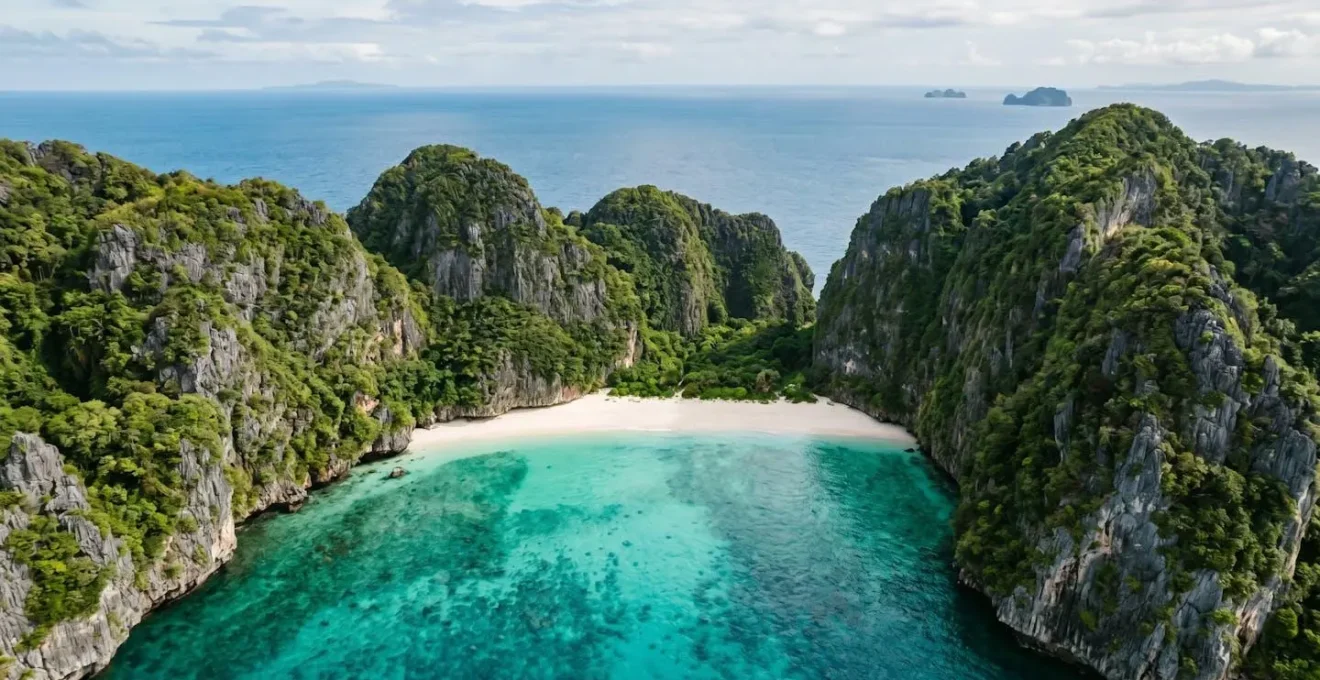
In an era of performative travel, the pursuit of a secluded cove has evolved from a simple desire for quiet into a profound act of cognitive and ecological preservation.
- True coastal solitude triggers a scientifically-proven relaxation response that crowded social environments cannot replicate, offering genuine cognitive restoration.
- The greatest threat to these fragile spaces is unintentional exposure through social media; protecting their anonymity has become an ethical imperative for conscious travellers.
Recommendation: Shift your focus from discovering « hidden » places to mastering strategic timing and respectful visitation, understanding that the value lies not in the secret, but in the solitude it temporarily provides.
The modern traveller is caught in a paradox. We journey across the globe in search of escape, only to find the same crowds we left behind, all holding up phones to capture the same iconic view. The travel experience, once a private dialogue between a person and a place, has become a public performance. We are told that the solution is to find « hidden gems, » to go « off the beaten path. » But this advice often leads to a frustrating chase, where yesterday’s secret cove is today’s trending hashtag.
This relentless cycle of discovery and destruction misses the point. The growing ache for a secluded island cove isn’t just about a preference for quiet or a prettier photograph. It is a deep, instinctual rebellion against the cognitive overload and emotional burnout of a digitally saturated world. It is a search not just for an empty beach, but for a moment of perceptual anonymity—the freedom to exist in a place without being watched, rated, or documented. This desire represents a fundamental shift in travel values, away from consumption and towards restoration.
But what if the true art of finding solitude isn’t about location, but about perspective? What if the key lies not in discovering more, but in understanding more deeply? This article reframes the search for seclusion. We will move beyond the simplistic hunt for secret spots to explore the psychological science of coastal calm, the ethical dilemmas of sharing, and the strategic mastery of timing. This is a guide to reclaiming the very essence of personal travel in an age that threatens to homogenize it, empowering you to articulate and act upon why these quiet corners of the world matter more than ever.
This guide will explore the profound value of coastal solitude and provide a framework for experiencing and protecting it. We will delve into the science of why the sea calms us, the ethics of sharing our discoveries, and the practical strategies for finding quiet in a world that never stops talking.
Table of Contents: Why Secluded Island Coves Are a Modern Necessity
- Why Does Coastal Solitude Reduce Travel Stress More Than Resort Social Environments?
- How to Discover Secluded Coves Whilst Respecting Their Fragile Seclusion Status?
- Should You Share Secluded Island Coves on Social Media or Protect Their Anonymity?
- The Seclusion Mistake: Visiting « Hidden » Coves During Peak Hours When Everyone Else Arrives
- When Are Island Secluded Coves Actually Empty: Daily and Seasonal Solitude Windows?
- How to Share Hidden Beach Photos Without Revealing Their Precise Locations?
- When Should You Visit Fragile Island Ecosystems to Minimise Environmental Disturbance?
- Should You Share Hidden Beach Locations Online or Protect Their Secrecy?
Why Does Coastal Solitude Reduce Travel Stress More Than Resort Social Environments?
The calming effect of the ocean is a universally acknowledged feeling, but it is far more than a poetic notion. It is a profound psychophysiological response. Unlike the high-sensory, socially demanding environment of a resort pool or a busy beach club, a secluded cove offers a unique form of cognitive restoration. This isn’t merely relaxation; it’s the active process of your brain recovering from the fatigue of directed attention that dominates modern life. In a quiet coastal setting, your mind is free from the constant task of navigating social cues, filtering noise, and processing complex stimuli. It can switch to a state of « soft fascination, » where attention is held effortlessly by the gentle, repetitive patterns of nature.
The science behind this is compelling. The sound of waves, in particular, has a powerful effect on our nervous system. As the PADI Research Team explains in their analysis of ocean sounds and mental health:
Natural water sounds activate the parasympathetic nervous system, which helps us relax and unwind.
– PADI Research Team, PADI Blog on Ocean Sounds and Mental Health
This activation slows the heart rate, reduces cortisol levels, and promotes a state of calm. Crucially, the sounds of nature are processed differently by the brain than artificial or human-made noises. Specific research from Brighton and Sussex Medical School has demonstrated that the gentle ebb and flow of waves, typically falling within a 40-60 decibel range, creates a form of « pink noise » that can improve sleep and concentration. This contrasts sharply with the unpredictable, often jarring sounds of a social environment—clinking glasses, loud conversations, and background music—which keep the sympathetic (« fight or flight ») nervous system on low-level alert.
This paragraph introduces the concept of cognitive restoration. To fully appreciate this state, it is helpful to visualize the environment that enables it.
As this image conveys, solitude in nature allows for a level of introspection and mental unwinding that is impossible to achieve when our senses are constantly engaged by social demands. The value of a secluded cove, therefore, lies not just in its beauty, but in its capacity to provide a neurologically restorative sanctuary—a benefit that a bustling resort, by its very design, cannot offer.
How to Discover Secluded Coves Whilst Respecting Their Fragile Seclusion Status?
In an age dominated by Google Maps and satellite imagery, the act of discovery has been flattened into a digital query. Yet, finding a truly secluded cove requires a return to more analogue, respectful methods. The goal is not to « conquer » or « reveal » a hidden spot, but to encounter a place on its own terms. This means shifting your mindset from an extractor of information to a patient observer of the landscape. The most rewarding discoveries are often made by abandoning the digital crutch and engaging directly with the physical world.
The first step is to embrace « deep mapping »—a process that goes beyond simple navigation. Instead of searching for « secret beaches, » study topographic maps or nautical charts of an island. Look for tell-tale signs: small indentations in the coastline inaccessible by a main road, headlands that might shelter a pocket of sand, or footpaths that seem to fade into the vegetation. This method requires more effort, but it inherently filters for places that are less likely to be overrun. It respects the effort that seclusion demands.
Another powerful and often overlooked method is local, non-transactional inquiry. This doesn’t mean walking into a tourist shop and asking, « Where are the hidden beaches? » which will likely get you a canned answer. It means engaging in genuine conversation with people whose lives are intertwined with the landscape—a fisherman mending his nets, an elderly farmer tending a coastal grove, or the owner of a small, family-run taverna away from the main port. Ask about the coastline, the winds, the history of a particular headland. The clues to a quiet spot are often embedded in these stories, offered not as a commodity but as a shared piece of local knowledge. This approach requires patience and genuine curiosity, virtues that are antithetical to the instant gratification of a geotag.
Finally, use your own two feet. The most effective tool for discovery is and always has been walking. Choose a section of coastal path and follow it without a specific destination in mind. Pay attention to small, unofficial trails that branch off. Be prepared for the path to be challenging or to lead nowhere. This process of exploration is the reward in itself. It ensures that the coves you do find have been earned through physical effort, a natural barrier that protects their seclusion far more effectively than any digital secrecy. It is a return to a form of travel where the journey, not just the destination, holds the value.
Should You Share Secluded Island Coves on Social Media or Protect Their Anonymity?
The moment you find it—that perfect, empty arc of sand—the modern impulse is to capture and share it. It stems from a genuine desire to communicate beauty and perhaps, subtly, to broadcast the quality of our own experience. However, in the context of overtourism, this seemingly innocent act has become a profound ethical dilemma. Every geotagged post, every « DM me for the location » story, acts as a digital breadcrumb, contributing to a trail that can lead to the very destruction of the place’s solitude. The question is no longer just about personal expression; it’s about collective responsibility.
As one travel writer searching for « a Greece not watered down from the impact of overtourism, social media, and materialism » discovered, the allure of a place is often tied to its anonymity. Protecting that anonymity is a choice.
A Greece not watered down from the impact of overtourism, social media, and materialism.
– Old Soul Explorer travel writer, Complete Guide to Karpathos Greece’s Most Remote Island
The argument for « gatekeeping » beautiful places can feel elitist or selfish. Why shouldn’t everyone be able to enjoy this? The flaw in this logic is the assumption that every place can withstand « everyone » enjoying it. Fragile ecosystems and small coves have a finite social and ecological carrying capacity. The problem is not sharing, but the scale and speed at which digital sharing operates, bypassing the natural filters of distance, difficulty, and local knowledge. A location that could sustainably handle a few dozen visitors a day, arriving by foot or small boat, can be completely overwhelmed when thousands are directed there by an algorithm.
Case Study: Thailand’s Maya Bay and the Cost of Viral Fame
The devastating impact of geotagged tourism is starkly illustrated by Maya Bay. Featured in the 2000 film « The Beach, » its fame exploded with social media. The picturesque cove was soon receiving nearly 7,000 tourists per day. By 2018, this unsustainable influx had destroyed the local ecosystem, leaving only 8% of its coral reefs alive and forcing a complete, multi-year closure for rehabilitation. This case is a powerful testament to how a location’s digital footprint can lead to its physical demise, transforming a natural wonder into a casualty of its own popularity.
Ultimately, the decision to protect a location’s anonymity is an act of ecological empathy. It prioritizes the health of the place over the validation of the individual’s experience. It is a conscious choice to become a guardian rather than a promoter, to value the preservation of a feeling for the few who might discover it organically over the broadcasting of an image to the many. It is the understanding that some of the most beautiful things are defined by the difficulty of reaching them, not by their ease of access.
The Seclusion Mistake: Visiting « Hidden » Coves During Peak Hours When Everyone Else Arrives
One of the greatest fallacies of modern travel is the concept of the truly « hidden » place. In a world mapped to the meter, genuine secrets are exceedingly rare. The more common reality is the « temporarily empty » place. Many travellers make the fundamental mistake of focusing all their energy on *where* to go, assuming that a geographically remote cove will guarantee solitude. They succeed in finding the spot, only to arrive between 11 AM and 3 PM to find a dozen other « discoverers » who followed the same blog post or Instagram guide.
This phenomenon is a direct result of the hyper-concentration of tourism. It’s not just that popular islands are crowded; it’s that visitors within those islands cluster in predictable patterns. As a stark illustration, according to a 2023 World Travel & Tourism Council study, an astonishing 77% of tourist overnight stays occur on just 5% of island land area. This intense spatial concentration is mirrored by an equally intense temporal concentration. The vast majority of day-trippers and beachgoers operate on an unspoken schedule: a late start after breakfast, hitting the coast in the late morning, and leaving in the late afternoon to prepare for dinner. This creates a « rush hour » of peak occupancy, even at so-called hidden spots.
The strategic error is believing that seclusion is a static property of a location. It is not. Solitude is a fluid state, a function of time as much as space. This paragraph introduces the critical importance of temporal strategy. To master seclusion, one must learn to read the rhythms of a place, much like reading a tide chart.
Just as this chart reveals windows of opportunity dictated by natural forces, a traveller must learn to identify the « social tides » of a destination. The key to unlocking solitude is temporal deliberation: the conscious and strategic choice to operate outside the collective schedule. Instead of joining the midday pilgrimage, you must embrace the early mornings, the late afternoons, and the « in-between » moments that the majority of visitors overlook.
When Are Island Secluded Coves Actually Empty: Daily and Seasonal Solitude Windows?
Mastering temporal deliberation goes beyond the simple advice to « go early. » It involves a more nuanced understanding of both daily and seasonal rhythms that create predictable windows of solitude. These windows are often hiding in plain sight, counter-intuitive to the average tourist’s schedule.
On a daily basis, the most reliable windows are at the extreme ends of the day. The « golden hour » for solitude is often sunrise. Being at a cove as the first light hits the water guarantees an experience free from crowds and often offers the most beautiful, atmospheric conditions. Similarly, the period just before sunset, after the majority of families and day-trippers have packed up, can be exceptionally peaceful. Another, less obvious, window is the « siesta » period. In many Mediterranean and tropical cultures, the hours from 1 PM to 4 PM are the hottest of the day, a time when locals and savvy travellers retreat indoors. While main beaches might remain busy, the coves requiring a short hike or extra effort often empty out during this time.
Seasonally, the concept of the « shoulder season » (the months just before and after the high season) is well-known. However, the data reveals a more dramatic reality. For instance, data from Santorini’s village of Oia reveals that garbage collection spikes from just 2 tons per day in February to a staggering 26 tons per day in August. This thirteen-fold increase is a proxy for the sheer volume of human presence. Visiting in a month like May or October doesn’t just mean fewer people; it means experiencing an entirely different version of the island, one that is not groaning under the weight of its own popularity. But even within the peak season, micro-windows of opportunity exist.
Case Study: The Rental Turnaround Day Strategy
A detailed analysis of tourism patterns in Mediterranean islands reveals a « Saturday Paradox. » Saturday is the primary changeover day for weekly rentals. While airports, ports, and main roads are gridlocked, the island’s secondary beaches and coves become surprisingly quiet. This is because departing tourists are busy packing and travelling, while arriving tourists are occupied with checking in, unpacking, and grocery shopping. This creates a 4-6 hour window of calm, typically from 10 AM to 4 PM, directly contradicting the conventional wisdom that all weekend days are impossibly crowded.
Identifying these windows requires a shift from a location-based itinerary to a time-based one. It means planning your days around the rhythm of the place, not the other way around. It is the ultimate expression of respect for a destination: aligning your presence with its moments of quiet breath.
How to Share Hidden Beach Photos Without Revealing Their Precise Locations?
In the digital age, sharing our travel experiences feels natural and connecting. Yet, as we’ve explored, a single geotagged photo can unwittingly act as the first domino in a cascade of overtourism. The solution is not to stop celebrating or capturing beauty, but to adopt a more thoughtful, intentional approach to sharing. It is entirely possible to convey the emotion, atmosphere, and beauty of a secluded place without betraying its location. This practice is the cornerstone of becoming an « un-geotagged self »—one who prioritizes the experience over its documentation and the place over its promotion.
The first and most critical step is technical. Most modern smartphones automatically embed GPS coordinates and other sensitive information directly into the image file. This is known as EXIF (Exchangeable Image File Format) data. Simply posting a photo without a visible tag is not enough if the data is still hidden within the file itself. Anyone with basic tools can extract this information. Therefore, developing a habit of « scrubbing » this data before uploading is essential for any conscious traveller.
Beyond the technical, there is an artistic and narrative approach. Shift your photographic focus from the grand, identifiable landscape to the intimate detail. Instead of the wide shot that captures the unique curve of the bay and the specific rock formations, focus on the texture of the sand, the pattern of light on the water, the form of a unique shell, or a close-up of coastal flora. These images evoke the feeling and essence of the place—its « thereness »—without creating a replicable, map-able postcard. They invite your audience to feel what you felt, rather than showing them where you were.
This ethos extends to your captions. Resist the urge to name the island, the region, or even the country. Instead, craft « feeling-first » descriptions. Talk about the sound of the water, the temperature of the breeze, the scent of the salt and wild herbs, the feeling of the sun on your skin. Use abstract and evocative language like « a quiet corner of the coast » or « somewhere the sea meets the sky. » This not only protects the location but also elevates your storytelling, encouraging a deeper connection from your audience than a simple location tag ever could.
Your Action Plan: The Digital Leave No Trace Checklist
- Before uploading, check metadata using your phone’s built-in settings (iOS: Photos > select image > swipe up; Android: Gallery > Details) to see if location data is present.
- Use free EXIF removal apps (e.g., Metapho for iOS, Photo Metadata Remover for Android) to strip all location data, timestamps, and camera information from your images.
- For desktop workflows, use bulk processing tools like ExifTool (command-line) or EXIFPurge (GUI) to remove metadata from multiple images at once.
- Verify removal by re-checking the image’s metadata after processing, as not all social media platforms reliably strip this data upon upload.
- Adopt abstract photography: capture intimate details like sand texture, water patterns, or coastal flora instead of wide, identifiable landscapes.
- Craft ‘feeling-first’ captions that describe emotional and sensory experiences (e.g., ‘a hidden corner of the coast’) rather than naming islands or regions.
When Should You Visit Fragile Island Ecosystems to Minimise Environmental Disturbance?
The conversation about responsible travel often centers on *what* we do: picking up trash, not touching wildlife, staying on trails. However, an equally critical, and often overlooked, dimension is *when* we do it. For fragile island ecosystems, the timing of human presence can be the single most significant factor determining whether our visit is benign or deeply disruptive. Minimizing our impact requires us to elevate our understanding from a simple « leave no trace » ethos to a more sophisticated « right-time, right-place » consciousness, aligning our travel calendar with the biological calendar of the destination.
Many island ecosystems have critical periods of vulnerability that are invisible to the casual visitor. These can include seabird nesting seasons on coastal cliffs, turtle hatching periods on specific beaches, or coral spawning events that occur on precise nights following a full moon. The presence of humans, even in small, well-behaved numbers, can cause catastrophic disruption during these windows. A single person walking too close to a cliff edge can cause an entire bird colony to abandon its nests. The light from a single flashlight on a beach at night can disorient thousands of turtle hatchlings, leading them away from the sea to their deaths.
This paragraph introduces the critical importance of aligning our visits with the biological needs of an ecosystem. The environment must be seen not as a static backdrop, but as a living entity with its own rhythms and periods of vulnerability.
The most responsible approach is to proactively research the specific ecological cycles of your destination *before* you book your trip. Look for information from local conservation groups, national park services, or marine biology research institutes. If you discover your planned travel dates coincide with a critical biological event like a nesting season, the most ethical choice may be to adjust your itinerary to avoid that specific area, or even to choose a different time of year to travel altogether. This represents a fundamental shift: putting the needs of the ecosystem ahead of our own convenience or desire for a particular experience.
Case Study: Maya Bay’s Recovery and the Lesson in Biological Timing
The closure and partial recovery of Thailand’s Maya Bay provided a crucial lesson in ecological timing. During the initial period of overtourism, the constant boat traffic and human presence during peak coral spawning and fish breeding seasons caused the most severe, long-term damage. After the bay was closed in 2018, marine biologists observed that the ecosystem’s recovery was not linear. The regrowth of coral to 20-30% by 2023 was only possible because the ecosystem was left entirely undisturbed during its most vulnerable reproductive cycles. The case starkly illustrates that even limited visitation, if timed poorly around biological cycles, can cause irreversible harm, underscoring that « when » we visit is as important as « how. »
Key takeaways
- The search for coastal solitude is a psychological need for cognitive restoration, scientifically supported by how natural sounds affect our nervous system.
- True seclusion is a function of time, not just location; mastering temporal strategy (daily, seasonal, and event-driven windows) is more effective than searching for « secret » spots.
- Protecting a location’s anonymity by avoiding geotagging and practicing « digital leave no trace » is a critical ethical act for the modern, conscious traveller.
Should You Share Hidden Beach Locations Online or Protect Their Secrecy?
We arrive, at last, at the heart of the matter. Having understood the psychological need for solitude, the methods of respectful discovery, and the ethics of sharing, the question of protecting a location’s secrecy can be seen in its true light. It is not an act of selfish « gatekeeping. » Rather, it is the ultimate expression of a new travel consciousness. It is the final, logical step in transitioning from a passive consumer of places to an active guardian of their integrity. In an age where everything is discoverable with a click, choosing to hold something back—a location, a feeling, a moment—is a powerful act of resistance.
This act of guardianship is a direct rebuttal to the culture of performative travel. It asserts that the value of an experience is not measured by its online reach or the number of likes it garners. Its value is intrinsic, located in the personal and un-broadcastable connection between a human and a place. By choosing not to geotag, not to name, not to create a digital pathway for the masses, you are preserving the very conditions that made the experience special in the first place: the thrill of organic discovery, the sense of peace that comes with anonymity, and the feeling of being in a place that does not feel commodified.
As Sustainable Travel International poignantly argues, this choice represents a deeper level of engagement with the places we visit.
Protecting a location’s secrecy is the final step in transitioning from a passive tourist to an active guardian of the place.
– Sustainable Travel International, What is Overtourism and Why is It a Problem?
This perspective transforms secrecy from a negative act of withholding to a positive act of preservation. You are not keeping a place *from* people; you are preserving the *potential for discovery* for future travellers who are willing to put in the same effort, to follow the same respectful path. You are curating the future, leaving a trail not of digital breadcrumbs, but of quiet, protected potential. This is a profound legacy, far more meaningful than that of a viral Instagram post. It is a commitment to ensuring there are still places in the world that can offer the profound gift of being found.
By adopting this mindset—prioritizing temporal strategy over location hunting, embracing digital anonymity, and aligning our presence with ecological rhythms—we can redefine what it means to be a traveller in the 21st century. The ultimate goal is to find these moments of profound peace and then, through our conscious choices, ensure they remain for others to discover on their own terms. Begin today by planning your next journey not around a destination, but around the search for true, restorative solitude.