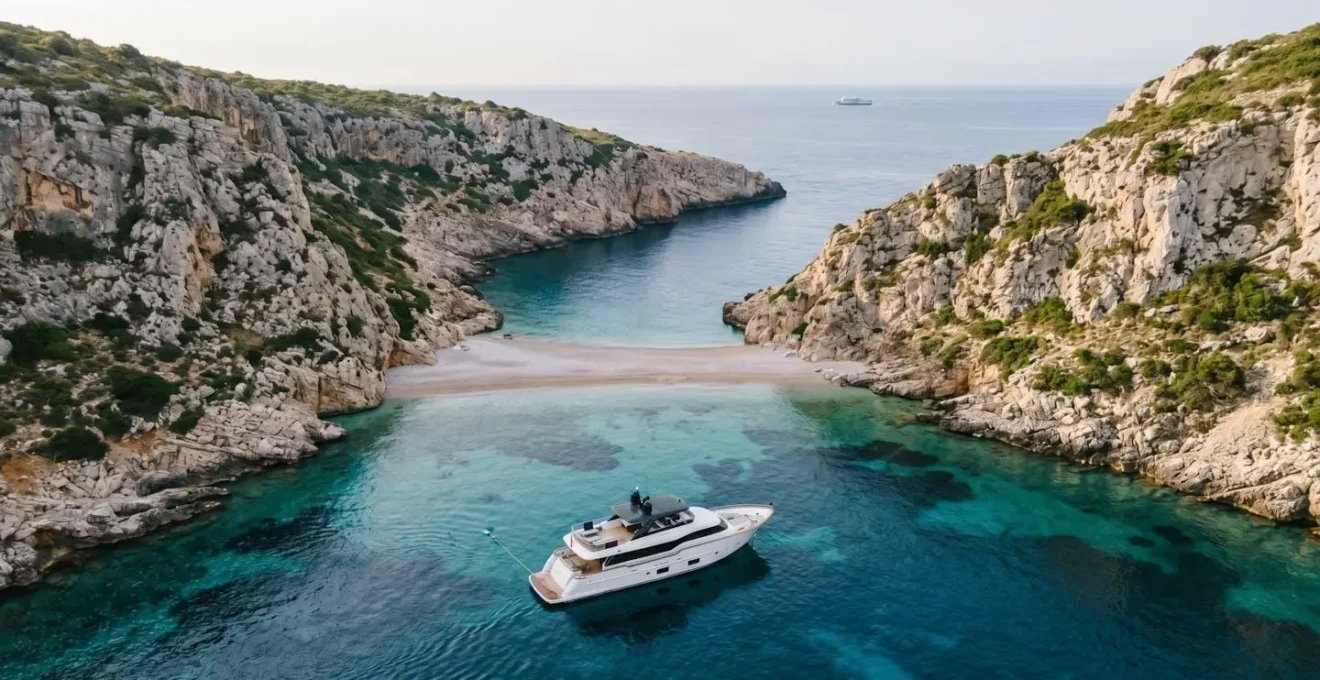
A private charter’s high price is justified when it unlocks a superior « cost-per-unique-experience » that public ferries cannot offer.
- Charters provide exclusive access to geographic and temporal « inventory »—secluded coves, after-hours park access, and flexible schedules—that are physically or logistically impossible for ferries.
- The total cost of multi-island ferry travel, including « logistical friction » (taxis, wasted time, hotel changes), can approach charter costs while delivering a fraction of the experience.
Recommendation: Instead of comparing ticket prices, calculate the value of accessing 2-3 extra pristine locations per day and avoiding hours of transit friction. This reframes the charter from a luxury expense to a high-yield investment in your group’s time and experience.
For a small group planning an island adventure, the price tag of a private charter boat can induce immediate sticker shock. A single day’s charter can cost three to five times more than a handful of round-trip ferry tickets. The conventional wisdom is simple: ferries are for budgets, charters are for luxury. This initial calculation leads countless groups to piece together complex ferry schedules, believing they’ve made the financially prudent choice. They dream of discovering hidden coves and experiencing the islands’ authentic beauty, all while saving a significant amount of money.
But what if this entire cost-benefit analysis is fundamentally flawed? The common advice often overlooks the hidden taxes of public transport—the logistical friction, the wasted hours, the « last mile » problem of getting from a port to a pristine beach. The crucial mistake is comparing the charter’s upfront cost to a ferry ticket’s face value. The true value of a private charter is not measured in luxury amenities, but in a metric that public transport simply cannot compete with: the cost-per-unique-experience. A charter grants your group access to an exclusive inventory of places and moments that are categorically unavailable to the ferry-bound traveler.
This guide reframes the debate. We will move beyond the simplistic « cost vs. freedom » argument and provide a rigorous, value-focused analysis. We will break down the specific scenarios where a private charter’s premium is not just justified, but becomes the most economically sound choice for a small group wanting to maximize their return on time and create a genuinely unique island exploration itinerary.
This article provides a detailed breakdown of the value proposition of private charters. Explore the sections below to understand how to analyze costs, negotiate rates, and plan an itinerary that truly justifies the investment over conventional ferry travel.
Summary: When Do Private Charter Boats Justify Their Cost Over Public Ferry Services?
- Why Do Charter Boats Provide Access to Island Locations Unreachable by Any Public Transport?
- How to Negotiate Island Charter Boat Rates: Half-Day or Full-Day for Best Value?
- Skippered Charter Boat or Bareboat Rental: Which for Island Coastal Exploration?
- The Charter Booking Mistake: Not Specifying Your Island Itinerary Needs to the Operator
- When Are Charter Boat Trips Most Likely to Be Cancelled Due to Island Weather Conditions?
- The Archipelago Planning Mistake: Not Checking Ferry Frequency Between Your Chosen Islands
- How to Use Topographic Maps to Locate Unmarked Pristine Beaches?
- How to Plan an Archipelago Exploration Route That Maximises Island Diversity?
Why Do Charter Boats Provide Access to Island Locations Unreachable by Any Public Transport?
The primary justification for a charter’s cost lies in its ability to access an inventory of locations and times that are physically and logistically off-limits to public ferries. Ferries are large, deep-draft vessels constrained to established ports and deep-water channels. They operate on fixed schedules designed for mass transit, not exploration. This operational model means they cannot navigate into shallow coves, approach unmarked beaches, or linger for a perfect sunset.
A private charter vessel, by contrast, is designed for access. Its shallow draft allows it to glide over reefs and enter secluded bays that would ground a ferry. This physical advantage unlocks a vast geographic inventory of pristine, crowd-free locations. The value here isn’t just about privacy; it’s about accessing superior snorkeling spots, untouched beaches, and dramatic cliff-lined coves that ferry passengers will only ever see from a distant postcard.
Beyond geography, charters unlock temporal inventory. As a case from the Florida Keys highlights, when sailing to Dry Tortugas National Park, charter guests could experience the park entirely to themselves after the last day-trip ferry departed. This transformed a popular destination into a private sanctuary, proving that a charter’s value is also in its ability to grant exclusive access to a location during times when public transport cannot operate. This is a common theme in charter-rich destinations; for example, over 3,000 yachts and charter vessels visit Tobago Cays Marine Park annually, a place largely inaccessible by other means, demonstrating the scale of this exclusive access.
How to Negotiate Island Charter Boat Rates: Half-Day or Full-Day for Best Value?
When evaluating charter costs, the most common mistake is to look at the half-day rate and see it as the « cheaper » option. A value-based analysis reveals this is often false economy. The critical metric is not the total price, but the cost per hour of effective experience. A 4-hour charter is not 4 hours of exploration; once you subtract the time for briefing, safety checks, and transit from the main port to the first point of interest, your group may only get 2 to 2.5 hours of actual beach or snorkeling time.
An 8-hour full-day charter, while more expensive upfront, dramatically changes this equation. The transit time becomes a much smaller percentage of the total duration, often yielding 5-6 hours of pure experience time. This doesn’t just double the time; it exponentially increases the possibilities, allowing access to 3-5 distant, superior locations instead of just one or two nearby, often more crowded, spots. For a small group, this means the cost per person, per unique location visited, plummets on a full-day charter.
The table below breaks down this value differential. While a full-day charter might cost 25-180% more than a half-day, it can deliver over 120% more experience time and access to 150-250% more locations, often making the cost-per-hour of enjoyment significantly lower.
| Charter Duration | Base Cost Range | Effective Experience Hours | Cost Per Hour | Locations Reachable |
|---|---|---|---|---|
| Half-Day (4 hours) | $1,200 – $2,500 | 2-2.5 hours (excl. transit) | $480 – $1,000 | 1-2 nearby locations |
| Full-Day (8 hours) | $1,500 – $7,000 | 5-6 hours (excl. transit) | $250 – $1,167 | 3-5 distant locations |
| Value Differential | +25-180% cost | +120-140% time | -48 to +17% | +150-250% |
Rather than negotiating for a simple percentage discount, focus on increasing the value. Operators are often more flexible on operational add-ons than the base price. Inquire about booking during the shoulder season for significant savings, negotiate for inclusive fuel on extended routes, or ask for complimentary premium water toys. Booking last-minute can also yield substantial discounts if your group’s schedule is flexible.
Skippered Charter Boat or Bareboat Rental: Which for Island Coastal Exploration?
For a group with certified, experienced sailors, a bareboat (boat-only) rental seems like an obvious way to cut costs. However, for the vast majority of small groups, this is a high-risk, low-reward strategy. The decision to hire a skipper is not a luxury expense; it is an investment in safety, efficiency, and—most importantly—local knowledge. A skipper is a value multiplier. They transform the charter from a simple boat rental into a curated, stress-free exploration experience.
The premium for a skipper is often a sound investment. According to 2026 Mediterranean charter market data, a skippered charter adds a 15-25% total cost increase over a bareboat rental. For this modest premium, your group offloads all responsibility for navigation, safety, and vessel management. More critically, you gain a local expert who knows the exact time a popular cove clears of tourists, which anchorage is sheltered from the afternoon wind, and the location of a « secret » snorkeling spot not found on any public chart. This local knowledge is the key to unlocking the true potential of your charter day.
Before even considering a bareboat rental, your group must honestly assess its capabilities. This is not the time for overconfidence. A charter company will require proof of extensive and recent experience on a similar-sized vessel. But beyond the official requirements, the real question is whether your group is prepared for the practical challenges. Use the following checklist to determine if your group is truly « bareboat ready. »
Your Bareboat Readiness Self-Assessment Checklist
- Licensing: Do you hold a recognized boating qualification (ICC, RYA Day Skipper, ASA 104) valid in the destination country?
- Recent Experience: Have you logged at least 200 nautical miles on a similar-sized vessel within the past 24 months?
- Advanced Maneuvering: Can you confidently execute Mediterranean stern-to mooring in 25-knot crosswinds with an audience watching from the quay?
- Weather Interpretation: Can you interpret local swell charts, distinguish between wind chop and ground swell, and make safe navigation decisions based on Beaufort scale forecasts?
- Emergency Procedures: Do you know VHF emergency channels for local sea rescue and can you set a kedge anchor to prevent swing in crowded anchorages?
If there is any hesitation on any of these points, the decision is clear. A skippered charter is the more responsible, enjoyable, and ultimately higher-value choice for your group’s island exploration.
The Charter Booking Mistake: Not Specifying Your Island Itinerary Needs to the Operator
One of the most significant yet common mistakes groups make is treating the charter booking process as a simple transaction. They book a boat and a skipper, assuming the operator will magically provide the perfect day. This passive approach wastes the single greatest asset of a skippered charter: the skipper’s deep, nuanced local knowledge. To truly justify the cost, your group must shift from being passive passengers to active collaborators in designing the itinerary.
As a charter industry analysis in the Click&Boat Charter Guide 2025 points out, the skipper’s role extends far beyond simply driving the boat.
The skipper’s local knowledge extends far beyond navigation—they know the exact time a cove clears of other tourists, which beach clubs accept visiting yachts, and the stories behind every landmark.
– Charter industry analysis, Click&Boat Charter Guide 2025
To unlock this value, you must provide your operator with a clear brief of your group’s preferences and priorities *before* the trip begins. A great skipper can tailor the day to any desire, but they can’t read minds. Are you avid photographers seeking dramatic golden-hour light, or a family with nervous swimmers who need calm, shallow waters? Do you crave total seclusion or want to stop at a lively beach club for lunch? Communicating these needs transforms the skipper from a driver into a personal concierge for the archipelago.
Use a structured template to communicate your desires. This simple step ensures the operator matches you with the right boat, the right skipper, and a provisional itinerary that aligns with your vision. Specify your primary goal, desired pace (relaxed vs. active), preferred atmosphere (secluded vs. social), and any physical limitations. This proactive communication is the difference between a generic boat ride and a perfectly curated, high-value experience.
When Are Charter Boat Trips Most Likely to Be Cancelled Due to Island Weather Conditions?
A common fear for groups investing in a charter is the risk of cancellation due to bad weather. Unlike a ferry ticket, which might be refunded or rescheduled, a non-refundable charter deposit can feel like a significant gamble. However, this fear is often based on a misunderstanding of how professional charter operations work. While safety is always the top priority, outright cancellations are rare. The true value of a charter in uncertain weather lies in its flexibility to adapt.
As a best practices guide notes, the mindset should be about adaptation, not cancellation.
A good charter is rarely cancelled; the itinerary is adapted. The key question should be: ‘What is your Plan B if prevailing wind makes our primary route uncomfortable?’
– Charter planning best practices, Worldwide Boat Charter Etiquette Guide
A skilled skipper doesn’t see a 20-knot wind as a cancellation event; they see it as a reason to pivot to the island’s sheltered leeward side, which will be calm and beautiful. They understand the difference between uncomfortable wind chop and dangerous ground swell from a distant storm. Where a ferry is either running or it isn’t, a charter has a near-infinite number of « Plan B » options. This adaptability is a core part of its value proposition. Before booking, discuss the operator’s policy and ask about their typical alternative itineraries for various wind conditions.
To have a productive conversation, it helps to understand the basic terminology. Knowing these terms allows you to ask more intelligent questions and better understand the skipper’s decisions on the day of the charter.
- Windward vs. Leeward: The windward side of an island faces the wind and will have rougher conditions. The leeward side is sheltered, offering calm anchorages.
- Chop vs. Swell: Chop is caused by local wind and is often just an uncomfortable ride. Swell is generated by distant storms and can create dangerous surf in coves, even on a calm, sunny day.
- Beaufort Scale: A measure of wind force. Most comfort-focused charters will adapt itineraries above Beaufort Force 5 (17-21 knots) and may stay in port at Force 7+ (28-33 knots).
- Fetch: The distance over open water that wind has to travel. A longer fetch creates larger waves, so a skipper will choose anchorages protected from long fetches.
The Archipelago Planning Mistake: Not Checking Ferry Frequency Between Your Chosen Islands
For groups planning a multi-island trip, the « cheap » ferry option often reveals its true cost through logistical friction. This is the cumulative time, money, and stress spent managing the rigid, disconnected nature of public transport. You may find that the two islands you wish to visit have no direct ferry link, or the one ferry that does run only operates on weekends, forcing a complete overhaul of your itinerary. This friction creates a significant hidden cost.
A comparative analysis from the Virgin Islands perfectly illustrates this. Public ferries to a popular destination like Jost Van Dyke had limited weekend service, creating a fixed, short stay on the island. Furthermore, ferries only arrive at main ports, creating a « last mile » problem that requires expensive water taxis or long walks to reach the actual destination beaches. A private charter eliminates both the scheduling constraints and the last-mile problem in one stroke, connecting any two points on the map at the group’s convenience.
When you map out a hypothetical 3-day itinerary, the value proposition becomes starkly clear. The ferry-based plan is a logistical puzzle of booking tickets, changing hotels, and rushing to meet fixed departure times, ultimately limiting your exploration. The charter-based plan is a seamless, fluid experience that maximizes discovery and relaxation.
| Metric | Public Ferry Itinerary | Private Charter Itinerary |
|---|---|---|
| Islands Visited | 2 islands | 4 islands + 5 hidden coves |
| Travel Days | 3 days | 3 days |
| Ferry/Transport Tickets | 4 ferry tickets + water taxis | Single charter booking |
| Accommodation Changes | 1 overnight hotel change required | 0 changes (sleep aboard) |
| Schedule Flexibility | Bound to fixed departure times | Adjust in real-time (extended stops, spontaneous detours) |
For a small group, the time saved and stress avoided by eliminating logistical friction is a tangible financial benefit. When you factor in the cost of extra transport and potentially an extra night’s accommodation, the price gap between the ferry and charter options begins to narrow significantly, while the experience gap remains a chasm.
How to Use Topographic Maps to Locate Unmarked Pristine Beaches?
The ultimate justification for a charter’s cost is its ability to take you to places that feel truly undiscovered. While a good skipper has a mental library of these spots, you can elevate your group’s experience from a passive tour to a collaborative exploration by doing your own research. Using publicly available topographic maps and nautical charts, you can identify potential hidden gems and work with your skipper to verify their accessibility.
This process transforms your role from passenger to active participant, adding a layer of adventure and ownership to the trip. The method involves cross-referencing two different types of maps to find locations that are inaccessible by land and safely approachable by sea. First, on a topographic map, look for beaches or coves bordered by steep, tightly packed contour lines. This indicates cliffs or impenetrable terrain, meaning the beach is likely free of roads, trails, and the crowds that come with them. This is the first sign of a potential hidden paradise.
Once you’ve identified a candidate, you must switch to a nautical chart to assess its viability from the water. Check for safe anchoring symbols (sand or mud is better than rock), and ensure the depth soundings are suitable for your charter vessel (typically 8-15 feet). This two-step process allows you to build a list of high-potential targets to discuss with your skipper, asking « Can we get here? » This proactive approach is highly valued by skippers and dramatically increases the quality of your itinerary. It’s also critical to have these maps available offline, as you’ll likely lose cell service in these remote areas. Shallow-draft charters are particularly adept at this, enabling access to unique features like the dynamic sand cays that appear and disappear with tides, as seen in remote expeditions.
Key Takeaways
- A charter’s value is in accessing exclusive « geographic and temporal inventory »—secluded coves and after-hours access—that is unavailable via public transport.
- The correct metric for comparison is « cost-per-unique-experience, » not ticket price. Full-day charters often provide a lower cost-per-experience than half-day trips.
- A skipper is a « local knowledge multiplier. » To unlock their full value, you must proactively communicate your group’s specific itinerary goals and preferences.
How to Plan an Archipelago Exploration Route That Maximises Island Diversity?
The final piece of the value puzzle is strategic itinerary planning. A poorly planned charter can feel like a series of rushed boat rides, failing to justify its cost. A well-planned route, however, maximizes your investment by delivering a high density of diverse experiences with minimal logistical friction. One of the most effective, high-value strategies is the « Hub-and-Spoke » model. This approach directly contrasts with the exhausting point-to-point travel required by ferries.
Instead of packing up and moving to a new island (and new accommodation) each day, your charter becomes a floating base camp. The skipper anchors in a central, protected bay for 2-3 days. This becomes your stable « home, » from which you launch daily explorations to surrounding islands and coves using the boat’s tender or by simply moving the main vessel for short day trips. Each evening, you return to the same comfortable anchorage. This model eliminates the check-out/check-in cycle completely, saving hours of precious vacation time and energy.
The pinnacle of this concept is the liveaboard charter, which represents the ultimate in experiential diversity. A case study from Raja Ampat, Indonesia, shows how a 7-10 day liveaboard provides access to an incredible range of activities from a single floating base: snorkeling volcanic reefs at dawn, kayaking through jungle lagoons mid-morning, and hiking to panoramic viewpoints in the afternoon. This demonstrates the ultimate charter value: not just geographic access, but complete temporal and experiential control that no other form of transport can provide.
To further maximize your experience, plan your route to be slightly out of sync with the standard « milk run » that most charters follow. By offsetting your itinerary by a day or reversing the typical loop, you can often find the most popular anchorages blissfully empty. A good route prioritizes quality over quantity, limiting daily travel to a reasonable 20-30 nautical miles to allow for spontaneity and deep exploration of 2-3 key stops.
For your next group trip, shift your analysis from comparing ticket prices to calculating your return on experience. Begin by planning your ideal route, identifying the unique locations and moments a ferry can’t deliver. It is in that gap—the space between a ferry’s rigid schedule and a charter’s limitless potential—that the true value lies.