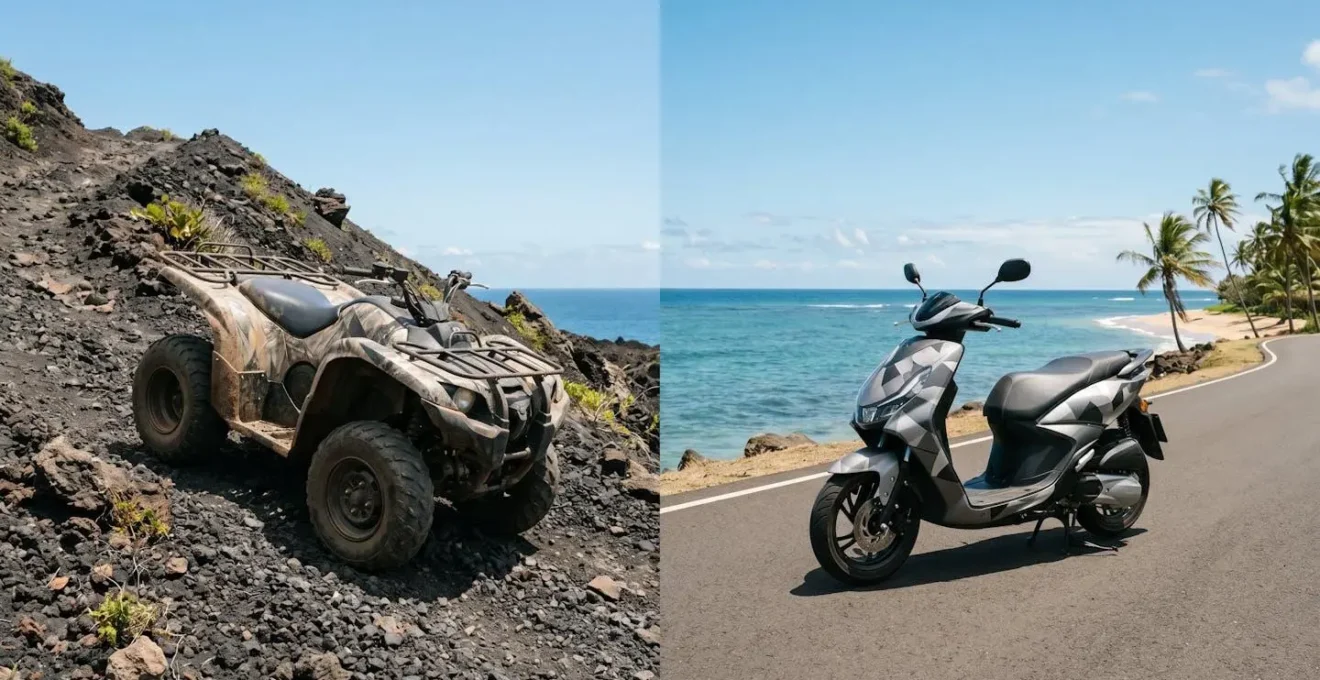
The choice between a quad and a scooter is not about preference; it’s a critical decision dictated by terrain physics.
- Scooters are sufficient for paved roads and hard-packed gravel (Terrain Types 1 & 2), but become dangerous or useless on loose sand, steep gradients, or rocky tracks.
- Quad bikes, with their wide wheelbase, low-pressure tires, and cargo capacity, are essential for accessing remote volcanic cliffs, beaches, and high-altitude trails (Terrain Types 3 & 4).
Recommendation: Match your vehicle to the most difficult terrain on your itinerary, not the easiest. A quad’s capability can be the difference between a successful trek and a failed adventure.
The vision is classic: you, a winding coastal road, and the freedom of two (or four) wheels on a sun-drenched island. But a critical decision point arrives where the smooth asphalt ends and a dusty, rock-strewn track begins. This is the accessibility threshold, the moment where your choice of rental vehicle determines the rest of your day—and possibly your entire adventure. Do you turn back on your scooter, or do you power forward on your quad bike?
Most travel advice frames this as a simple debate: the scooter’s convenience versus the quad’s power. This overlooks the fundamental truth that governs island exploration. The decision is not one of style or comfort, but of physics and capability. It’s about understanding the specific demands of the terrain and matching them with the right mechanical solution. A mismatch doesn’t just mean inconvenience; it can mean getting stranded, damaging a vehicle, or missing out on the very experiences you came to find.
This guide moves beyond generic recommendations. We will analyze the specific terrain types you’ll encounter on an island, from crumbling asphalt to loose volcanic scree. We will break down the crucial safety protocols for operating a quad without prior experience, demystify the insurance complexities of off-road use, and examine why the right vehicle is as essential as the right pair of hiking boots for high-altitude treks. Ultimately, this analysis will provide a clear framework for choosing the vehicle that unlocks your desired adventure outcome.
To make the most informed decision for your island exploration, it’s essential to understand the specific capabilities of each vehicle type. This guide is structured to walk you through every critical factor, from the physics of the terrain to the logistics of rentals and safety, ensuring your choice is based on sound analysis rather than guesswork.
Summary: A Terrain-Based Guide to Island Vehicle Choice
- Why Do Quad Bikes Access Island Trails That Scooters and Cars Cannot Reach?
- How to Ride Island Quad Bikes Safely With No Previous Off-Road Experience?
- Guided Quad Tour or Independent Rental: Which for Island Off-Road Exploration?
- The Quad Riding Mistake That Causes Rollovers on Island Hill Terrain
- When Does Quad Rental Insurance Cover Off-Road Damage Versus Void Your Protection?
- Why Do Island Scooter Rentals Require International Driving Permits Despite Lax Checking?
- The Volcanic Trek Mistake: Inadequate Gear for High-Altitude Temperature Extremes
- Which Islands Have the Most Spectacular Volcanic Cliffs Accessible for Hiking?
Why Do Quad Bikes Access Island Trails That Scooters and Cars Cannot Reach?
The ability of a quad bike, or All-Terrain Vehicle (ATV), to traverse paths inaccessible to scooters and cars is not a matter of opinion but a result of fundamental engineering principles. The core difference lies in stability geometry and traction management. A scooter’s two-wheel, in-line design and high-pressure tires are optimized for efficiency on smooth, paved surfaces. On anything less than ideal, this design becomes a liability. In contrast, a quad bike’s four-wheel stance, low-pressure tires, and independent suspension create a vastly more stable platform for navigating unpredictable surfaces.
This capability difference is best understood by classifying common island terrains. Each type presents a unique challenge that exposes the limitations of a standard vehicle and highlights the necessity of an ATV. Consider this a framework for assessing your destination’s « real » accessibility:
- Type 1 – Crumbling Asphalt: Deteriorated paved roads with potholes and surface breaks. Scooters handle these cautiously, but a quad’s superior suspension absorbs impacts confidently.
- Type 2 – Hard-Packed Gravel: Compacted dirt trails common on island perimeters. Scooters can manage at low speeds, but a quad’s four-wheel traction provides superior stability and control.
- Type 3 – Loose Sand/Shingle: Beach approaches and coastal tracks. This is an absolute accessibility threshold. A scooter’s narrow tires will dig in and get stuck, while a quad’s wide tire surface area and low-range gears allow it to float over the surface.
- Type 4 – Steep Gradient Dirt: Mountain ascents and volcanic slopes. A scooter risks flipping backwards (wheelies) on ascents and losing control on descents. A quad’s weight distribution and independent suspension are engineered to maintain four-point contact, preventing rollovers when ridden correctly.
The physics of vehicle stability on these uneven surfaces are non-negotiable. The visual below demonstrates the fundamental difference in how these vehicles interact with challenging ground, explaining why one can proceed where the other simply cannot.
As the image illustrates, the wide, square footprint of the quad tires distributes weight and maintains grip far more effectively than the narrow, linear contact points of scooter tires. This difference in « stability geometry » is the primary reason quad bikes can unlock remote parts of an island that remain physically off-limits to all other common rental vehicles.
How to Ride Island Quad Bikes Safely With No Previous Off-Road Experience?
Approaching a quad bike with the mindset of a scooter or car driver is a critical error. The controls and physics of an ATV are unique, particularly the thumb throttle and the need for active rider input—shifting your body weight—to maintain stability. For a novice, the key to a safe and enjoyable experience is not bravery, but a methodical familiarization with the machine’s behavior in a controlled environment before tackling a challenging trail. The most severe accidents often happen within the first hour of a rental due to a lack of this basic orientation.
Data consistently shows that rollovers are the most significant danger associated with ATV riding. In fact, most ATV-related deaths result from a rollover or flip, an event often triggered by incorrect rider input on uneven terrain. This underscores the absolute necessity of mastering the basics before you encounter a steep hill or a sudden obstacle. A few minutes spent in the rental shop’s parking lot can be the most important part of your journey, building muscle memory that will become automatic on the trail.
Before you even think about hitting the trail, insist on performing a quick, five-minute drill in a safe, open area. This isn’t about looking like a pro; it’s about building a foundational understanding of the machine’s unique dynamics.
Your Pre-Ride Capability Check: The 5-Minute Quad Control Drill
- Thumb Throttle Familiarization: From a complete stop, practice gentle acceleration using only your thumb. Feel the sensitivity. Unlike a motorcycle’s twist grip, the thumb throttle requires a different kind of finesse. Do this until your starts are smooth, not jerky.
- Emergency Braking Drill: From about 15 mph (25 km/h), execute 3-5 hard stops on pavement, then on a patch of gravel if available. Feel the forward weight shift and understand the significant difference in stopping distance between surfaces.
- Low-Speed Figure-Eights: Complete several tight circular patterns in both directions. This is critical for experiencing the unique quad steering dynamic: you must lean your body to the *outside* of the turn to counterbalance the centrifugal force, the opposite of a bicycle.
- Hill Simulation & Weight Shift: Find a very slight incline. Practice driving up it while shifting your body weight forward, over the handlebars. Then, practice descending while shifting your weight back, behind the seat. This is the single most important skill for hill safety.
- Obstacle Swerving: Use water bottles or rocks as markers. Practice swerving to avoid them while maintaining control. This builds the instinct to steer around a sudden obstacle on a trail instead of panicking.
Completing this simple audit of your own skills provides the confidence and muscle memory needed to react properly when you’re miles from the rental shop. It transforms the quad from an intimidating machine into a predictable tool for exploration.
Guided Quad Tour or Independent Rental: Which for Island Off-Road Exploration?
Once you’ve decided a quad bike’s capabilities are necessary for your adventure, the next logistical question is how to access them: through a structured guided tour or an independent, go-anywhere rental? This is not just a question of cost but of experience, access, and risk management. The optimal choice depends entirely on your personal goals, confidence level, and desire for spontaneity versus curated discovery.
A guided tour’s primary advantage is the mitigation of risk and the inclusion of local knowledge. Guides lead you along proven routes, provide real-time instruction on vehicle handling, and often have access to private lands or unmapped viewpoints that are off-limits to independent renters. For a first-time rider or a traveler focused on safety and efficiency, a tour offers a packaged adventure with zero navigational anxiety. Conversely, independent rental offers the ultimate freedom. You control the itinerary, the pace, and the destination. For experienced riders or those who prioritize spontaneous discovery over a set path, the autonomy of an independent rental is its main draw.
Case Study: Fuerteventura’s Hybrid Exploration Model
A popular approach in Fuerteventura’s volcanic north demonstrates the value of a hybrid strategy. Travelers participate in a two-hour guided quad tour through the challenging, Mars-like landscapes. This experience serves as a practical training session, with professional guides teaching vehicle control and safe riding techniques specific to the volcanic terrain. Having gained this confidence and local insight, many participants then opt for independent rentals on subsequent days, using their newfound skills to explore less-demanding public trails at their own pace. This model eliminates initial anxiety while building the real skills needed for solo exploration.
To make a decision, it’s helpful to weigh these factors systematically. The following matrix provides a clear comparison to help you align your choice with your travel style.
| Factor | Guided Tour | Independent Rental |
|---|---|---|
| Best For | First-time riders, safety-focused travelers | Experienced riders, freedom seekers |
| Access | Private lands, unmapped viewpoints, local-only spots | Public trails and marked routes only |
| Learning Curve | Real-time instruction, immediate feedback | Self-taught, trial and error |
| Cost (typical) | $80-150 for 2-3 hours | $40-80 per day |
| Navigation Risk | Zero – guide leads | High in unfamiliar terrain |
| Cultural Immersion | High – storytelling and local history | Low – solo experience |
| Flexibility | Fixed route and schedule | Complete control of itinerary |
The Quad Riding Mistake That Causes Rollovers on Island Hill Terrain
The single most dangerous situation for any quad bike rider, novice or expert, is navigating a steep hill. It is here that the laws of physics are most unforgiving and where a simple mistake can lead to a catastrophic rollover. The data on this is stark and unequivocal: a federal safety analysis documented that at least 65% of fatal ATV incidents involve rollover. This is not a risk to be taken lightly; it is a predictable outcome of specific, identifiable errors in rider technique. Understanding and avoiding these mistakes is the key to conquering island high points safely.
The fundamental mistake that precipitates most rollovers is a misunderstanding of the vehicle’s center of gravity and the rider’s role in managing it. Unlike in a car, the rider’s body weight is an active component of the quad’s stability system. On a steep incline or descent, you are not a passive passenger; you are a dynamic counterbalance. Failing to shift your weight correctly, or attempting maneuvers that shift the quad’s center of gravity outside its wheelbase, is the direct cause of most flips.
The proper body positioning for descending a steep hill is critical. As seen in the image, the rider must shift their weight as far back as possible and keep their arms extended to maintain control and prevent the rear wheels from lifting.
To prevent becoming a statistic, every rider must internalize the four critical rules of hill safety. These are not suggestions; they are laws of off-road survival.
- Rule 1: Never Traverse a Steep Hill Sideways. This is the cardinal sin of quad riding. Always ride straight up or straight down steep slopes. Attempting to cross a hill laterally (a « sidehill ») shifts the center of gravity downhill, placing it outside the wheelbase and causing an almost inevitable lateral rollover.
- Rule 2: Look Where You Want to Go. On narrow cliffside trails, « target fixation » is your enemy. Staring at the cliff edge or the obstacle you want to avoid will cause you to unconsciously steer directly towards it. Train your eyes on the safe path ahead, and your hands will follow.
- Rule 3: Separate Turning from Braking on Descents. Never turn the handlebars sharply while simultaneously applying the brakes on a steep downhill. This causes the outside front wheel to dig in, creating a pivot point that can initiate a dangerous diagonal rollover. Brake first in a straight line, release, and then turn gently.
- Rule 4: Check and Adjust Tire Pressure. Rental companies often over-inflate tires for road use, making them hard and « skittish » on loose terrain. Before heading off-road, ask to have the pressure reduced slightly (consult the rental agent for specs). This increases the tire’s contact patch, providing dramatically better grip and preventing the initial slide that can lead to a loss of control.
When Does Quad Rental Insurance Cover Off-Road Damage Versus Void Your Protection?
This is arguably the most misunderstood and financially hazardous aspect of renting a quad bike for island exploration. Many travelers assume that the Collision Damage Waiver (CDW) or liability insurance purchased at the rental counter provides comprehensive protection. In the vast majority of cases, this assumption is dangerously wrong. The moment your tires leave the paved asphalt, you are likely entering a contractual grey area where your insurance coverage is completely voided.
Rental agreements for all vehicles, but especially for those capable of off-roading, are filled with exclusionary clauses. As one insurance specialist bluntly states, the policy is clear. An expert on a public forum noted, « If you drive offroad, or even on unpaved roads, you violate the terms of the rental agreement and void any liability insurance or CDW/LDW. You will be legally liable for any and all damage to the rental car. » This means that a minor rollover on a dirt track, a broken axle from hitting a rock, or even scratches from brush could leave you personally liable for the full cost of repairs or even the replacement of the vehicle, which can run into thousands of dollars.
If you drive offroad, or even on unpaved roads, you violate the terms of the rental agreement and void any liability insurance or CDW/LDW. You will be legally liable for any and all damage to the rental car.
– Rental insurance specialist, Quora rental insurance discussion
Furthermore, do not expect your personal credit card’s rental insurance to save you. These benefits almost universally exclude off-road activities and specific vehicle types. For example, according to major credit card benefit terms, driving a rental car off-road can void cardmember insurance protections, and vehicles like motorcycles and scooters are often not covered at all. To protect yourself, you must become an aggressive interrogator before signing any contract. Do not accept verbal assurances. Your only protection is what is explicitly stated in writing.
Arm yourself with these three non-negotiable questions to ask your rental agent, and do not leave the shop until you have satisfactory, written answers:
- Question 1: « Is damage on unpaved dirt trails to [specific beach or attraction name] covered by this insurance, or does off-road use void the CDW? » Name specific trails you plan to visit. Do not accept a vague « yes »; demand to know if that specific route is covered.
- Question 2: « Can you show me in writing where off-road coverage is stated in this contract? » This is the most important question. Make the agent point to the exact clause in the document you are about to sign. If they can’t, the coverage does not exist.
- Question 3: « What is the exact procedure if I have a mechanical failure or accident off-road? Who do I call, and what are the potential towing costs? » Understand the emergency protocol and your potential out-of-pocket expenses before you need them. Towing a damaged quad from a remote trail can be incredibly expensive.
Why Do Island Scooter Rentals Require International Driving Permits Despite Lax Checking?
A common and confusing scenario plays out at island rental shops worldwide: you’re handed the keys to a 125cc scooter after showing only your standard car driver’s license, yet the law in that country technically requires an International Driving Permit (IDP) with a motorcycle endorsement. The rental shop’s lax attitude creates a dangerous illusion of legality. The critical detail they fail to mention is that their willingness to rent you the vehicle has absolutely no bearing on your legal status or, more importantly, your insurance coverage in the event of an accident.
The core of the issue is a conflict between commercial incentive and legal liability. The rental shop wants to make a sale. You, the tourist, are the primary customer. Turning you away for lack of a specific document is bad for business. However, this informal transaction does not supersede national or international law. As the Bikago rental service in Bali clarifies, this practice can have catastrophic consequences. The service explicitly warns, as seen in their Bali International Driving License requirements guide, that this could lead to your medical insurance being voided in an accident.
Rental companies may provide 125cc scooters with just a car license, but technically this is not legal for motorbikes in most jurisdictions. This could lead to your medical insurance being voided in the event of an accident.
– Bikago rental service, Bali International Driving License requirements guide
The requirement for an IDP is widespread, with over 150 countries recognizing International Driving Permits based on UN conventions. Driving without one in a country that requires it is not a minor infraction; it is the trigger for a devastating « insurance invalidation chain reaction. »
- Step 1: No IDP = Driving Illegally. Regardless of the rental shop’s leniency, if the country requires an IDP for your license type (per the 1949 Geneva Convention), you are operating a vehicle without legal authorization.
- Step 2: Illegal Driving = Insurance Void. Your travel medical insurance and any rental damage waiver you purchased contain exclusion clauses for « illegal acts. » Driving without the proper permit automatically triggers these clauses.
- Step 3: Voided Insurance = Full Personal Liability. In an accident, you become personally and fully liable for all costs. This includes your own medical bills, the medical bills of any third parties, all vehicle damage (yours and others’), and any associated legal fees. This can easily amount to tens or hundreds of thousands of dollars.
- Step 4: Police Report Complications. In an accident investigation, local police will demand to see an IDP. Without it, you may be automatically deemed at fault, detained, or even face criminal charges, regardless of who actually caused the accident.
The rental shop’s casual attitude is a trap. The onus is on you to research the legal requirements of your destination and arrive with the correct documentation. The small fee and effort to obtain an IDP from your home country’s automobile association is negligible compared to the ruinous financial risk of driving without one.
The Volcanic Trek Mistake: Inadequate Gear for High-Altitude Temperature Extremes
A frequent and dangerous mistake made by island adventurers is underestimating the dramatic temperature drop at high altitudes. The warm, humid air at sea level creates a false sense of security. Travelers set out for a volcanic peak dressed for the beach, not realizing that for every 100 meters of elevation gained, the temperature can drop by approximately 1°C, a phenomenon compounded by significant wind chill at exposed summits. A 1000-meter peak can easily be 10°C colder than the coast, turning a pleasant hike into a dangerously cold ordeal. Here, the choice of vehicle is not just about access, but about survival gear capacity.
A scooter offers virtually zero storage. A quad bike, with its front and rear cargo racks, is a portable base camp. This difference in cargo capacity directly translates into a difference in safety and the potential for a successful adventure. This is not a minor point of convenience; it is the determining factor between reaching the summit in comfort and abandoning the trek due to hypothermia.
Case Study: The Tale of Two Tourists on Fuerteventura
On Fuerteventura’s volcanic treks, the vehicle-gear capacity mismatch creates dramatically different outcomes. Tourist A, having rented a scooter for beach mobility, attempts a volcano hike with only a t-shirt and flip-flops. The scooter’s zero storage meant no room for layers, water, or proper footwear. Facing temperatures 10°C colder at the summit with severe wind chill, they are forced to abandon the trek halfway, cold and defeated. Tourist B, however, chose a quad bike specifically for volcano exploration. They strapped a backpack containing a windbreaker, a thermal layer, 2L of water, and hiking boots to the rear rack. They successfully completed the summit hike in comfort and safety. The quad’s cargo capacity didn’t just enhance the experience—it made the adventure possible.
The contrast between the warm beach and the cold, windswept volcanic summit requires a thoughtful approach to layering and gear, which is only possible if your vehicle can transport it.
When planning a high-altitude island trek, your packing list must account for these extremes. The following items are non-negotiable and demonstrate why a quad’s cargo rack is an essential piece of safety equipment.
- Layer 1 – Compact Windbreaker: A packable shell jacket that blocks wind chill at the summit. It fits in a small stuff sack and straps easily to a quad rack.
- Layer 2 – Thermal Base Layer: A lightweight merino or synthetic long-sleeve shirt adds significant warmth without bulk.
- Extremity Protection: A beanie and lightweight gloves are critical. Most body heat is lost through the head, and hands get cold quickly in the wind.
- Hydration: A minimum of 2L of water per person. High-altitude exertion causes rapid dehydration. A quad rack allows for carrying extra water impossible on a scooter.
- Nutrition & Safety: High-energy snacks, a basic first-aid kit, and a headlamp are essential. Volcanic fog can descend rapidly, and remote trails have no services.
Key takeaways
- Vehicle selection is a function of terrain physics; match the vehicle to the most challenging terrain you plan to face.
- Quad bike stability comes from a wide wheelbase and active rider weight shifting; master this in a safe area before tackling hills.
- Off-road use almost universally voids standard rental insurance and credit card protections; verify specific off-road coverage in writing.
Which Islands Have the Most Spectacular Volcanic Cliffs Accessible for Hiking?
The ultimate reward for choosing the right vehicle is access. Many of the world’s most breathtaking volcanic cliffs and viewpoints are gated by terrain, where the accessibility threshold is defined by the road—or lack thereof—leading to the trailhead. Some iconic vistas are conveniently located at the end of a paved road, making a scooter or small car perfectly adequate. Others, often the more wild and secluded spots, require navigating kilometers of sand, rock, or mud, making a quad bike or 4WD vehicle an absolute necessity.
Your vehicle choice, therefore, directly dictates your potential itinerary. It’s crucial to research the specific access conditions of your target destination rather than relying on the island’s general reputation. The Canary Islands serve as a perfect example of this principle.
Case Study: Vehicle-Dependent Cliff Access in the Canary Islands
The Canary Islands provide a perfect case study in vehicle-dependent cliff access. In Lanzarote, the magnificent Famara Cliffs are easily reached via paved roads leading to the Mirador del Río viewpoint; a scooter suffices. In stark contrast, reaching the remote western volcanic cliffs of Fuerteventura requires navigating several kilometers of sandy and rocky unpaved tracks where a scooter would be useless. Only quads or 4WD vehicles can safely make this journey. Meanwhile, Gran Canaria’s famous Roque Nublo represents a middle ground; paved mountain roads lead to designated parking areas near the trailhead, making a car ideal, while a quad is unnecessary. This illustrates that vehicle choice must align with specific destination infrastructure, not island reputation alone.
This principle applies globally. To help in your planning, the following table breaks down some of the world’s most spectacular volcanic islands, highlighting their key cliff features and, most importantly, the type of vehicle required to access them. This framework allows you to see the direct link between vehicle capability and destination possibility.
| Island & Location | Cliff Feature | Vehicle Required | Trailhead Access | Typical Rental Cost |
|---|---|---|---|---|
| Santorini, Greece | Caldera cliffs (300m) – Fira to Oia trail | Scooter or Walk | Paved road, town parking | €15-25/day scooter |
| Lanzarote, Canary Islands | Famara Cliffs (671m) – Mirador del Río viewpoint | Scooter or Car | Paved to viewpoint, car parking available | €20-30/day scooter |
| Fuerteventura, Canary Islands | Western coast volcanic formations | Quad Essential | 5+ km sandy/rocky tracks, no pavement | €50-80/day quad |
| Réunion Island | Piton de la Fournaise cirques & cliffs | Car to base, Hiking | Paved mountain roads to trailheads | €30-50/day car |
| Gran Canaria, Canary Islands | Roque Nublo volcanic cliffs (1813m) | Car or Guided Tour | Mountain roads, designated parking areas | €30-45/day car |
| St. Eustatius, Caribbean | The Quill crater rim & lava cliffs | Car or Walk | Paved road to park entrance | $40-60/day car |
| Fogo, Cape Verde | Monte Fogo crater & coastal cliffs | 4WD or Guided Only | Extreme terrain requires specialized vehicle | €60-100/day 4WD |
Therefore, before booking your next island adventure, analyze your target destinations using this framework. Assess the accessibility threshold of the cliffs, trails, and peaks you wish to conquer, and select the vehicle that possesses the necessary terrain capability. This analytical approach transforms vehicle rental from a mundane transaction into a strategic decision that will define the very scope of your exploration.