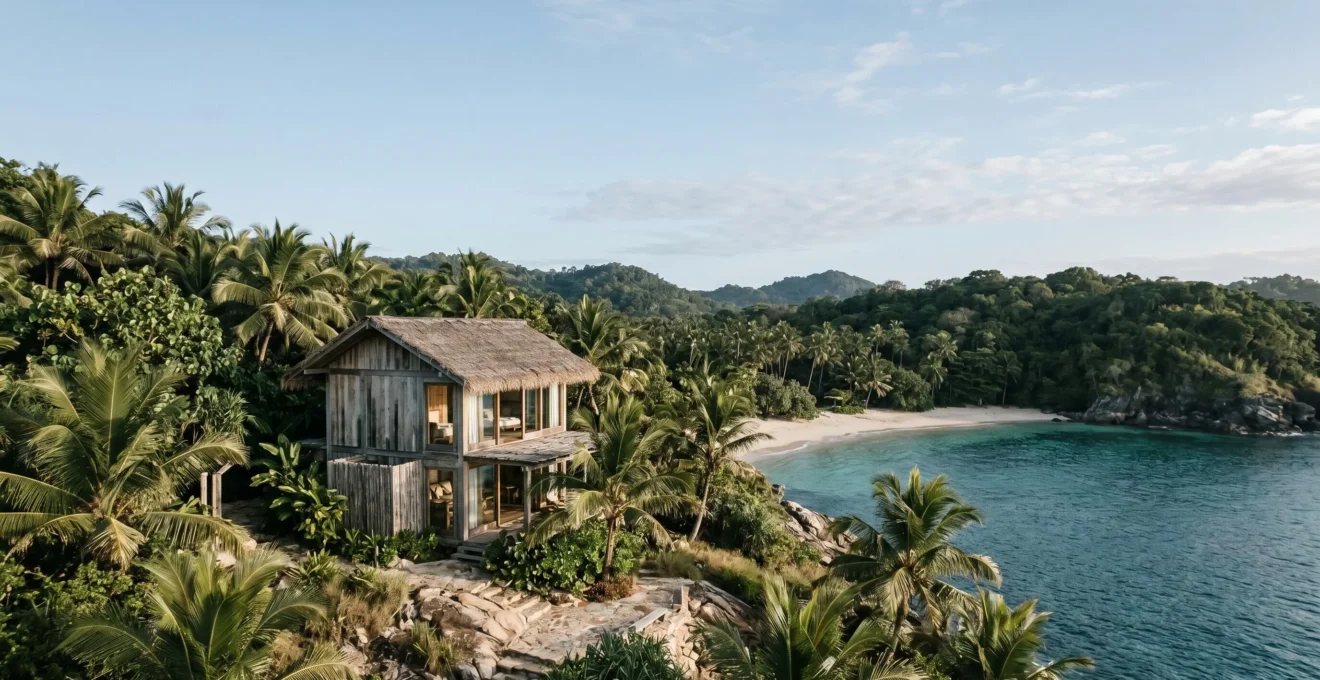
Spotting a true boutique island resort requires auditing its ‘chain of local custody’, not just its star rating or design aesthetic.
- Look for verifiable proof of local design partnerships and regional suppliers, not just generic ‘island-inspired’ decor.
- Assess if ‘eco-friendly’ claims are backed by rigorous third-party certifications like B Corp or EarthCheck to separate genuine conservation from greenwashing.
Recommendation: Prioritise properties where unscripted, expert service is the main amenity and where the journey itself often acts as a filter for authenticity.
In my fifteen years of reviewing island properties, I’ve seen the term « boutique » stretched to its breaking point. It’s a word that once promised intimacy, character, and a true sense of place. Now, it’s often little more than a marketing veneer applied to what are essentially downsized chain hotels, complete with standardised furniture and globally sourced menus. Discerning travellers arrive expecting a unique cultural immersion and instead find a familiar, corporate-designed experience, just with fewer rooms. They’ve been lured by promises of « local flavour » and « unique design, » only to discover the character is manufactured, not inherent.
The common advice—look for a small number of rooms or read online reviews—is no longer sufficient. The hospitality giants have become masters of mimicry, adopting the language and visual cues of authenticity without embracing its substance. But what if the real key to identifying a genuine boutique gem isn’t found in a simple checklist of features? What if it lies in a forensic mindset, an ability to trace what I call the « chain of local custody »?
This guide is built on that principle. It will equip you with a critic’s framework for auditing a resort’s authenticity before you book. We will move beyond superficial aesthetics to examine the verifiable markers of a property deeply rooted in its location—from its architectural provenance and supply chains to the quality of its human expertise. It’s time to learn how to distinguish true character from a clever disguise.
This article provides a detailed framework for identifying genuinely authentic properties. Below is a summary of the key areas we will explore to help you refine your search and make a more informed choice for your next island escape.
Summary: How to Identify Genuinely Authentic Island Resorts
- Why Do Family-Run Boutique Resorts Offer More Authentic Experiences Than Corporate-Owned Properties?
- How to Verify a Boutique Resort Uses Local Architects and Regional Suppliers?
- Boutique Eco-Resort or Luxury Resort With Green Claims: Which Genuinely Protects Island Ecosystems?
- The Boutique Resort Mistake: Booking During Events That Fill Every Room
- When Do Boutique Island Resorts Offer Better Value Than Large Resorts for Couples?
- When Should You Reserve Île de Ré Restaurants: How Far in Advance for Peak Season?
- How to Cope With Turbulence on Small Propeller Flights Between Islands?
- Which Premium Hotel Amenities Actually Enhance Island Holidays Versus Marketing Gimmicks?
Why Do Family-Run Boutique Resorts Offer More Authentic Experiences Than Corporate-Owned Properties?
The most fundamental signal of authenticity often lies in ownership. A family-run or independently owned resort operates on a different axis of motivation than a corporate entity. For a family, the resort is frequently a legacy, an extension of their identity and connection to the island. Decisions are guided by a long-term vision and personal pride, not by quarterly earnings reports or shareholder demands. This fosters an environment where the guest experience is paramount because each visitor’s satisfaction is a direct reflection on the family’s name and heritage.
Corporate-owned properties, even those branded as « boutique, » are beholden to a system of standardization. Their primary goal is replicability and scalability. The general manager is often an expatriate on a two-year rotation, tasked with implementing brand standards rather than cultivating a unique local ecosystem. In contrast, an independent owner-operator is deeply invested in the local community—their staff are neighbors, their suppliers are local partners, and their reputation is built over decades. This intrinsic connection is almost impossible to manufacture.
The challenge for travellers is that the market is consolidating. In 1990, about two-thirds of U.S. hotels were independent; today, independents account for one-third, a trend reflected globally. This makes the search for true independence more critical than ever. When you choose a family-run property, you are not just booking a room; you are investing in a local economy and becoming part of a story that is inextricably linked to the place itself. The service feels different because it is personal, not procedural.
How to Verify a Boutique Resort Uses Local Architects and Regional Suppliers?
A resort’s « unique design » is a common marketing claim, but the discerning traveller must ask: unique to what? The key is to investigate the architectural provenance. A truly authentic resort doesn’t just import a trendy design; it collaborates with local architects and craftspeople who understand the island’s climate, materials, and cultural vernacular. Before booking, check the resort’s « About Us » or « Our Story » page. Do they name their architect? Do they mention specific local artisans, woodworkers, or weavers who contributed to the space?
Look for tangible evidence. The textures and materials should tell a story of place. Are the tiles handmade by a nearby studio, with subtle imperfections that signal craftsmanship? Is the furniture custom-made from local timber, or is it the same mass-produced rattan piece you could find in Miami or Bali? These details are the fingerprints of authenticity, revealing a commitment to the local economy and a genuine sense of place that cannot be replicated by a corporate procurement department.
As the image above highlights, the story is in the details—the grain of reclaimed wood, the weave of a hand-loomed textile. This is the physical manifestation of the chain of local custody. A resort that proudly showcases these elements is one that values its connection to the island’s creative ecosystem. If this information is not readily available, don’t hesitate to ask. A genuinely proud owner will be delighted to share the stories behind their property’s creation.
Case Study: Cobblers Cove, Barbados
A prime example of verifiable local integration is Cobblers Cove on Barbados’s west coast. Owner Sam de Teran collaborated directly with designers to create custom rattan furniture and featured works by Barbadian artists throughout the property. The gardens were designed by a protégé of a legendary local horticulturist, and the restaurant is helmed by a Bajan chef. This is a model of authentic local sourcing, where the resort’s very fabric is woven from the island’s talent and resources.
Boutique Eco-Resort or Luxury Resort With Green Claims: Which Genuinely Protects Island Ecosystems?
In today’s travel market, « sustainability » is as overused as « boutique. » Nearly every hotel, from sprawling mega-resorts to intimate lodges, makes claims of being « green » or « eco-friendly. » For the discerning traveller, the challenge is to separate genuine environmental stewardship from cynical greenwashing. A luxury resort might encourage you to reuse your towels while operating a desalting plant that damages marine ecosystems. True eco-resorts, by contrast, are built from the ground up with conservation as a core principle, not an afterthought.
The key is to look for proof beyond vague marketing statements. Hotels are aware of consumer skepticism; research published in the journal Sustainability reveals that hotel greenwashing negatively impacts guest trust and their willingness to book. To combat this, look for rigorous, third-party certifications. These aren’t awards a hotel can buy; they require extensive audits and a demonstrated commitment to measurable standards. A hotel that has undergone this process will proudly display these credentials.
Don’t be fooled by a resort’s self-created « green program. » Instead, seek out globally recognized marks of approval. These certifications assess everything from energy and water consumption to waste management, employee welfare, and community engagement. They are the most reliable indicators that a resort’s commitment to protecting the island’s fragile ecosystem is real and not just a marketing ploy.
Action Plan: Verifying Credible Sustainability Claims
- B Corporation (B Corp): Check if the resort is listed. This certification independently assesses a company’s entire social and environmental performance, from supply chain to employee benefits.
- The Long Run: Look for this standard, which focuses on nature-based businesses and audits their commitment to Conservation, Community, Culture, and Commerce (the 4Cs).
- EarthCheck: Inquire if the resort undergoes annual EarthCheck audits, which benchmark energy use, waste management, and social responsibility against scientific data.
- LEED Certification: For architecture, verify if the buildings are LEED-certified, which provides a transparent framework for healthy, efficient, and carbon-saving green buildings.
- Green Globe: Ask about Green Globe certification, a framework specifically for the travel and tourism industry focused on reducing emissions and supporting biodiversity.
The Boutique Resort Mistake: Booking During Events That Fill Every Room
The core promise of a true boutique resort is personalized, intuitive service. It’s the feeling that you are a known guest, not just a room number. This delicate ecosystem of service, however, is highly sensitive to occupancy rates. The biggest mistake a traveller can make is booking a small, intimate property during a major island-wide event, a large wedding buyout, or peak holiday season when it is running at 100% capacity.
When every room is full, the very thing that makes a boutique hotel special—its ability to deliver personal attention—is the first thing to break down. The staff, no matter how dedicated, becomes overwhelmed. The serene pool deck turns into a battle for sun loungers. The quiet breakfast room becomes a crowded buffet line. The front desk, which normally offers thoughtful, bespoke advice, is reduced to handling logistical fire-fighting. In essence, the property begins to operate like the very chain hotel you were trying to avoid.
The authentic boutique experience thrives in the space created by manageable occupancy. It depends on the staff having the time and mental bandwidth to anticipate needs, remember preferences, and create those unscripted moments of delight that become cherished memories. Before booking, check the island’s event calendar. If your dates coincide with a major festival, conference, or public holiday, consider shifting your trip. Or, at the very least, adjust your expectations. You might be staying in a beautiful, small hotel, but you are unlikely to receive the true boutique service it is known for.
Independent hotels focus on the individual guest and create personalized guest profiles to anticipate needs and tailor services, especially for repeat guests. However, this personalized touch—the hotel’s competitive edge—depends on manageable occupancy levels. At 100% capacity during major events, the intimate service quality that defines boutique experiences becomes difficult to maintain.
When Do Boutique Island Resorts Offer Better Value Than Large Resorts for Couples?
At first glance, boutique resorts often appear more expensive than their larger, all-inclusive counterparts. A simple comparison of nightly rates can be misleading. For couples seeking a certain kind of experience, the « value » of a boutique property extends far beyond the room price. It’s an equation of quality over quantity, and of bundled authenticity versus a-la-carte add-ons.
Large resorts often use a low base rate as a lure, but the ancillary costs quickly accumulate. Every meal, every cocktail, every activity comes with a separate charge. These properties are designed to keep you on-site and spending. A boutique resort, especially a high-end one, may have a higher upfront cost but often includes elements that enhance the experience without appearing on a bill. This can include anything from complimentary yoga classes and non-motorized watersports to impromptu cooking demonstrations with the chef. The value lies in what is seamlessly integrated, not what is itemized.
For couples in particular, the value proposition is about privacy, intimacy, and peace. You are paying for an environment free from crowded pools, loud entertainment programs, and long buffet queues. You are paying for a curated atmosphere. A recent accommodation analysis shows that while hotels can have lower initial rates, the final bill for food and activities can make a resort with bundled amenities a better overall value. A boutique resort offers a different kind of bundling: one of experience, where the tranquility, personalized service, and authentic connection to the place are the most valuable inclusions of all.
When Should You Reserve Île de Ré Restaurants: How Far in Advance for Peak Season?
This question, specific as it is, serves as a perfect litmus test for a resort’s authenticity. It represents the kind of granular, hyper-local knowledge that separates a true concierge from a glorified booking agent following a script. Any hotel can book you a table at the most famous restaurant. But a genuinely connected, boutique hotel’s staff will provide nuanced advice that reflects deep, on-the-ground intelligence.
Imagine you ask the front desk this question about France’s Île de Ré. A standard corporate hotel employee might give you a generic answer: « You should book a few weeks in advance for peak season. » A truly expert local concierge, however, would provide a far more textured response. They would know that for a Michelin-starred spot like La Baleine Bleue in Saint-Martin-de-Ré, you need to book the moment reservations open, often two months out. But they would also know about a fantastic, family-run bistro in Ars-en-Ré that doesn’t even take online reservations—you need to call after 5 PM the day before. They would know which places save tables for walk-ins and which are completely hopeless without a booking in August.
This is service as an amenity. The value isn’t a list of restaurants; it’s the insider knowledge that unlocks a more authentic and seamless experience. It’s the human connection and expertise that you see in a handwritten note or a shared moment over a map. Before you travel, test your prospective hotel. Email them a specific, nuanced question like this about their location. The quality and detail of their response will tell you everything you need to know about their level of authentic local integration.
How to Cope With Turbulence on Small Propeller Flights Between Islands?
The journey to a truly remote and authentic island resort is often part of the experience itself, and it can be a filter. While many travellers prefer the seamless transit to a mega-resort near a major international airport, the world’s most pristine and untouched hideaways often require an additional step: a small propeller flight, a speedboat, or both. These smaller aircraft are more susceptible to the whims of tropical winds, meaning turbulence is not just a possibility, but a probability.
Coping with this is as much a mental game as a physical one. First, understand that it’s normal. Propeller planes fly at lower altitudes where air is denser and more prone to thermal activity, especially when flying over a mix of cool ocean and warm land. The bumps are an expected part of the journey, not a sign of danger. Focus on the destination: the very inaccessibility that causes this bumpy ride is what protects the island from mass tourism, preserving its unique character. The turbulence is, in a way, the guardian at the gate of authenticity.
Practically, choose a seat towards the front of the plane where the ride is generally smoother. Avoid heavy meals before the flight, stay hydrated, and use the air vent to keep cool air on your face. But most importantly, reframe the experience. See it not as an ordeal to be endured, but as the final, dramatic transition from the mundane world to a truly special place.
Case Study: The Journey as a Filter to Six Senses, Félicité
The journey to Six Senses Zil Pasyon on Félicité Island in the Seychelles exemplifies this principle. The island, a protected nature reserve, is uninhabited save for the resort. To reach it requires a small flight or boat transfer. As one review notes, this journey ensures the destination is ‘truly as raw, unspoilt and authentic as it gets.’ The travel itself selects for guests who are seeking genuine seclusion, not just convenience.
Key Takeaways
- True authenticity is found in a verifiable « chain of local custody, » not in marketing claims or superficial design.
- Prioritize family-run properties and look for concrete evidence of collaboration with local architects and suppliers.
- Distrust generic « eco-friendly » statements and seek out rigorous, third-party certifications like B Corp or EarthCheck as proof of genuine commitment.
Which Premium Hotel Amenities Actually Enhance Island Holidays Versus Marketing Gimmicks?
The final test of a boutique resort’s soul is its definition of « luxury. » In the world of corporate hotels, luxury is often a list of branded, tangible things: a specific brand of coffee machine, a celebrity-chef-endorsed restaurant franchise, a « pillow menu. » These are marketing gimmicks—replicable, scalable, and devoid of place. They are designed to create a consistent brand experience, whether you are in Dubai or the Dominican Republic. An authentic island resort, however, understands that the greatest luxury is an experience that could only happen right here, right now.
True premium amenities are rooted in the location. It’s not about the brand of espresso machine, but about the locally roasted coffee beans in the grinder. It’s not a generic spa menu, but treatments using botanicals grown in the resort’s own garden. The most valuable amenities are often intangible, centered around access and expertise. This is the concept of « Service as an Amenity »—the idea that the most precious feature is a human one.
This table below illustrates the crucial difference between the manufactured amenities of a chain and the authentic offerings of a true boutique property. It’s a guide to help you read between the lines of a hotel’s feature list and identify what truly adds value to your island holiday.
| Feature Category | Boutique Resort Authentic Amenity | Chain Hotel Standard Feature | Value Indicator |
|---|---|---|---|
| F&B Experience | On-site chef using ingredients from resort’s organic garden or named local suppliers; menu changes based on daily catch/harvest | Standardized menu items replicated across brand properties; generic ‘local-inspired’ dishes | Context-specific vs replicable anywhere |
| Cultural Integration | Staff empowered to create bespoke local experiences (e.g., personal market tour with chef, private island historian walk) | Pre-packaged excursions booked through third-party operators; staff follows scripts | Service as amenity vs amenity list |
| In-Room Details | Locally woven textiles, custom furniture by regional artisans, minibar with island-distilled spirits | Branded coffee machine, pillow menu, standard bath products across all locations | Could only exist here vs corporate standard |
| Wellness Offerings | Treatments using botanicals grown on property; practitioners trained in regional healing traditions | International spa brand franchise; standardized treatment menu | Rooted in place vs imported concept |
Independent hotels prioritize ‘Service as an Amenity’ over ‘Stuff in a Room.’ The most valuable amenity is a staff empowered to create bespoke experiences: the chef who will cook a dish that isn’t on the menu, or the GM who personally drafts a hiking itinerary for you.
– Hospitality industry analysis, Mews Independent Hotel Differentiation Report
Ultimately, choosing a resort is choosing a philosophy. By applying this critical framework, you empower yourself to look past the polished marketing and find those rare, special properties where the luxury is authentic, the service is genuine, and the connection to place is the greatest amenity of all.