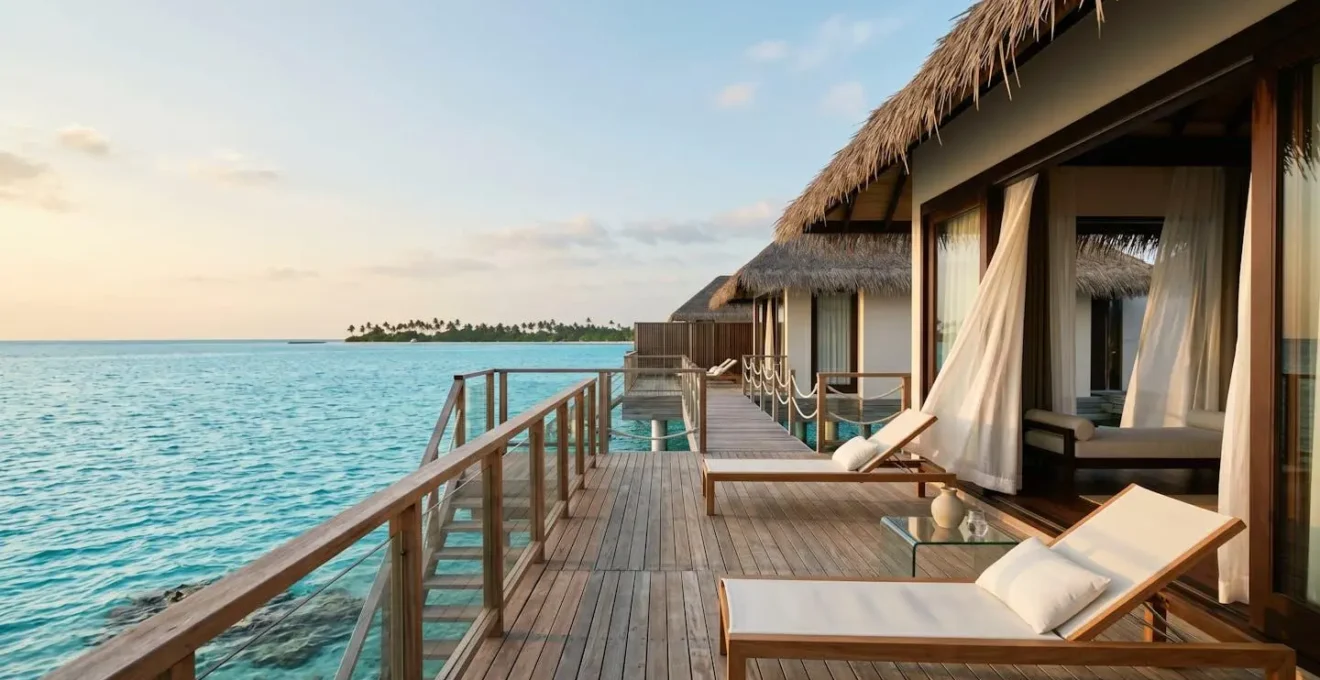
The authenticity of an overwater villa is not determined by its location (Maldives vs. Asia) or its thatched roof, but by verifiable structural and operational factors that guarantee seclusion and genuine ocean access.
- A higher price in the Maldives often reflects an « operational premium »—the logistical costs of running a truly remote private island, which is the foundation of an exclusive experience.
- Authenticity is a function of design: private lagoon stairs, end-of-pontoon positioning, and sufficient water depth are more critical than aesthetic choices like glass floors.
Recommendation: Before booking, conduct a « privacy audit » using the checklist in this guide to ensure your investment delivers a genuinely premium experience, not just a picturesque one.
The dream of an overwater villa—a private sanctuary suspended over a turquoise lagoon—is a powerful one for luxury travellers. Many assume this bucket-list experience is a simple choice between the iconic atolls of the Maldives and the seemingly more accessible options in Southeast Asia, like Thailand or Bora Bora. The decision is often framed around budget and aesthetic preference: rustic thatch versus modern design. But this binary choice overlooks the most crucial element: authenticity. What truly separates a genuinely secluded, immersive marine escape from a beautiful but experientially compromised alternative?
The common advice focuses on finding deals or choosing a villa for a honeymoon, but rarely delves into the nuances that define a quality stay. The reality is that not all overwater villas are created equal. Some are built over shallow, murky water, while others are positioned so close to neighbours or resort activity hubs that they lack any real privacy. The term « authenticity » is often misused to describe a traditional look, when it should refer to the core promise of the experience: unparalleled connection to the ocean and total seclusion.
This guide moves beyond the superficial. We will dissect the factors that constitute a truly authentic overwater stay, guided by a new principle: authenticity is not a location, but a verifiable set of criteria. It’s found in the structural design that ensures privacy, the operational logistics that create genuine seclusion, and the quality of the natural environment you are paying a premium to access. By understanding these distinctions, you can ensure your investment delivers the tranquil, immersive escape you envision, regardless of whether you choose the Maldives or Southeast Asia.
To help you make an informed decision, this article breaks down the key differentiators between a premium and a standard overwater experience. We will explore the pricing structures, verification techniques, and critical location mistakes to avoid, providing you with a framework to audit any potential booking.
Summary: A Specialist’s Guide to Finding Truly Authentic Overwater Villas
- Why Do Maldives Overwater Villas Cost Three Times More Than Similar Bora Bora or Thailand Options?
- How to Confirm Overwater Villas Have Private Lagoon Access Stairs Before Booking?
- Traditional Thatched Overwater Bungalow or Modern Glass-Floor Villa: Which for a Honeymoon?
- The Overwater Villa Mistake: Booking Next to Resort Activity Centres
- When Can You Book Overwater Villas for 40% Less With Calm Seas Guaranteed?
- Why Do Corner Hotel Rooms Offer 180-Degree Ocean Views Worth the 30% Upcharge?
- Why Are Hotel Infinity Pools Overrated on Islands With Pristine Beach Access 50m Away?
- How to Book Luxury Island Vacation Homes for Weddings and Milestone Birthday Celebrations?
Why Do Maldives Overwater Villas Cost Three Times More Than Similar Bora Bora or Thailand Options?
The most immediate difference travellers notice is the significant price gap between Maldivian overwater villas and their counterparts in Southeast Asia. This isn’t merely a reflection of brand prestige; it’s rooted in a fundamental operational premium that directly translates to a more authentic and exclusive experience. The geography of the Maldives, an archipelago of over 1,000 coral islands, necessitates a level of logistical complexity that is the very source of its unparalleled seclusion.
Unlike many resorts in Thailand or the Caribbean which are located on larger, more accessible islands, a majority of luxury Maldivian properties occupy their own private island. This « one island, one resort » model is the cornerstone of its appeal. However, it creates substantial overhead. Everything from construction materials and gourmet food to staff and guests must be transported via seaplane or speedboat. This logistical challenge is reflected in the final price. For instance, transfer costs can range from $85 to $1,950 per adult, a hidden fee that significantly widens the pricing gap.
This higher operating cost supports a superior guest experience and justifies the premium rates. Hospitality industry data shows the average daily rate (ADR) for luxury and upper-upscale resorts in the Maldives is substantially higher than in competing markets. A recent report confirms that for these top-tier resorts, the ADR reached $747 for the 2023 calendar year. This price point is not just for a room; it’s for a guaranteed bubble of privacy, pristine and uncrowded natural surroundings, and a level of service that is only possible in a self-contained, remote environment. In essence, you are paying for the absence of everything that compromises a tranquil escape: no crowds, no shared beaches with other properties, and no noise from outside the resort.
How to Confirm Overwater Villas Have Private Lagoon Access Stairs Before Booking?
One of the most defining features of an authentic overwater villa is direct, private access to a vibrant lagoon. Yet, marketing photos can be deceiving. An aerial shot might show a villa over stunningly blue water, but it won’t reveal if the water is too shallow to swim in at low tide, or if the « access » is merely a view with no stairs. Verifying genuine lagoon usability is a critical step in your pre-booking audit to avoid an experiential compromise.
The promise of stepping from your private deck directly into the ocean is central to the overwater fantasy. This requires not just the presence of stairs, but also sufficient water depth, clarity, and safety. A villa built over a shallow, rocky, or murky patch of water fails to deliver on this core promise, regardless of how luxurious its interior may be. It becomes a beautiful room with a nice view, not an immersive marine experience. Therefore, you must proactively investigate the specific conditions of the villa you intend to book.
Don’t rely solely on the resort’s curated gallery. Perform your own due diligence by looking for guest-generated content and asking targeted questions. This proactive approach separates savvy travellers from those who are disappointed upon arrival. The following checklist provides a concrete framework for this verification process, helping you confirm that your chosen villa delivers the genuine article.
Action Plan: Verifying True Lagoon Access
- Request Specific Visuals: Ask the resort for underwater photos or videos taken from the water level of your specific villa category, not just generic aerial shots. This helps verify water clarity and depth.
- Direct Inquiry: Call the resort’s reservation team directly. Ask about positioning choices, such as the pros and cons of end-of-pier locations versus those closer to shore, and inquire about water depth at low tide.
- Review Keyword Search: Scour guest reviews on platforms like TripAdvisor for keywords such as ‘low tide,’ ‘shallow water,’ ‘murky,’ or ‘water clarity’ to uncover real-world usability issues.
- Confirm Island Type: Verify whether the property is a private resort island or a guesthouse on a local island. The latter often have villas built over less inspiring, shallow water with compromised lagoon quality.
- Examine the Marine Life: Ask if the area directly beneath the villas is a healthy reef or a sandy bottom. A healthy marine ecosystem is a strong indicator of high-quality, clear water.
Traditional Thatched Overwater Bungalow or Modern Glass-Floor Villa: Which for a Honeymoon?
The choice between a traditional, thatched-roof bungalow and a sleek, modern villa with a glass floor is often presented as the key decision for a romantic getaway, especially a honeymoon. The rustic charm of natural materials evokes a sense of castaway romance, while glass floors offer a modern « wow » factor. However, for a truly memorable honeymoon, the most critical factor isn’t the aesthetic style, but the structural authenticity—the way the villa is designed for privacy and immersion in nature.
There is no denying the romantic appeal of this accommodation type. As travel experts at Out of Office note, « Overwater bungalows in the Maldives are one of the most popular honeymoon choices for obvious reasons. This type of accommodation is very much geared towards romantic trips. » The sense of being in your own private world is the ultimate luxury. Yet, this feeling is easily shattered if the design fails to deliver genuine seclusion. A glass floor is a novelty, but it loses its magic if you can hear your neighbours’ conversations. A thatched roof feels less authentic if your sundeck is in full view of the villa next door.
This is why, when choosing for a honeymoon, your focus should be less on the interior design theme and more on the villa’s positioning, orientation, and screening. Does the sundeck have high privacy walls? Is it oriented away from other villas to offer an uninterrupted ocean vista? Is it located at the far end of the pontoon, away from the noise and foot traffic of the main resort? These are the questions that determine the quality of your romantic escape.
Ultimately, a traditional design built with maximum privacy in mind will always feel more authentic and be more conducive to romance than a modern villa that compromises on seclusion. The best choice for a honeymoon is the villa that makes you feel like you are the only two people on the island. This is achieved through thoughtful architecture, not just stylistic choices.
The Overwater Villa Mistake: Booking Next to Resort Activity Centres
One of the most common and costly mistakes luxury travellers make is booking a stunning overwater villa that is poorly located within the resort. The allure of an overwater stay is rooted in peace, quiet, and seclusion. This entire experience can be compromised if your private sanctuary is situated next to a high-traffic area like a water sports centre, a main restaurant, or the resort’s arrival jetty. The constant hum of boat engines, the chatter of other guests, or the music from a beach bar can quickly erode the sense of tranquility you paid a premium for.
This is a classic example of an experiential compromise, where the visual promise of the villa is not matched by the reality of its environment. Resorts often have several categories of overwater villas, and the lower-priced options are sometimes those located in less desirable, higher-traffic zones. Third-party booking sites rarely provide this level of detail, showing only a generic room category. This is why a direct line of communication with the resort is invaluable.
As the hotel review experts at Oyster wisely advise, it’s essential to communicate directly with the property to ensure your preferences are met. They state, « Call the hotel directly when booking, not a third party. Every overwater bungalow category involves positioning choices such as: sunrise versus sunset exposure, end-of-pier versus closer to shore that third-party platforms don’t guarantee and the property’s reservation team can usually accommodate. » This proactive step is your best defence against a poor location.
When you call, you can specifically request a villa away from activity hubs. Ask for a resort map and inquire about the quietest sections of the property. This simple « privacy audit » can be the difference between a serene, immersive escape and a frustratingly noisy one. Remember, you are not just booking a room; you are investing in an environment. Ensuring that environment is peaceful is paramount.
When Can You Book Overwater Villas for 40% Less With Calm Seas Guaranteed?
The idea of securing an overwater villa for a significant discount while guaranteeing perfect weather sounds like a travel myth. While last-minute deals are rare in the luxury market, strategic timing can unlock substantial value without compromising on the experience. The key is to understand resort occupancy cycles and to target specific booking windows, particularly the « shoulder seasons. »
First, it’s important to dispel the notion of deep, last-minute discounts. The typical luxury traveller plans well in advance. In fact, most luxury travellers book 90–180 days in advance, meaning resorts have little incentive to offer significant short-term price drops. The real opportunity lies in booking during periods of lower demand. For the Maldives, the shoulder seasons—typically May and November—are prime targets. During these months, occupancy can dip to 40%, compared to over 80% in the peak dry season (December to April). This prompts resorts to offer more attractive pricing, sometimes including « stay longer, save more » promotions like a free fourth night.
Booking during a resort’s « soft opening » phase, within the first six months of operation, is another powerful strategy. New properties are eager to build occupancy and generate reviews, often offering introductory discounts of 30-40%. While you may encounter minor service adjustments as the team settles in, the trade-off is access to a brand-new villa at a fraction of its future price. Finally, waiting until 60 to 90 days before your intended stay can sometimes yield discounts of up to 30% if a resort finds itself with unexpected availability. This is riskier but can pay off for flexible travellers.
While shoulder seasons carry a slightly higher chance of rain, the term « rainy season » is often misunderstood. It typically means short, intense afternoon showers rather than all-day downpours. Crucially, because these islands are low-lying atolls, they are not prone to the turbulent seas associated with hurricane seasons elsewhere. The lagoons remain relatively calm year-round, ensuring the iconic turquoise water experience is preserved.
Why Do Corner Hotel Rooms Offer 180-Degree Ocean Views Worth the 30% Upcharge?
The concept of a premium « corner room » in a traditional hotel has a direct and even more valuable parallel in the world of overwater villas: the end-of-pontoon villa. Just as a corner room offers panoramic views by being positioned at the edge of a building, an end-of-pontoon villa provides an unparalleled sense of seclusion and an uninterrupted 180-degree vista of the open ocean. This superior positioning is a hallmark of structural authenticity and is almost always worth the upcharge.
These premier villas are the furthest from the island’s shore and from the foot traffic of other guests walking along the jetty. This distance creates a profound psychological and physical barrier, fostering a feeling of being in your own private world. There are no neighbours on one side, and your view is not of another row of villas but of the endless horizon. This is the pinnacle of the overwater experience, delivering the promise of seclusion in its purest form.
Resorts explicitly recognize this superior value. An analysis of Sandals Resorts’ overwater bungalow positioning highlights this, noting that the most desirable bungalows are those on the perimeter of the pier that « face directly out toward the ocean. » As the Caribbean Resort Guide points out, while all units have stunning views, these end units offer a superior level of privacy and a more immersive connection with the sea. This prime real estate is limited, making it a key differentiator that commands a higher price.
When evaluating villa options, always ask about the availability of these end-of-pontoon locations. Even if it requires a 20-30% upcharge, the investment translates directly into a more authentic experience. You are paying for something tangible: more privacy, less noise, and a better view. This is a far more meaningful upgrade than a minor aesthetic flourish or a slightly larger room in a less desirable location.
Key Takeaways
- Authenticity is verifiable: True overwater luxury depends on measurable factors like water depth, villa positioning, and genuine privacy, not just aesthetics or location.
- Price reflects logistics: The higher cost of Maldivian villas is often due to the « operational premium » of running a remote, private island, which is the foundation for unparalleled seclusion.
- Strategic booking is key: Significant savings can be achieved without compromising the experience by targeting shoulder seasons (May, November) or a resort’s soft-opening phase.
Why Are Hotel Infinity Pools Overrated on Islands With Pristine Beach Access 50m Away?
In the lexicon of luxury travel, the infinity pool has become an almost mandatory feature. It is a powerful visual symbol, yet in the context of a premium overwater resort, it can be a redundant and even distracting one. When you have paid a premium for a villa that offers direct access to one of the world’s most beautiful natural « swimming pools »—the pristine, warm, and vibrant lagoon—an artificial, chlorinated pool can seem entirely superfluous. The most authentic luxury resorts understand this, prioritizing the natural environment over man-made amenities.
The core philosophy of an authentic overwater experience is immersion in nature. It’s about the connection to the sea, the feeling of the gentle current, and the sight of marine life from your private deck. An infinity pool, however beautiful, represents a separation from this environment. It encourages guests to gather in a communal space, looking at the ocean from a distance rather than being in it. For travellers seeking genuine seclusion and a deep connection with the marine world, the lagoon itself is the ultimate amenity.
Case Study: Gili Lankanfushi’s « No News, No Shoes » Philosophy
Gili Lankanfushi in the Maldives, a resort with a near-perfect rating from thousands of reviews, perfectly embodies this principle. Its entire ethos is built around its « no news, no shoes » philosophy, encouraging guests to disconnect from the outside world and reconnect with the natural surroundings. Each of its thatched-roof villas is an open-air oasis with direct ocean access, rooftop terraces, and sun-drenched decks with catamaran nets suspended over the water. As a detailed review by Islands.com highlights, the resort intentionally forgoes features like communal pools to focus on maximizing the private, natural lagoon experience that guests pay a premium to access. This represents the pinnacle of the authentic overwater stay, where the environment itself is the primary luxury.
This is not to say infinity pools have no place, but their importance diminishes in proportion to the quality of the natural water access. When choosing a resort, consider this a key indicator of its philosophy. A property that heavily markets its infinity pool may be compensating for a lack of high-quality, swimmable lagoon or beach space. Conversely, a resort that emphasizes its house reef, lagoon clarity, and private villa access is likely more aligned with an authentic, nature-focused experience.
How to Book Luxury Island Vacation Homes for Weddings and Milestone Birthday Celebrations?
For truly unforgettable milestone celebrations like weddings or landmark birthdays, the concept of authenticity is elevated from a private villa to an entire private island. The ultimate luxury is not just seclusion, but exclusive use. This is achieved through a « resort buyout, » where a group books an entire small-scale luxury property, transforming it into their personal estate for the duration of the event. This model guarantees unparalleled privacy and a level of personalization that is impossible in a larger, shared resort.
Booking a private island or securing a full resort buyout is the definitive way to ensure every aspect of a celebration is tailored to your vision. It eliminates any potential for disruption from other guests and allows for complete freedom in planning schedules, menus, and activities. The entire staff is dedicated solely to your group, creating an incredibly intimate and high-touch service environment. This is particularly appealing for high-profile individuals or for those who simply value absolute discretion and control over their special occasion.
Case Study: The Cayo Espanto Private Island Model
Cayo Espanto, a private island resort off the coast of Belize, exemplifies this exclusive buyout model. With just seven villas in total, it is perfectly scaled for intimate events. The resort has built its sterling reputation, reflected in its near-perfect Tripadvisor rating, on its ability to tailor every stay to the individual needs of its guests. As highlighted in travel features, it operates as an ideal Caribbean escape for small-group weddings or milestone celebrations. By offering the entire island for exclusive use, Cayo Espanto demonstrates how the buyout model provides the ultimate framework for an authentic, deeply personal, and completely private event.
To arrange such a booking, the process begins with identifying resorts that are structurally suited for buyouts—typically those with a limited number of villas (usually under 20). The initial contact should be made well in advance, often a year or more, directly with the resort’s general manager or events team. You will work with them to craft a fully customized package, detailing everything from culinary preferences and decor to entertainment and excursions. This collaborative process ensures the celebration is a true reflection of the host’s personality, creating an authentic and memorable experience for every guest.
To ensure your next milestone vacation delivers on its promise of an authentic, secluded, and unforgettable experience, use this specialist framework to audit your options. By looking beyond the glossy photos and focusing on verifiable factors of privacy, access, and operational quality, you can invest with confidence in a trip that will become a cherished memory.